Missiles.
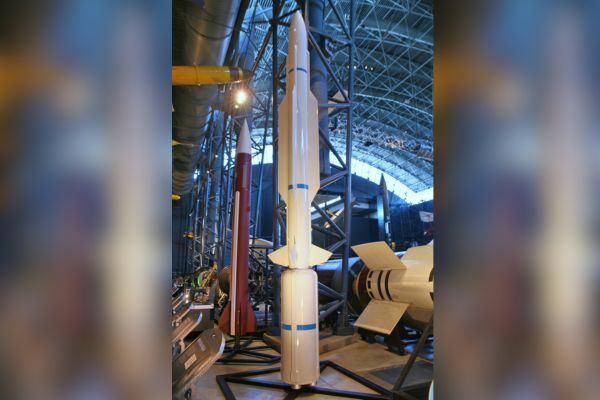
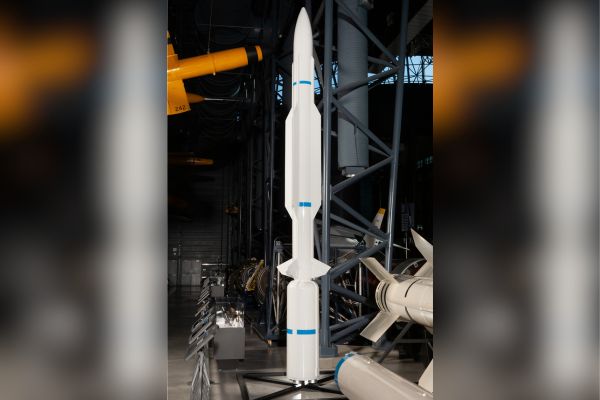
SM-3 Standard Missile 3.

The Standard Missile-3 (SM-3) is a U.S. exo-atmospheric ballistic missile defense interceptor developed by Raytheon, an RTX business, for the U.S. Navy and the Missile Defense Agency (MDA). Integrated into the Aegis Ballistic Missile Defense (Aegis BMD) system, it is primarily designed to intercept short- to intermediate-range ballistic missiles during the midcourse phase of flight, outside the Earth's atmosphere. Unlike missiles using a conventional explosive warhead, the SM-3 employs a kinetic kill vehicle that destroys its target through direct impact using the hit-to-kill principle. The SM-3 family has evolved through the Block I, Block IA, Block IB, Block IB Threat Update, and Block IIA variants, with changes involving propulsion, infrared sensors, target discrimination, and kill vehicle maneuverability.
Country users: United States, Japan

Description
The Standard Missile-3 originated from the development of the SM-2 Block IV and was designed to provide the Aegis system with an exo-atmospheric ballistic missile interception capability. Early versions retained elements of the SM-2 Block IV propulsion architecture while adding a third propulsion stage, a new guidance architecture, and a kinetic kill vehicle derived from the Lightweight Exo-Atmospheric Projectile (LEAP) program. This configuration enables the interceptor to reach ballistic missile targets outside the atmosphere during the midcourse phase of flight.
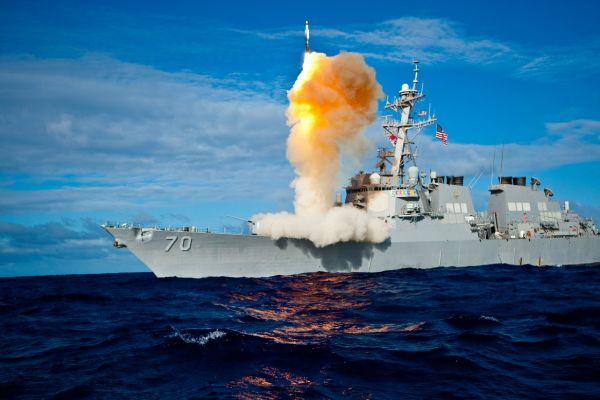
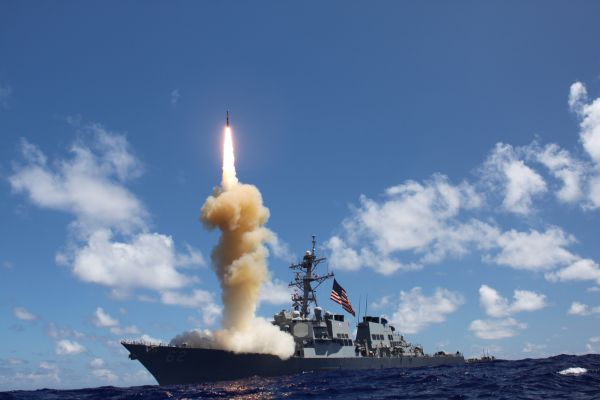
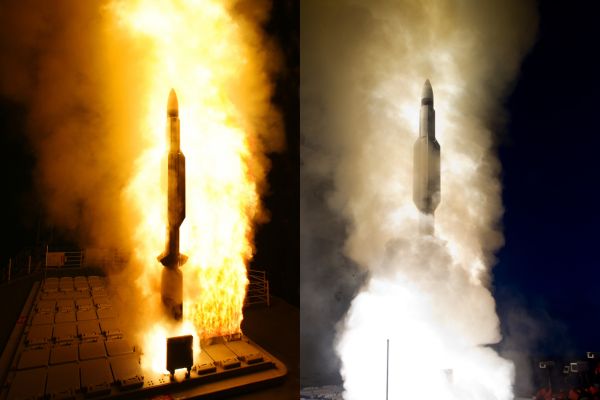
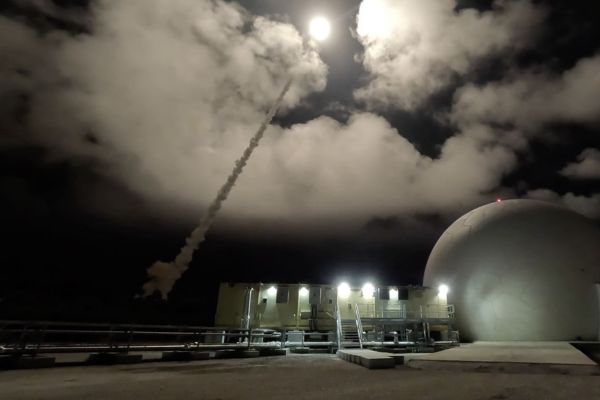
The SM-3 can be launched from both naval platforms and fixed land-based installations. On Aegis BMD-equipped warships, it is fired from Mk 41 Vertical Launch System (VLS) cells. On land, the missile is deployed through Aegis Ashore, whose launchers and architecture are closely derived from those installed aboard U.S. Navy cruisers and destroyers. The Missile Defense Agency identifies Aegis Ashore as the land-based component of Aegis BMD and as a platform for SM-3 interceptors.
In Europe, two U.S.-operated Aegis Ashore installations provide this fixed land-based capability. The site at Deveselu, Romania, has been operational since 2016, while the Redzikowo, Poland, site became operational in 2024. Both installations are part of NATO's ballistic missile defense architecture and complement U.S. Navy Aegis destroyers based at Rota, Spain. The activation of Redzikowo also completed the infrastructure planned under the U.S. European Phased Adaptive Approach (EPAA). In November 2024, the Polish site was formally integrated into NATO's ballistic missile defense command-and-control structure.
During an engagement, sensors associated with the Aegis system detect and track the ballistic missile threat while the combat system develops a firing solution. After launch, the SM-3 uses inertial navigation and receives guidance updates as it climbs toward the planned interception area. Following separation of the propulsion stages, the kinetic kill vehicle is released. Its infrared sensor searches for and discriminates the target, while its divert and attitude control system performs the trajectory corrections required to achieve a direct collision.
The SM-3 does not rely on an explosive detonation to destroy its target. The interception is achieved through the kinetic energy generated by a high-velocity collision between the kill vehicle and the targeted missile or ballistic warhead. Raytheon compares the kinetic effect to a ten-ton truck traveling at approximately 600 mph striking the target. Production of the SM-3 family is being expanded. In October 2024, Raytheon received approval for full-rate production of the SM-3 Block IIA, following a $1.9 billion Missile Defense Agency contract awarded in July 2024 for interceptors intended for the United States and Japan. Work under the contract is scheduled to continue through February 2031.
The SM-3 Block IB also remains in production. In May 2025, the Missile Defense Agency awarded Raytheon a $1 billion contract for up to 55 SM-3 Block IB All-Up Rounds, with work scheduled through March 31, 2031. In February 2026, RTX announced new long-term agreements with the U.S. Department of Defense intended to increase SM-3 Block IIA production and accelerate production of the Block IB. Industrial cooperation between the United States and Japan on the Block IIA is also being expanded. In April 2026, the two countries confirmed measures intended to increase SM-3 Block IIA production by approximately four times, while assessing options for further acceleration and expansion. Japan's Ministry of Defense reiterated this objective in May 2026 during a visit to Mitsubishi Heavy Industries facilities involved in SM-3 Block IIA production.
Japan is also preparing the SM-3 Block IIA for integration aboard its future Aegis System Equipped Vessels (ASEV). The Japanese Aegis J7.B architecture associated with the SPY-7 radar has already demonstrated the fire-control functions required to support the SM-3 Block IIA. In March 2026, the MDA and the Japan Maritime Self-Defense Force completed a further integration milestone with the first live-target tracking exercise using the SPY-7 radar integrated with the Aegis Weapon System for the ASEV program.
SM-3 Standard Missile 3 Variants:
- SM-3 Block I: The SM-3 Block I was the initial development and limited-production configuration of the family. Derived from the SM-2 Block IV, it established the basic SM-3 architecture by adding a third propulsion stage, GPS-aided inertial navigation, and a LEAP-derived kinetic kill vehicle for exo-atmospheric interception.
- SM-3 Block IA: The SM-3 Block IA was the first major production version of the missile. It is designed to intercept short- to intermediate-range ballistic missiles during the midcourse phase of flight. Its configuration includes a 21-inch booster, followed by an upper missile body approximately 13.5 inches or 0.34 m in diameter. The Block IA uses a kill vehicle equipped with an infrared sensor and a Solid Divert and Attitude Control System (SDACS). The first Block IA interceptors were deployed in 2006.
- SM-3 Block IB: The SM-3 Block IB retains the general dimensions and propulsion architecture of the Block IA while introducing changes to the kinetic kill vehicle. It is equipped with a two-color infrared seeker, an improved signal processor, and a Throttleable Divert and Attitude Control System (TDACS). The TDACS increases the kill vehicle's maneuverability during the final phase of the interception. The two-color seeker also improves discrimination between the actual threat object and other objects within the ballistic threat cloud. The Block IB became operational in 2014 and can be deployed from both naval and land-based platforms. As with the Block IA, the reference figures used for the Block IB are a range of 700 km and a speed of approximately 3.0 km/s.
- SM-3 Block IB Threat Update: The SM-3 Block IB Threat Update (TU) is an evolution of the Block IB intended to improve performance against more complex ballistic missile threats. Changes primarily involve software, algorithms, and target discrimination capabilities rather than a major redesign of the propulsion architecture. A production-representative configuration successfully intercepted a medium-range ballistic missile target in 2017.
- SM-3 Block IIA: The SM-3 Block IIA represents a more extensive redesign of the SM-3 architecture. Jointly developed by the United States and Japan, it uses larger rocket motors and an enlarged kinetic kill vehicle. These changes increase interceptor velocity, expand the defended area, and reduce the time required to reach ballistic missile threats. Unlike the Block IA and Block IB, whose diameter decreases above the booster, the Block IIA has a diameter of approximately 21 inches, or 0.53 to 0.54 m, along most of the missile body. The additional internal volume accommodates more propulsion in the second stage, and a larger kill vehicle with increased divert capability. The Block IIA kill vehicle also incorporates an upgraded divert control system, revised communications, and a new-generation two-color seeker. The reference figures used for the Block IIA are a range of approximately 2,500 km and a maximum speed of approximately 4.5 km/s. The Block IIA is primarily intended for regional defense against ballistic missiles, including intermediate-range threats. Its higher velocity and increased kill vehicle performance also provide some capability against longer-range targets. In November 2020, an SM-3 Block IIA launched from the destroyer USS John Finn successfully intercepted an ICBM-class target.
- SM-3 Block IIB: The SM-3 Block IIB was a proposed follow-on version intended to provide higher interceptor velocity and greater capability against long-range ballistic missiles. The program was cancelled in 2013 before the missile entered production.
Technical Data
-
Design and Configuration
The SM-3 is a multi-stage, solid-fuel interceptor designed for exo-atmospheric ballistic missile defense. The Block IA and Block IB use a Mk 72 Booster, followed by a Mk 104 dual-thrust rocket motor and a Mk 136 third-stage rocket motor before releasing the kinetic kill vehicle. The Block IIA retains the general multi-stage propulsion concept but introduces larger-diameter stages and increased propellant volume. This configuration increases its atmospheric exit velocity and expands the area that can be defended. The operational SM-3 variants use the Mk 41 Vertical Launch System when deployed aboard Aegis-equipped warships. The Mk 41 launcher architecture is also used by fixed Aegis Ashore installations.
-
Warhead
The SM-3 does not use a conventional explosive warhead. Its terminal element is a Kinetic Kill Vehicle, derived from the LEAP program. The target is destroyed through direct collision at high velocity. The kill vehicle combines an infrared sensor for target detection and discrimination with a set of thrusters used for trajectory corrections and attitude control. The Block IB introduced a two-color infrared seeker and TDACS, while the Block IIA uses a larger kill vehicle with increased seeker sensitivity and maneuvering capability.
-
Guidance Systems
The SM-3 uses a combination of inertial navigation, command guidance, and midcourse trajectory updates, supported by the Aegis combat system. During the exo-atmospheric terminal phase, the kinetic kill vehicle uses its infrared seeker to acquire and discriminate the target. The divert and attitude control system then performs the trajectory corrections required to achieve a direct impact.
-
Propulsion
The SM-3 family uses solid-fuel rocket propulsion. For the Block IA and Block IB, the propulsion architecture consists of: Mk 72 Booster: first stage providing the initial thrust after launch from the Mk 41 VLS.
Mk 104 Dual Thrust Rocket Motor: second stage that continues to accelerate the missile during its climb.
Mk 136 Third Stage Rocket Motor: third stage providing additional velocity and placing the interceptor on the trajectory required for exo-atmospheric engagement and release of the kinetic kill vehicle.The Block IIA uses larger rocket motors than previous versions. The additional propulsion contributes to its higher velocity and larger defended area.
-
Combat Use
The SM-3 demonstrated a secondary anti-satellite capability during Operation Burnt Frost in February 2008. A modified SM-3 launched from the cruiser USS Lake Erie destroyed the malfunctioning U.S. satellite USA-193 in low Earth orbit. The operation demonstrated that the SM-3 kinetic kill vehicle could also be employed against certain space objects under specific engagement conditions. The SM-3 saw its first combat use against a hostile ballistic missile threat in April 2024. The destroyers USS Carney and USS Arleigh Burke participated in the defense of Israel during the Iranian attack of April 13. The U.S. Navy subsequently confirmed that the engagement included the first operational combat use of the SM-3. RTX stated that SM-3 Block IB interceptors were used against Iranian ballistic missiles heading toward targets in Israel.
Specifications
-
Type
Surface-to-Air Missile, Exo-atmospheric ballistic missile defense interceptor
-
Country users
United States, Japan
-
Designer Country
United States
-
Basing
Sea-based and fixed land-based
-
Launcher Types
Mk 41 Vertical Launch System aboard Aegis BMD-equipped warships, Fixed Aegis Ashore launch installations
-
Warhead
Non-explosive kinetic kill vehicle using hit-to-kill interception
-
Propulsion
Multi-stage solid-fuel propulsion:
Block IA / IB:
Mk 72 Booster
Mk 104 Dual Thrust Rocket Motor
Mk 136 Third Stage Rocket MotorBlock IIA:
Solid-fuel architecture with larger rocket motors and increased propellant volume -
Speed
SM-3 Block IA: 3.0 km/s
SM-3 Block IB: 3.0 km/s
SM-3 Block IIA: 4.5 km/s -
Range
SM-3 Block IA: 700 km
SM-3 Block IB: 700 km
SM-3 Block IIA: 2,500 km -
Dimensions
Length: 6.55m
SM-3 Block IA / IB:
0.53 m / 21 in booster
0.34 m / 13.5 in upper missile bodySM-3 Block IIA:
Approximately 0.54 m / 21 in