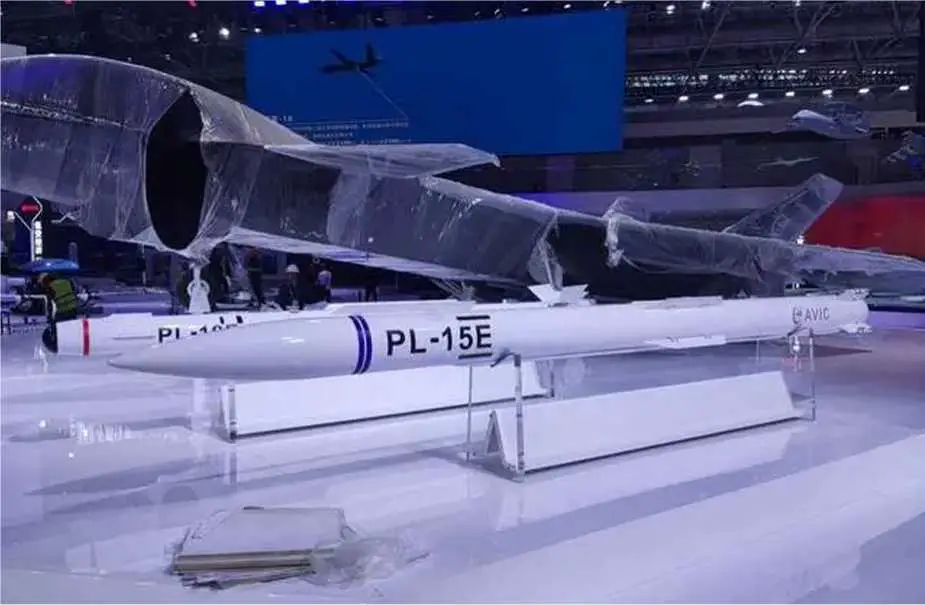
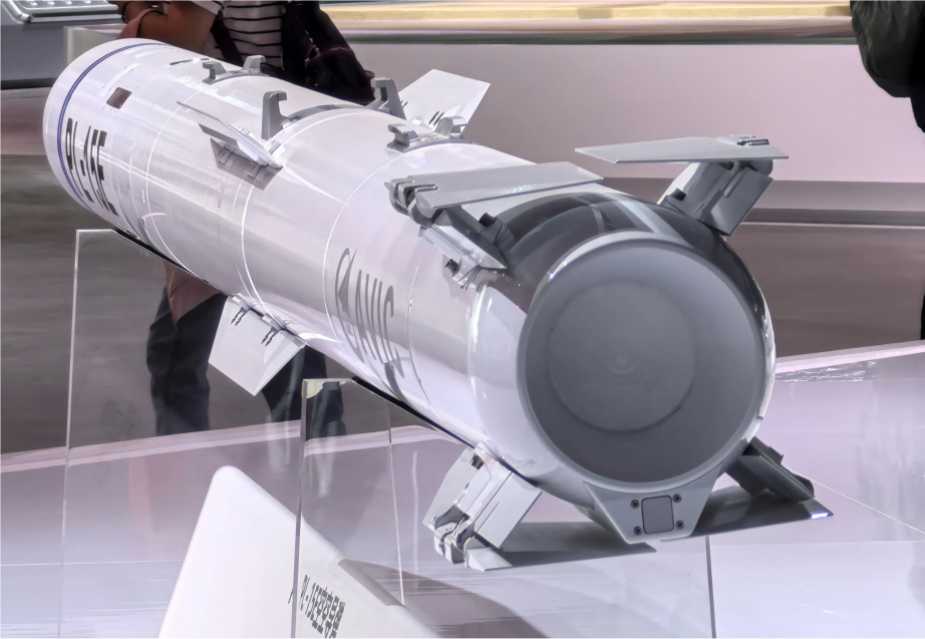
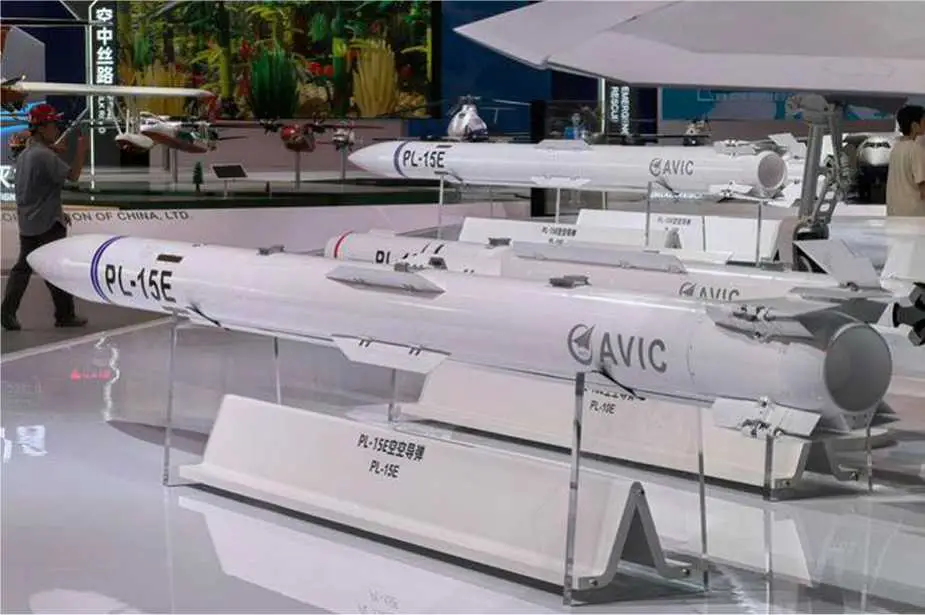
The PL-15 (Pi Li-15 or Thunderbolt-15) is an advanced beyond-visual-range air-to-air missile (BVRAAM) developed by the People’s Republic of China. Designed and manufactured by the state-owned China Aerospace Science and Industry Corporation (CASIC), the PL-15 represents a significant leap in the capability of the People's Liberation Army Air Force (PLAAF) to engage aerial threats at extended ranges.
Country users: China, Pakistan






Technical Data
-
Design
The PL-15 features a conventional cylindrical missile body with a length estimated between 4.0 and 4.5 meters and a diameter of approximately 200 mm. It uses four small control fins at the rear and cropped delta fins at mid-body for aerodynamic stability and maneuverability.
The missile’s airframe is optimized for high-speed, high-altitude performance, with internal bays compatibility on stealth fighters like the J-20. Its compact design allows it to be carried in tandem with other munitions for multi-role missions.
The propulsion system is a dual-pulse solid-fuel rocket motor, which gives the missile an extended range estimated between 200 and 300 kilometers. Some reports suggest it may also use a ramjet variant under development, potentially improving kinematic performance.
-
Warhead
The PL-15 is equipped with a high-explosive fragmentation warhead designed to destroy fast-moving airborne targets. The warhead is triggered by a laser proximity fuse and/or active radar proximity fuse, allowing detonation at optimal distances for maximum kill probability.
While specific weight details are not publicly disclosed, estimates place the warhead around 40 kg. The fragmentation pattern is optimized to defeat aircraft with high agility and even low radar cross-sections.
-
Guidance Systems
Guidance is a critical strength of the PL-15. It utilizes a multi-mode active radar seeker, believed to incorporate Active Electronically Scanned Array (AESA) radar technology for precision target acquisition and tracking in cluttered or contested environments.
The missile also supports inertial navigation (INS) for mid-course guidance, with updates from data-link systems provided by the launch platform. This enables the PL-15 to engage maneuvering targets at very long ranges while avoiding countermeasures.
This suite allows for "fire-and-forget" capability while also supporting mid-course corrections to adjust for dynamic air combat conditions.
-
Combat Use
Operational doctrine positions the PL-15 as the primary long-range air combat missile for China’s elite fighter units. It is deployed to engage adversary aircraft before they can launch their own weapons, denying them the chance to utilize support from AWACS, jammers, or tankers.
The PL-15 is compatible with China's latest combat aircraft, including the Chengdu J-20, Shenyang J-16, and advanced versions of the J-10. Its use is primarily in air superiority missions, although it also supports defensive counter-air (DCA) and offensive counter-air (OCA) tasks.
In tactical operations, the missile’s extended range allows for stand-off engagement, and its multi-mode guidance makes it highly resistant to electronic warfare. It is a key pillar in China’s anti-access/area denial (A2/AD) strategy, particularly in the Indo-Pacific region.


Photo Gallery