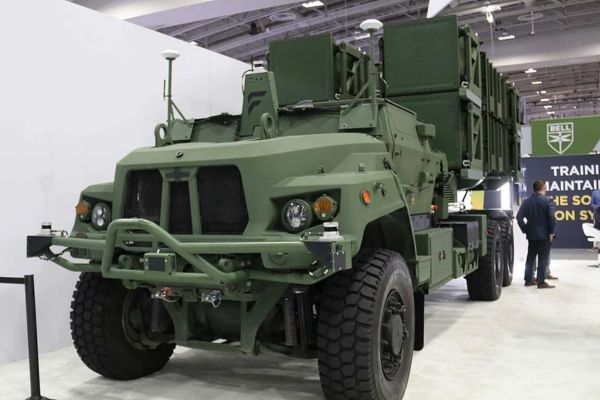
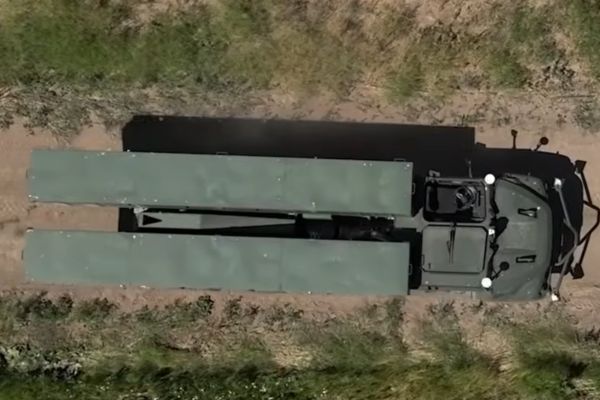
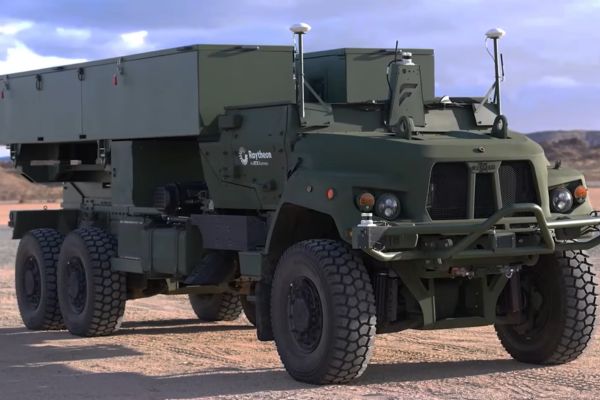
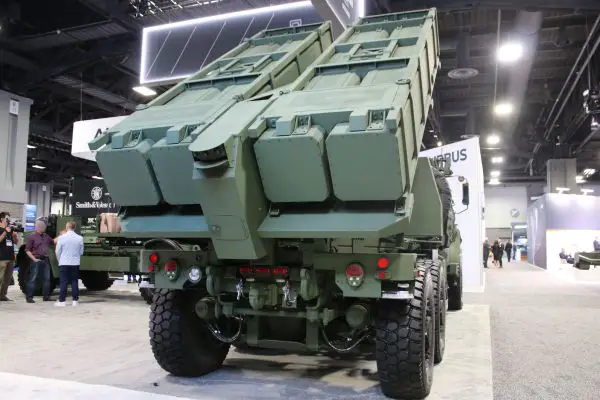
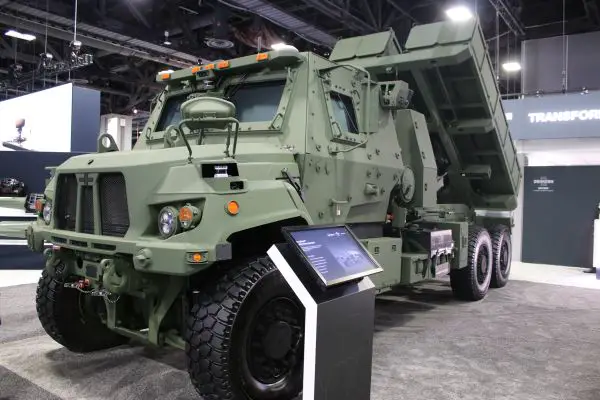
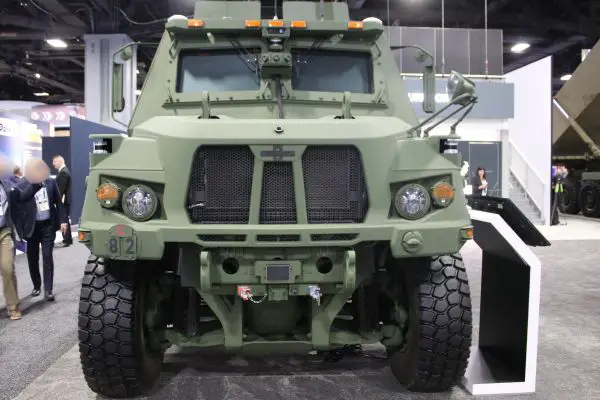
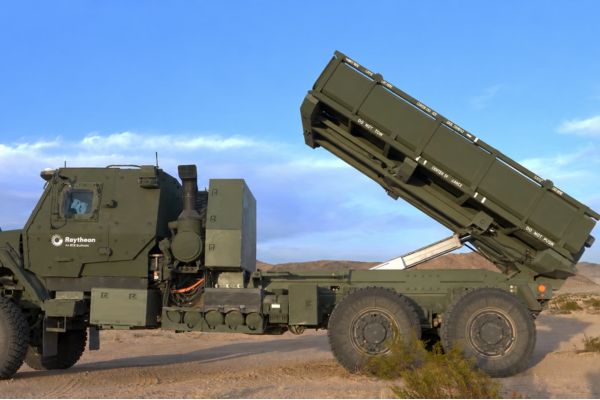
DeepFires is a mobile autonomous missile launcher developed in the United States by Raytheon, an RTX business, in cooperation with Forterra and Oshkosh Defense. Mounted on an Oshkosh FMTV A2 6×6 chassis, it combines a modular launcher, onboard vehicle power, and Forterra's AutoDrive system. It is described as autonomous because it can drive, employ its weapons, and be resupplied without personnel on board, while remaining under the control of a human command element.






Technical Data
-
Armament
DeepFires carries a rear-mounted elevating modular launcher that can be configured for offensive strikes or defensive missions. Raytheon states that the design provides increased magazine depth and allows effectors with different roles to be integrated on a common vehicle platform.
In the offensive configuration, Tomahawk and PrSM provide complementary deep precision-strike capabilities. Tomahawk has a range of approximately 1,600 km, while PrSM Increment 1 provides surface-to-surface engagement at ranges greater than 400 km against high-value land targets. In the defensive configuration, PAC-3 MSE and AIM-9X Sidewinder provide two air-defense layers. PAC-3 MSE uses hit-to-kill interception against tactical ballistic missiles, cruise missiles and aircraft, while AIM-9X provides short-range infrared-guided protection against aerial threats.
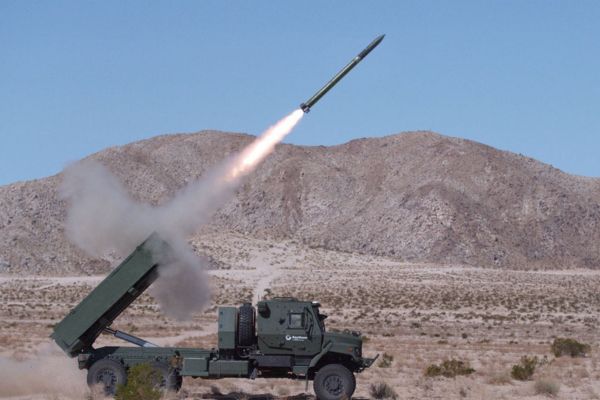
The 2025 live-fire event used an experimental Raytheon missile developed for the U.S. Army Joint Reduced Range Rocket program and powered by a rocket motor produced by Ursa Major. The event demonstrated the autonomous movement and launcher-employment sequence.
-
Design and protection
DeepFires is based on a three-axle FMTV A2 chassis with a 6×6 drivetrain. The launcher module, elevation mechanisms, electrical equipment, and resupply interfaces are installed behind either the cab or the uncrewed front module.
The cab-equipped configuration retains the three-seat armored FMTV cab. The FMTV A2 incorporates increased underbody protection, scalable crew-protection systems, three-point seat belts, automatic braking and a central tire inflation system. This model can carry up to three occupants while retaining autonomous operation without a crew.
The cabless configuration uses the same FMTV A2 6×6 chassis and launcher assembly. A compact module containing the equipment required to operate the vehicle replaces the driver and passenger compartment. With no personnel on board, soldiers are not directly exposed during movement, firing, and forward-area resupply operations.
-
Mobility
The FMTV A2 chassis combines a 6×6 drivetrain with higher-capacity suspension, increased engine power, and a central tire inflation system for off-road mobility. It also uses a higher-capacity alternator and a modernized 24-volt electrical system suited to mission-equipment integration.
The reference FMTV 6×6 profile includes a maximum speed of 96 km/h, a road range exceeding 483 km, a 60 percent grade capability and a 30 percent side-slope capability. The launcher module, autonomous equipment, and missile load determine operational weight and affect fuel consumption. C-130 transportability supports deployment by air. After arrival in theater, the vehicle can use its autonomous mobility to reach a deployment area, firing position, or resupply point.
-
Onboard Combat Equipment
Forterra's AutoDrive system provides autonomous operation on roads, off-road, and in tactical environments. It combines environmental perception, sensor fusion, redundant localization, path generation, and control of the vehicle's drive-by-wire systems. The localization architecture uses multiple navigation methods to maintain movement when GPS signals are disrupted or unavailable. Perception data is processed to create a three-dimensional representation of the surroundings, allowing the vehicle to adapt its route to terrain and obstacles.
Onboard vehicle power supplies the automotive systems, launcher, sensors, and autonomous equipment without an external generator. This allows the launcher to operate independently of an outside power source and supports mobility and survivability. DeepFires operates within an architecture that includes a JUMPS C2 command vehicle and an Autonomous Resupply Vehicle. The command vehicle transmits missions and keeps a human operator in the decision loop. The launcher and resupply vehicle then execute assigned movements, authorized firing sequences, and related logistics tasks.


Photo Gallery