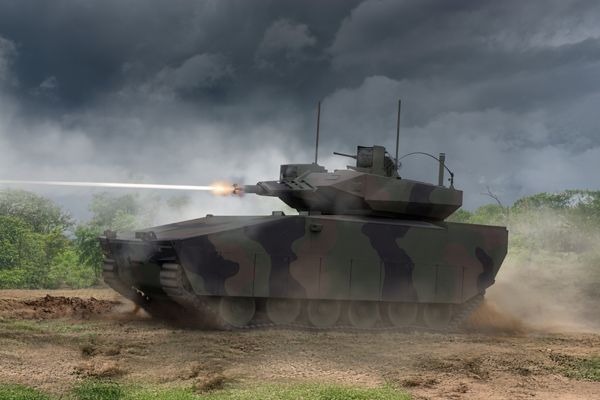
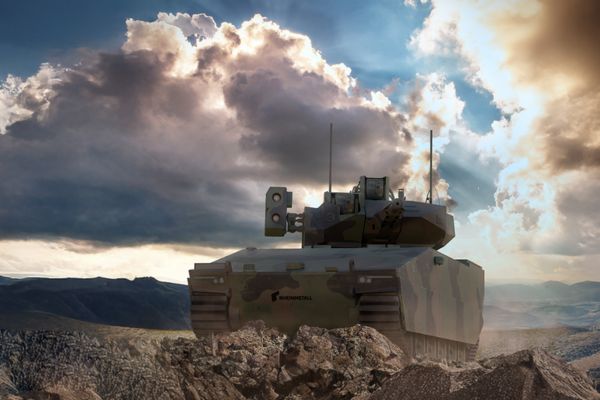
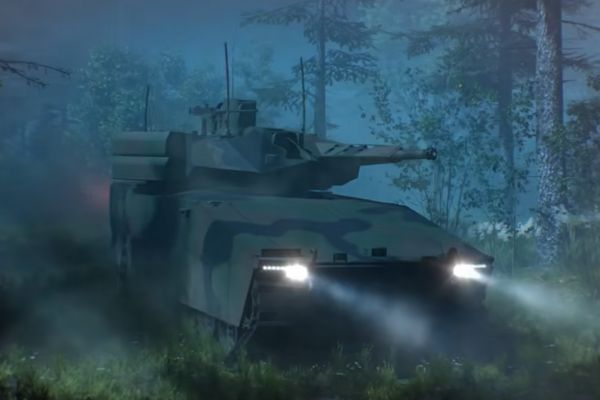
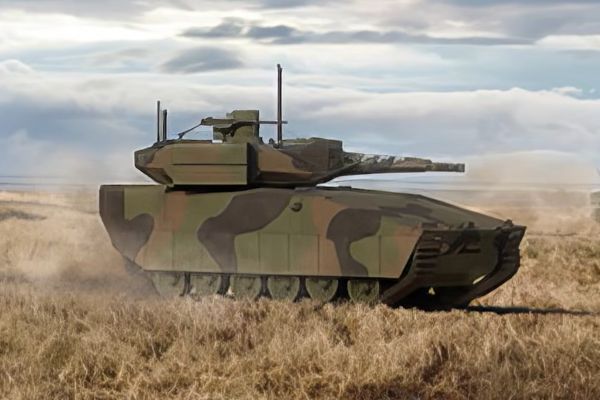
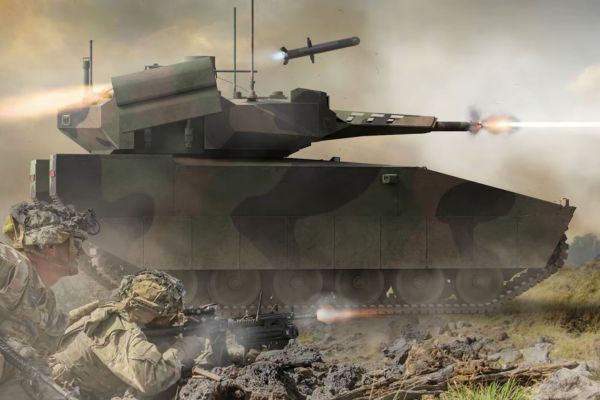
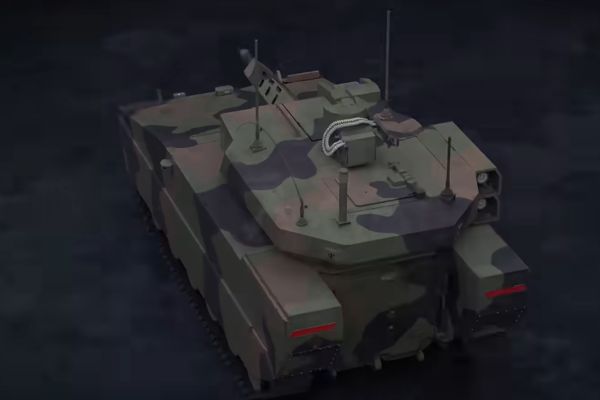
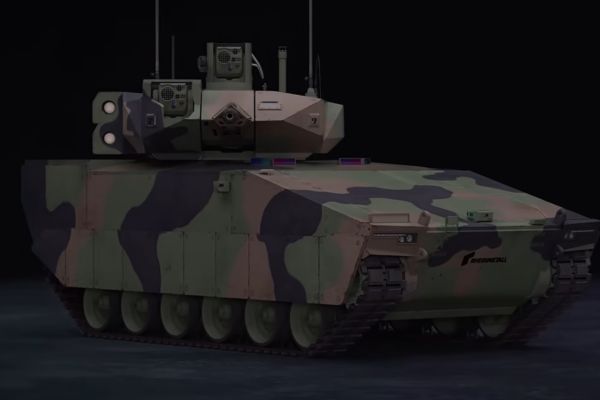
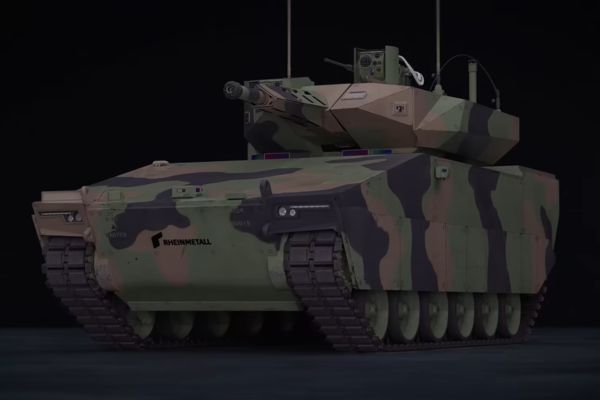
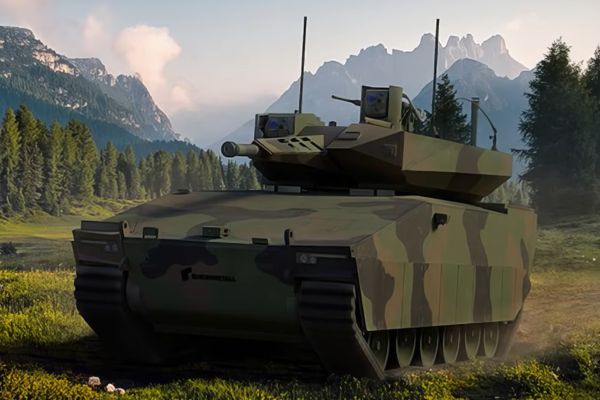
The Lynx XM30 is a next-generation tracked infantry fighting vehicle developed by American Rheinmetall Vehicles for the U.S. Army XM30 program. It is intended to replace the M2 Bradley within U.S. armored brigades and provide protected transport and fire support for an infantry squad during high-intensity combined-arms operations.






Technical Data
-
Design and Armor
The Lynx XM30 uses the general layout of a tracked infantry fighting vehicle, with an armored hull, an unmanned turret, a crew compartment, and a rear compartment for infantry personnel. The crew consists of two soldiers, while six dismounts are carried in the rear section. The two-person crew arrangement is enabled by the automation of tasks that would normally be divided among three operators. Driving, navigation, surveillance, and weapon-control information is presented through digital interfaces. This arrangement is intended to allow both crew members to access the vehicle’s main functions and assume selected duties when required.
The absence of a turret basket frees internal space and keeps the operators below the main protected roofline. The turret can therefore house the cannon, sensors, and weapon systems without requiring the commander or gunner to occupy the upper section of the vehicle. The rear compartment is designed to carry six infantry personnel and their equipment. The internal information systems are intended to provide dismounts with a tactical picture before they leave the vehicle, allowing them to review nearby threats, friendly positions, and the immediate surroundings before the rear ramp opens.
Protection is based on modular armor combined with active and passive measures. Mission-specific armor packages can be fitted according to the threat environment. The internal design also seeks to separate personnel, ammunition, fuel, and other components that could increase the effects of penetration. The vehicle is intended to integrate an active protection system able to detect, track, and counter anti-tank threats. Protection is supplemented by warning sensors, signature-management measures, and systems intended to improve awareness around the vehicle.
American Rheinmetall has also integrated a 360-degree vision system for the driver. It provides a representation of the immediate surroundings and a top-down view around the hull. The system is intended to reduce blind spots, support maneuvering in confined areas, and lower the risk of accidents when dismounted soldiers are operating close to the vehicle.
-
Mobility
The Lynx XM30 uses a hybrid-electric propulsion architecture. Allison Transmission provides the eGen Force transmission, developed for heavy tracked vehicles. The system combines mechanical propulsion with electrical power generation and distribution. The hybrid architecture is intended to supply energy to sensors, communications equipment, fire-control systems, active protection, electronic warfare equipment, and future upgrades. It also provides electrical and cooling capacity for later equipment integration.
Team Lynx has referred to a silent mobility capability. Under certain conditions, the vehicle may use stored electrical power to move with a reduced acoustic and thermal signature. The electrical system may also allow onboard equipment to operate while the combustion engine is shut down during surveillance periods. The Lynx XM30 is intended to operate with formations equipped with M1 Abrams tanks and move across difficult terrain. Its suspension, running gear, and drivetrain are being designed to support a heavy tracked vehicle while maintaining the tactical mobility required for combined-arms operations.
-
Onboard Combat Equipment
The Lynx XM30 is being developed as a digital and software-based platform with architecture intended to support future upgrades. Its electronic systems are compatible with the U.S. Army Ground Combat Systems Common Infrastructure and MOSA principles. This approach is intended to simplify the integration of new sensors, software, communications systems, and protection equipment from different suppliers. The vehicle is equipped with day and third-generation thermal observation systems. These sensors are intended to allow the commander and gunner to detect, identify, and track targets at extended range during day, night, and reduced-visibility conditions.
The digital fire-control system combines data from the sights, laser rangefinder, vehicle sensors, and tactical networks. Decision-support and assisted-recognition functions are intended to reduce the time between target detection and engagement. Anduril provides a Common Tactical Picture based on its Lattice software. The system combines information from onboard sensors, friendly units, and unmanned platforms to create a shared representation of the battlefield. It is also intended to reduce the workload placed on the two-person crew.
L3Harris Technologies provides mission systems, processors, secure communications equipment, and cybersecurity capabilities. These systems support data exchange, collaborative targeting, and integration with U.S. Army command networks. The vehicle is intended to control or cooperate with unmanned aircraft, robotic ground vehicles, and semi-autonomous systems. This function is part of the broader role assigned to the XM30 in future U.S. mechanized formations. The Lynx XM30 is also expected to include navigation systems, onboard diagnostics, vehicle health-monitoring equipment, and predictive maintenance functions. These systems are intended to help identify technical faults and reduce repair time.
-
Armament
The Lynx XM30 is equipped with an unmanned turret armed with a 50 mm automatic cannon. Industrial and specialist sources generally associate this configuration with the Northrop Grumman XM913 cannon chambered for 50 × 228 mm ammunition. The weapon is intended to provide greater range and terminal effect than the 25 mm M242 cannon used on the M2 Bradley.
The 50 mm cannon is intended to engage armored vehicles, fortified positions, anti-tank teams, and other threats at greater distances than Bradley’s current weapon. It is expected to be connected to a digital fire-control system, electro-optical sensors, and automated target acquisition and tracking functions.
The vehicle is also expected to carry secondary weapons and guided missiles. Raytheon is developing a Multi-Mission Launcher for the Lynx XM30. This system is intended to accept different effectors depending on the mission, including anti-tank missiles, loitering munitions, and systems intended to engage aerial or ground targets. Team Lynx has referred to the Javelin, the Coyote family, and the possible future integration of the TOW missile. The final launcher configuration and ammunition load have not been disclosed.
The unmanned turret keeps the crew inside the protected hull. It is also expected to include day and thermal sensors, a laser rangefinder, digital fire-control equipment, and systems allowing the commander and gunner to observe and engage targets independently.

Close view of the Lynx XM30 turret armed with one 50mm automatic cannon and a Multi-Mission Launcher


Photo Gallery