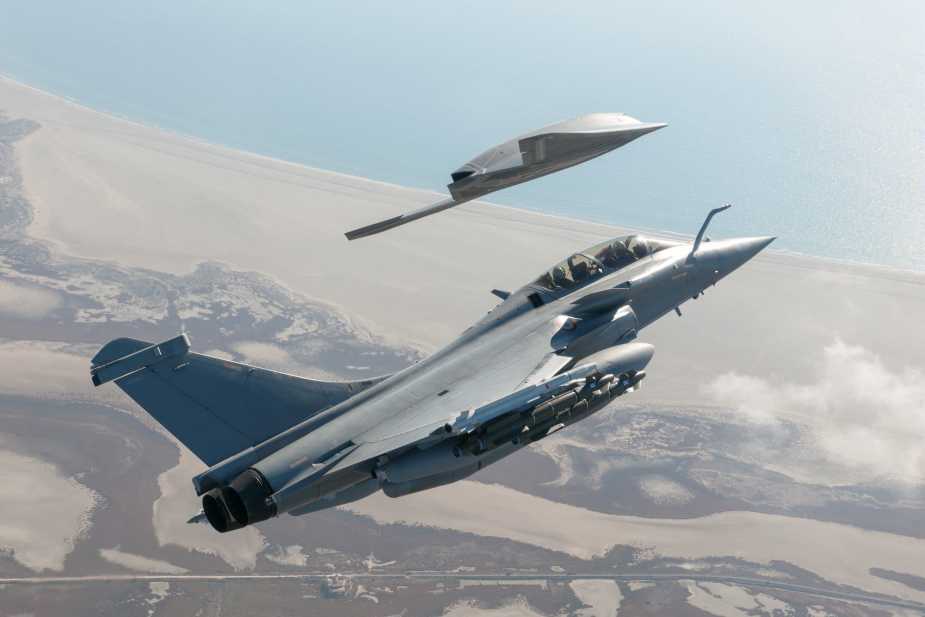
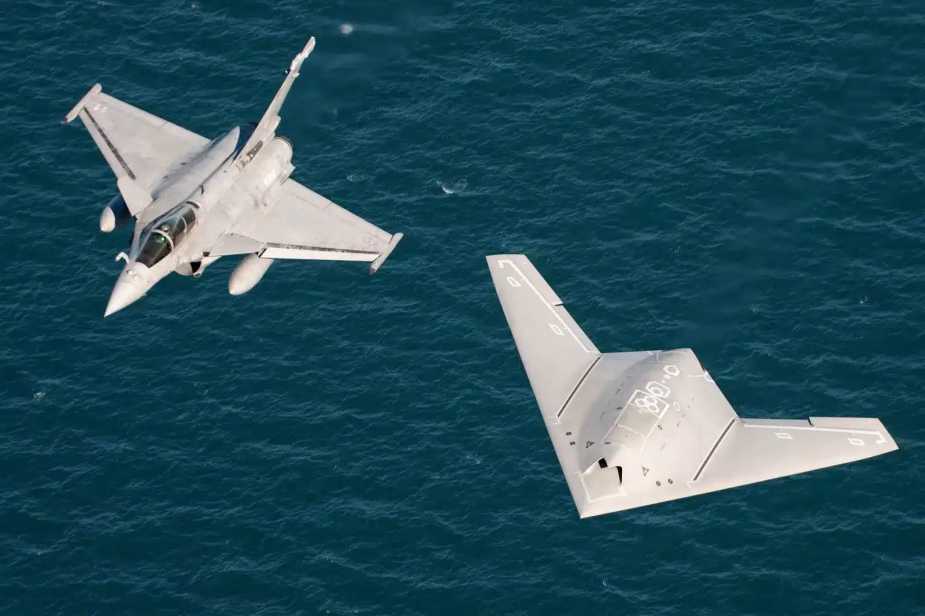
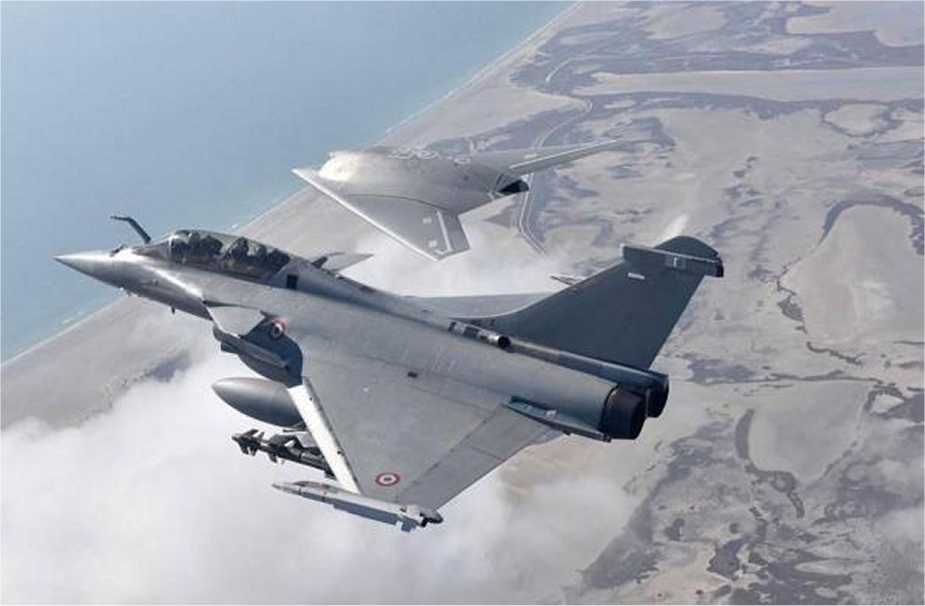
The Rafale F5 is a major modernization standard for Dassault Aviation’s twin-engine combat aircraft, intended to strengthen its effectiveness against advanced air defenses and support increasingly collaborative air operations. It combines renewed mission systems, electronic warfare, connectivity and propulsion developments with preparations for France’s future airborne nuclear weapon. The French defense procurement agency, DGA, targets qualification around 2033, followed by introduction into the French Air and Space Force and subsequently the French Navy.
Country users: France development
Key Tactical Insights:
• Collaborative Combat Ecosystem: The F5 standard shifts the Rafale from a standalone platform into an interconnected command hub, specifically optimized to operate alongside stealth unmanned combat air systems (UAVs) derived from nEUROn technology.
• Hypersonic Strike and Deterrence Renewal: Integration of the fourth-generation Air-Sol Nucléaire (ASN4G) hypersonic missile ensures long-term penetration capabilities against sophisticated anti-access/area-denial (A2/AD) networks.
• Deep-Strike Munition Interoperability: The F5 platform's digitized armament bus optimizes the integration of highly versatile payloads—including Meteor air-to-air, SCALP cruise, and Exocet anti-ship missiles—significantly compressing the sensor-to-effector latency during multi-domain engagement profiles.
• Sensor and Propulsion Power Scaling: Upgrading to the RBE2-XG active electronically scanned array (AESA) radar and the 9-tonne-thrust Safran M88 T-REX engine provides severe detection and kinematic performance boosts without altering the airframe’s physical footprint.







Key Technical Specifications
-
Design
The Rafale F5 is being developed from the existing Rafale platform, whose published reference dimensions are 15.30 m long, 10.90 m in wingspan and 5.30 m high. Dassault lists a maximum takeoff weight of 24,500 kg and an external-load capacity of 9,500 kg. These are baseline aircraft figures, not a separately qualified F5 specification. An important limitation concerns external load: the published allowance includes externally carried equipment and fuel, so it should not be presented simply as an available weapons load. Dassault’s baseline arrangement provides five heavy/wet stations within the aircraft’s overall store-station configuration.
-
Armament and Mission Systems
The Rafale F5 is intended to integrate the future ASN4G airborne nuclear missile, supporting renewal of France’s airborne deterrent. Official descriptions also associate the standard with improved operations in heavily contested environments and cooperation with a stealth combat drone. Published material does not establish the missile’s detailed operational performance or a finalized aircraft loadout. For conventional missions, the established Rafale weapons portfolio provides context: Dassault lists Meteor and MICA air-to-air missiles, SCALP cruise missiles, AM39 Exocet anti-ship missiles, AASM HAMMER precision weapons, and the internal 30M791 30 mm cannon. Their presence in the Rafale portfolio should be distinguished from completion of any F5-specific integration or certification.
-
Propulsion and Flight Performances
The Rafale F5 is planned to benefit from Safran Aircraft Engines’ M88 T-REX, an evolution intended for future Rafale standards. Its target afterburning thrust is 9 metric tonnes-force per engine, approximately 88.3 kN, compared with the current published 7.5-tonne figure. This represents a 20 percent thrust increase, with engine qualification planned to align with F5 introduction. Safran describes targeted changes to the compressor, turbine and nozzle while retaining the engine’s dimensions and modular approach. Maintaining installation compatibility is significant because propulsion modernization must fit within the existing aircraft architecture. Higher engine thrust does not, by itself, establish a new aircraft speed or combat radius. Dassault’s published baseline remains Mach 1.8 and a 50,000 ft service ceiling; these should be identified as reference values pending publication of F5-specific performance.
-
Avionics and Onboard Equipment
The Rafale F5 is planned to incorporate the Thales RBE2-XG radar, intended to increase detection performance and processing capacity while retaining the existing radar’s installation envelope. SPECTRA F5, developed by Thales and MBDA France, introduces a digitally renewed electronic warfare core with improved detection and jamming. The Inter-Vehicle Data Link—IVDL is intended to provide discreet, high-throughput communications resistant to jamming. Navigation modernization includes a very-low-drift inertial unit using a hemispherical resonator gyroscope. These developments accompany a more open mission-system architecture. Public disclosures do not provide numerical radar detection ranges or electronic warfare coverage.


Photo Gallery