






Breaking News






German Eurofighter Jets Patrol Romania After Russian Air Incursions.
Germany has rotated five Eurofighter Typhoons and roughly 170 personnel to Mihail Kogălniceanu Air Base for NATO’s enhanced Air Policing mission, taking over from Italy in late summer 2025. The deployment tightens response times on the Alliance’s southeastern flank and keeps a continuous deterrent posture over the Black Sea region.
Filmed at Ramstein and released on November 12, the report documents the German Air Force rotation that began in August, with Eurofighters sitting 24-hour Quick Reaction Alert in Romania and launching on short notice when ordered by NATO controllers. Allied Air Command and the Luftwaffe say the detachment, Germany’s fourth in Romania since 2014, assumed the mission from Italy and integrated with Romanian F-16S for daily training and alert duties. The posture underscores steady burden sharing and a clear, visible presence along NATO’s eastern border.
Follow Army Recognition on Google News at this link
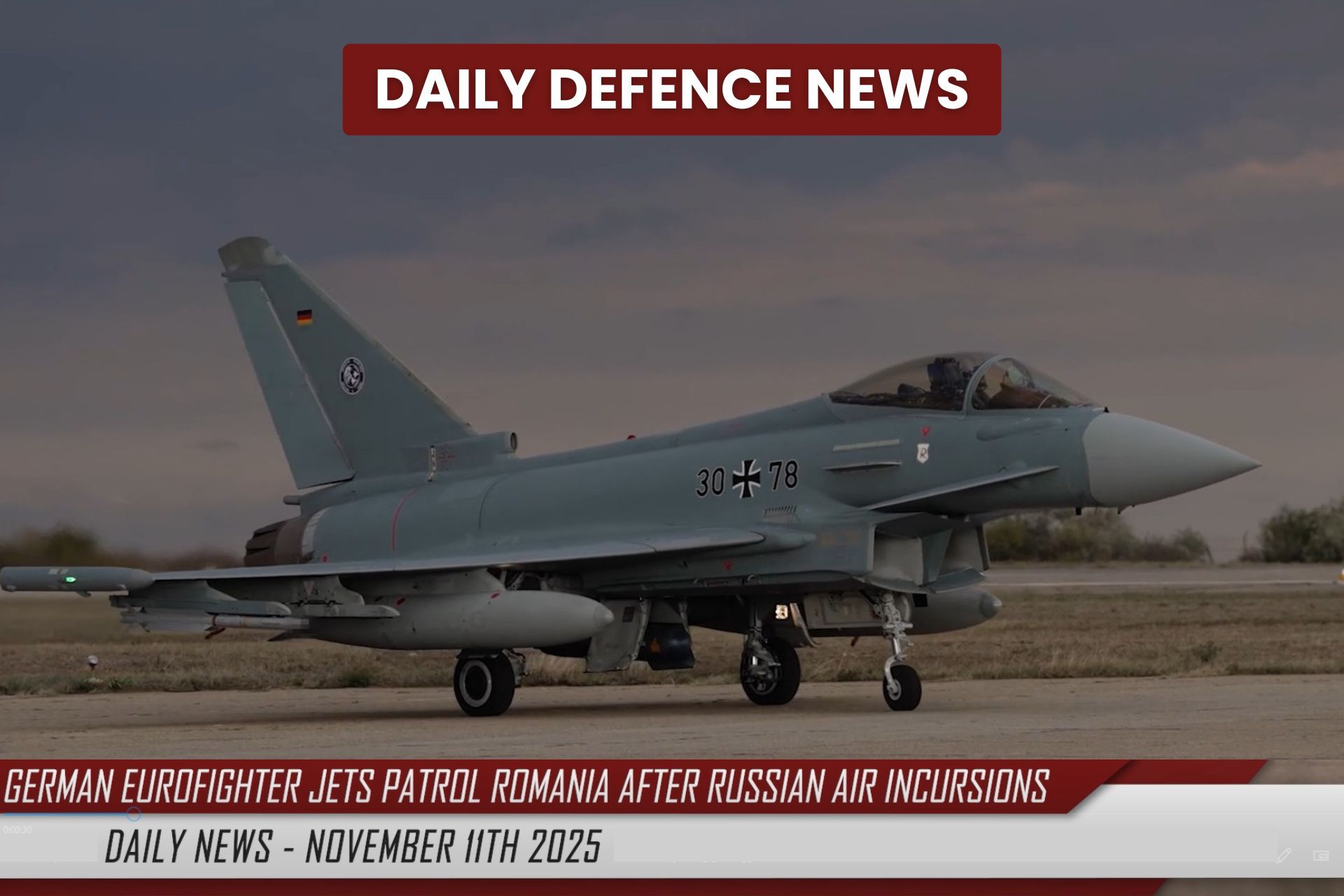
German Air Force Eurofighter on QRA at Mihail Kogălniceanu Air Base, Romania, during NATO enhanced Air Policing in 2025. (Picture source: US DoD)
Integrated into the Alliance posture since 2014, enhanced Air Policing is a peacetime mission to safeguard Allied airspace. In Romania, the Luftwaffe deployed five Eurofighter Typhoons and around 170 personnel. Crews maintain a 24-hour Quick Reaction Alert (QRA), ready to launch in under fifteen minutes on order from Allied air traffic controllers. Scrambles are triggered when an unknown aircraft approaches or enters Allied airspace without clear identification. Some cases involve civilian aircraft with transponder failures or lost communications. Others involve Russian military aircraft flying near NATO borders without radio contact, which requires close visual identification and, if needed, escorted deconfliction.
The Eurofighter Typhoon, powered by two Eurojet EJ200 engines, brings the speed and endurance needed for this mission. It reaches Mach 2 and can climb beyond 55,000 feet quickly, closing on an ambiguous track and keeping it under control. Its sensor suite combines an active electronically scanned array radar and an infrared search and track system, enabling long-range detection and identification even in dense electromagnetic environments. The onboard defensive aids and electronic warfare systems provide alerts and countermeasures that increase survivability during close encounters. Typical air-to-air weapons include the Advanced Medium Range Air-to-Air Missile (AMRAAM) for beyond visual range engagements and IRIS-T for short-range combat, allowing multiple target handling and fast transitions across interception phases.
Romania’s posture relies on close coordination with the Forțele Aeriene Române and their F-16S, as well as with Allied air command and control nodes. Routine combined training aligns procedures, harmonizes communications, and refines interception rules. This interoperability shortens the timeline from alert to identification, reducing risk for civil aviation and reassuring national authorities. The rotational model also ensures continuity. Italy held the posture in Romania until the handover and has redeployed another detachment to the Baltic Air Policing mission from Ämari in Estonia, maintaining coverage of both the northern and south eastern vectors of the Alliance.
Regional air activity makes this constant vigilance necessary. Russian military flights near Allied borders remain irregular, especially when no flight plan is filed and no radio replies are given. Air Policing provides a proven mechanism for detection, interception, identification, and, when required, escort. The German presence at Mihail Kogălniceanu reflects both burden sharing and credible responsiveness. A continuous alert posture, trained crews and a responsive command chain send a clear message of cohesion and resolve along the eastern borders.
Testimony from Detachment Commander Lieutenant Colonel Thomas Kötting and a pilot with the call sign Tenne explains daily alert routines, sortie preparation, coordination with Allied controllers, and the handling of short notice interceptions. Their accounts show how procedural discipline, system redundancy, and quality intelligence maintain a high level of safety over the Black Sea and Romanian approaches.
Operationally, the mission delivers more aircraft on alert and shorter response times. Strategically, it strengthens collective deterrence and supports freedom of air navigation around the eastern flank. The sequence captured in the video fits within the continuity of Allied rotations since 2014. It is a proven, visible, and effective posture designed to address varied incidents while avoiding escalation.