






Breaking News






Russia’s Su-57 Stealth Jet Makes High-Profile Dubai Airshow Debut After Nonstop UAE Flight.
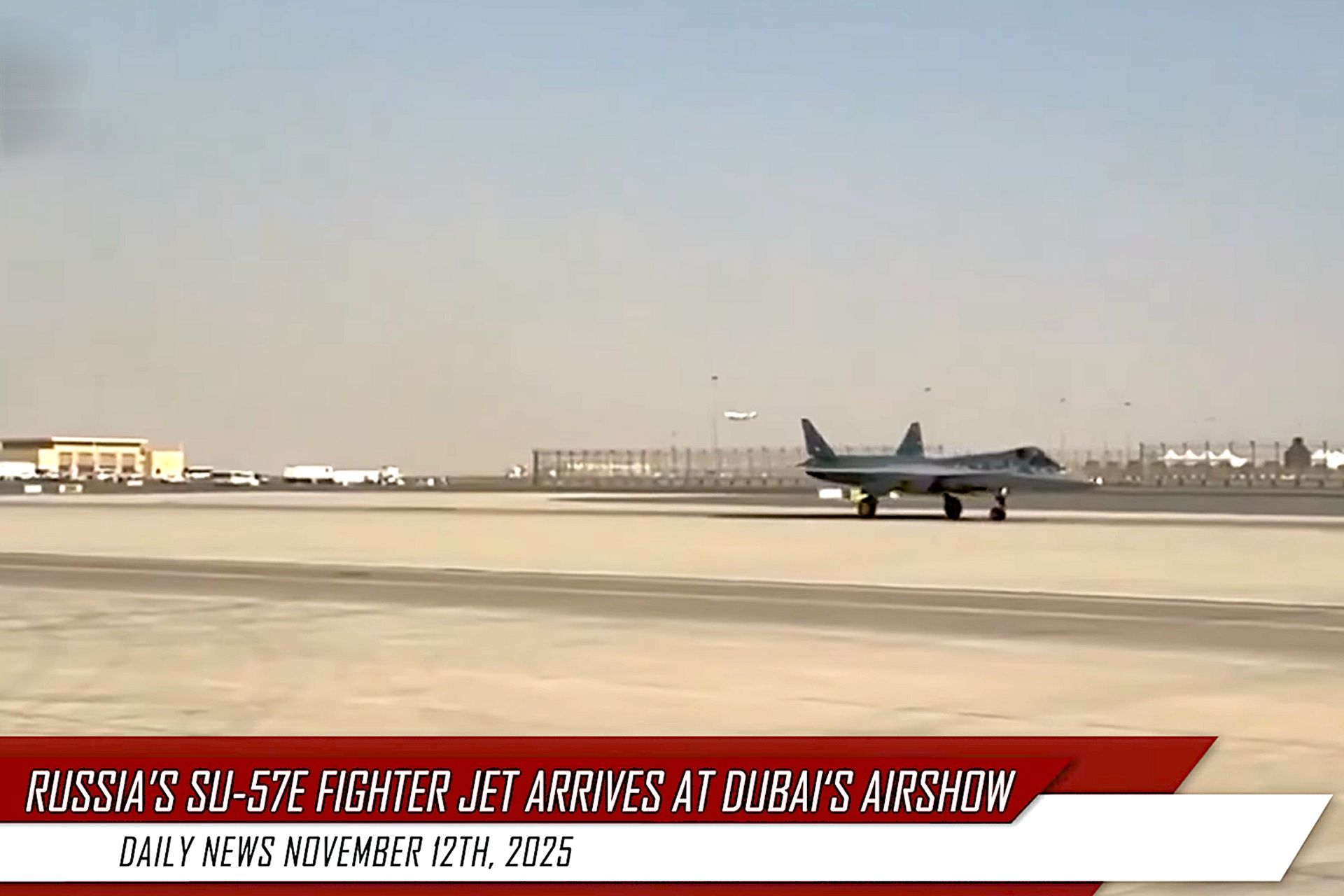
Russia’s export-configured Su-57E arrived in the United Arab Emirates on November 11 to join the Dubai Airshow program, following a nonstop ferry flight flown by Sukhoi test pilot Sergei Bogdan. The appearance targets prospective buyers at a major Gulf venue and aligns with Moscow’s push to reignite defense exports, including new messaging around internal-bay strike and air-to-air options.
On 11 November 2025, Russia’s fifth-generation Su-57E arrived in the United Arab Emirates to open its participation in the Dubai Airshow, following a nonstop ferry flight to Dubai International Airport, as reported by Russian News Agency Promvest. The prototype with tail number 509 will be shown both statically and in the flying programme, a high-visibility stage for Russia’s export-configured stealth fighter. The flight was performed by Sukhoi test pilot Sergei Bogdan, and the appearance includes a first public look inside the forward internal bay with new missile mock-ups, an overt signal about the aircraft’s intended role set. This matters because the UAE show gathers many of the Su-57E’s target customers and because it comes amid renewed Russian efforts to revive arms exports.
Russia’s export-configured Su-57 stealth fighter made its Dubai Airshow debut on 11 November 2025, arriving nonstop from Moscow and unveiling new missile bay mock-ups to signal its intended combat role (Picture Source: UAC)
Promvest reports the Su-57E completed a nonstop transit and is slated for daily flight demonstrations, with the aircraft opening its forward internal weapons bay in public for the first time. Inside were mock-ups of Kh-58UShK anti-radiation missiles, advertised at up to 250 km range, extendable to roughly 350 km in an aeroballistic configuration, signalling a stealthy suppression-of-enemy-air-defences (SEAD) profile. Additional R-74M2 short-range missiles were shown on external pylons, while the display routine highlighted super-maneuverability with flat-spin elements. This package is designed to show that the export variant keeps the trademark agility of the type while emphasising a stealth strike mission set that aligns with current combat lessons.
Fresh footage and imagery ahead of the show have underlined the SEAD theme: UAC-released video, covered by Army Recognition, showed the Su-57’s forward bay open in flight carrying two Kh-58-class missiles, pointing to a stealthy anti-radar loadout for standoff strikes. Beyond kinetic suppression, Russian industry messaging around the Su-57 family repeatedly ties the jet to manned-unmanned teaming, using the Su-57 as a controller for advanced unmanned systems (e.g., the S-70 Okhotnik) to scout, jam, or strike while the pilot remains offset. Russia describes this “loyal wingman” concept as a core trajectory for the platform’s development, dovetailing with its avionics and datalink architecture.
The Su-57 programme entered serial service in Russia in late 2020 after initial flight in 2010, with limited operational exposure for evaluation in Syria and subsequent standoff-weapons use reported in the Ukraine theatre, typically from well inside Russian airspace. Public data suggest a relatively small in-service fleet to date compared with Western peers, but with a roadmap to larger numbers by the late 2020s. As a comparator, the F-35’s maturation followed a different path, earlier mass production and wide export, but the Su-57E’s recent reveals (weapon bays, SEAD loadouts) indicate a narrowing focus on roles where stealth and long-range sensors/weapons can be leveraged without courting dense air defences. That evolution mirrors a broader fifth-generation pattern: stealth aircraft prioritising sensor fusion and stand-off effects over close-in penetration when risk is high.
Dubai Airshow (17–21 November 2025) gives Russia a premium venue to court customers from the Middle East, North Africa and Asia at a moment when its overall arms exports have contracted and buyers are diversifying supply. Showcasing a stealth SEAD loadout plays to demand for systems able to operate under modern integrated air-defence networks and to enable stand-in/stand-off combinations with unmanned assets. It also tests the Su-57E’s appeal in hot-and-humid conditions typical for Gulf operators. Geopolitically, Russia is signalling that, despite wartime constraints and sanctions, its combat aviation portfolio can field fifth-generation options, while simultaneously floating industrial cooperation offers (including to India) to overcome political and logistics headwinds. For regional forces, a credible Su-57E offer, especially if paired with loyal-wingman drones, would impact air-defence planning, electromagnetic-spectrum doctrine, and long-range strike calculus.
Domestically, Russia’s headline procurement remains the 2019 decision to buy 76 Su-57s by 2028; deliveries have been proceeding in batches, with state media noting additional handovers through 2024. Costing is opaque, but a rare factory poster seen in 2020 indicated early production airframes around 4.7 billion rubles each (incl. VAT), a figure that likely understates full programme/through-life costs and may not reflect later configurations. On exports, Moscow has repeatedly hinted that a first foreign customer will begin operating the Su-57E in 2025; multiple outlets frequently cite Algeria, while Russia has also courted India with proposals up to local production. However, as of today there is no public, on-the-record naming by Rosoboronexport/UAC of a signed, delivered Su-57E export contract. Dubai is therefore not just a flight demo, it is an audition aimed at converting years of interest into firm, disclosed deals.
The Su-57E’s early arrival in the UAE is more than a logistics milestone; it is a carefully staged debut of a stealth SEAD and manned-unmanned teaming narrative intended to reset Russia’s fighter export pitch. By flying in with tail 509, opening its forward bay, and highlighting anti-radiation missile carriage, Moscow is aiming squarely at the mission sets that matter to prospective buyers facing dense air defences. Whether that showmanship translates into publicly confirmed export deliveries remains the open question, but the messaging is clear: Russia wants the Su-57E to be seen not only as a supersonic stealth fighter, but as a command node for unmanned systems and a tool for degrading modern IADS, with Dubai as the launchpad.
Written by Teoman S. Nicanci – Defense Analyst, Army Recognition Group
Teoman S. Nicanci holds degrees in Political Science, Comparative and International Politics, and International Relations and Diplomacy from leading Belgian universities, with research focused on Russian strategic behavior, defense technology, and modern warfare. He is a defense analyst at Army Recognition, specializing in the global defense industry, military armament, and emerging defense technologies.