






Breaking News





Belgian Navy Modernizes Fleet With State-of-the-Art M940 Oostende Mine Countermeasure Ship.
The Belgian Navy has strengthened its maritime capabilities with the addition of the M940 Oostende, a state-of-the-art mine countermeasure vessel integrating autonomous and modular technologies. The ship enhances Belgium’s readiness to secure vital sea lanes and contribute to NATO mine warfare operations.
Belgium’s naval modernization has advanced with the arrival of the M940 Oostende. This state-of-the-art mine countermeasure vessel is designed to operate alongside unmanned systems for precision mine detection and clearance. Built under a joint Belgian-Dutch procurement program, the vessel marks a major step toward a fully digital, interoperable fleet. The fleet will be capable of handling complex maritime threats in Northern European waters.
Follow Army Recognition on Google News at this link
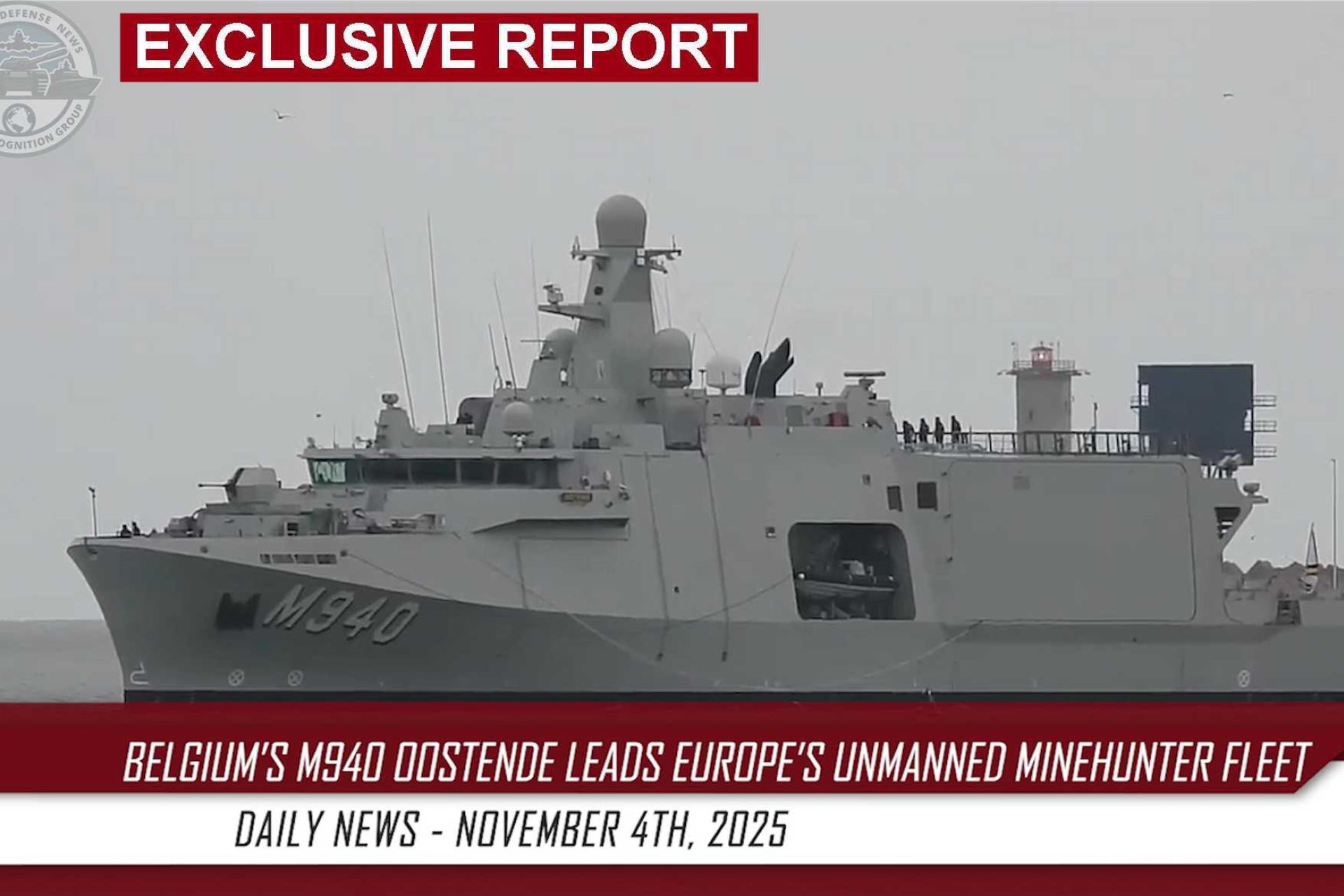
Belgian Navy’s M940 Oostende, the first of a new class of mine countermeasure vessels, equipped with advanced autonomous drone systems developed under the Belgian-Dutch rMCM program. (Picture source: Belgian Navy)
The M940 Oostende is the first in a new class of counter-measure ships developed under the Belgian-Dutch Replacement Mine Counter Measures (rMCM) program. This bilateral initiative, launched in 2019, involves the delivery of 12 next-generation MCM vessels: 6 to the Belgian Navy and 6 to the Royal Netherlands Navy. The program was awarded to Belgium Naval & Robotics, a consortium formed by France’s Naval Group and Exail, after an international tender. It includes not only the twelve vessels but also more than one hundred drones and robotic systems integrated into each ship’s mission toolbox.
The Oostende is not a traditional minehunter. It introduces a fundamentally new operational concept focused on stand-off operations—a method where the ship stays at a safe distance from danger zones. Rather than entering mined waters, the vessel acts as a mothership, launching and supporting a sophisticated suite of autonomous systems. These unmanned vehicles—including aerial drones, surface vessels, and underwater robots—execute mine detection, classification, and neutralization tasks, minimizing risk to human operators.
At the heart of its combat capability is a modular and scalable toolbox built around cutting-edge drones. The suite includes Exail’s A18-M autonomous underwater vehicle, equipped with synthetic-aperture sonar for high-resolution seabed mapping and the detection of buried or low-metallic mines. The A18-M is capable of conducting extended autonomous missions across complex underwater terrains.
Supporting this underwater component is the T18 towed sonar, a sensor system that detects underwater objects by emitting sound waves and analyzing their echoes. It is deployed via a dedicated unmanned surface vessel (USV), which is a remotely operated or autonomous boat without a crew on board. This system is particularly effective in shallow coastal waters and provides wide-area mine detection at high resolution. Once threats are identified, they are confirmed and neutralized using remotely operated vehicles (ROVs), which are underwater robots controlled from afar, deployed from the Inspector 125 surface drone. This USV is equipped to transport, deploy, and recover mine neutralization systems. It operates semi-autonomously and communicates in real time with the mothership, meaning it can perform tasks independently but stays in contact with the main vessel for updates or instructions.
Aerial drones further enhance the system by providing overwatch and situational awareness. These unmanned aerial vehicles (UAVs), or remote-controlled flying aircraft, monitor the mission zone, support navigation, coordinate between assets, and deliver real-time imagery and data feeds to the command team aboard the ship.
A centralized combat management suite, which Naval Group designed, controls all unmanned systems. The suite enables operators to simultaneously run multiple drones, integrate data fusion, classify threats automatically, and re-plan missions dynamically. This digital backbone uses a modular, open architecture, empowering teams to upgrade sensors, software, and mission payloads in the future.
Key features of the M940 Oostende include a length of approximately 82 m, a displacement of around 2,800 tons, and a hybrid diesel-electric propulsion system that ensures low acoustic signatures and reduced vulnerability to mine triggers. The ship’s hull is constructed from non-magnetic materials and engineered to withstand shock, significantly improving survivability in mine-laden waters.
The vessel's core crew numbers 30 to 40. Rotating teams of drone operators and mission specialists support them, depending on the deployment profile. Endurance enables multi-week missions in high-threat environments. Autonomous systems allow persistent operations and extend the ship’s reach far beyond the horizon.
The integration of this capability transforms Belgium’s naval force from a traditional coastal defense fleet into a high-tech operator capable of contributing meaningfully to NATO’s forward posture in strategic maritime corridors. The M940 is particularly suited to operate in environments such as the North Sea, the Baltic, and other shallow littoral zones where conventional mine hunting ships face high operational risks.
Operational deployment of the Oostende marks the first step in a phased rollout of six vessels for the Belgian Navy. Each ship will be equipped with its own dedicated toolbox of unmanned systems. The second platform is undergoing final integration testing. The full fleet is scheduled for delivery by 2030. Alongside these Belgian vessels, six sister ships will enter service with the Royal Netherlands Navy, reinforcing allied maritime cooperation.
In addition to shipbuilding, the rMCM program has driven the development of a new training pipeline for Belgian naval personnel. Crews are being prepared through a combined approach of seamanship, robotics operations, and mission command. Drone specialists are receiving factory-level training in coordination with Naval Group and Exail, ensuring full knowledge transfer and long-term operational autonomy for the Belgian Navy.
Even as the first systems are fielded, ongoing refinement continues. The unmanned components of the toolbox are designed for iterative upgrades. New capabilities and software enhancements are being developed in close cooperation between the naval forces and industry partners. The first deliveries of unmanned modules are expected by the end of November 2025. Further improvements are scheduled. The M940 Oostende is more than a new ship. It embodies Belgium’s commitment to innovation, sovereignty, and interoperability in defense. It signals a bold move into the future of naval warfare. Autonomy, digital command, and robotic precision now replace legacy tactics and limit human exposure to risk. For the Belgian Navy, this capability is not just a replacement. It is a reinvention. It is a reinvention.
Written by Alain Servaes – Chief Editor, Army Recognition Group
Alain Servaes is a former infantry non-commissioned officer and the founder of Army Recognition. With over 20 years in defense journalism, he provides expert analysis on military equipment, NATO operations, and the global defense industry.