






Breaking News






US, UK and Japan Carrier Fleet Shows Massive Power in the Indo-Pacific.
On August 10, 2025, the Philippine Sea hosted an unprecedented naval maneuver bringing together for the first time three aircraft carriers from three different nations operating in close formation alongside an American amphibious assault ship. This trilateral cooperation between HMS Prince of Wales of the United Kingdom, USS George Washington of the United States, and JS Kaga of Japan reflected a high level of operational integration, reinforced by the presence of USS America and a multinational escort force. This unique configuration demonstrated a shared intention to deploy a credible and coordinated force in a strategically sensitive environment.
Follow Army Recognition on Google News at this link
HMS Prince of Wales of the Royal Navy, USS George Washington of the US Navy, and JS Kaga of the Japan Maritime Self-Defense Force sailing in formation in the Philippine Sea alongside USS America and allied escort ships during a multinational exercise on August 10, 2025.
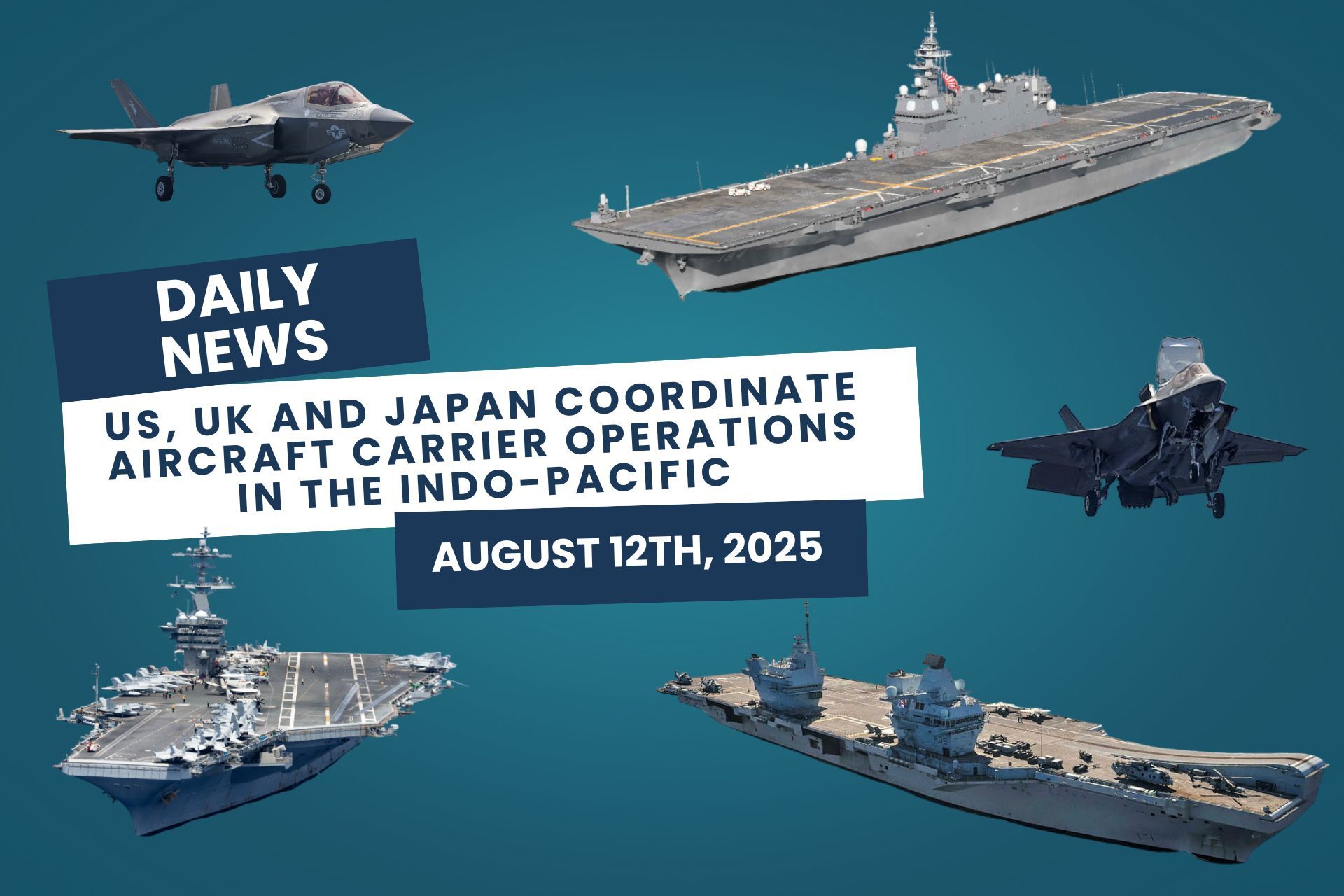
HMS Prince of Wales, a Queen Elizabeth-class aircraft carrier, is designed to operate F-35B short take-off and vertical landing aircraft as well as a wide range of support helicopters. USS George Washington, a Nimitz-class nuclear-powered aircraft carrier, embarks Carrier Air Wing 5, which includes F/A-18E/F multirole fighters, E-2D airborne early warning aircraft, and EA-18G electronic warfare aircraft.
JS Kaga, a helicopter carrier of the Izumo class, was ordered in 2010, laid down in October 2013, launched in August 2015, and commissioned on March 22, 2017. It has a full-load displacement of approximately 27,000 tons, a length of 248 meters, and a speed exceeding 30 knots. Its COGAG propulsion system consists of four LM2500IEC gas turbines driving two shafts. Initially designed to carry seven anti-submarine warfare helicopters and two search and rescue helicopters, it can accommodate up to 28 aircraft and is being modified to operate the F-35B fighter. Its armament includes two Phalanx CIWS and two SeaRAM systems for close-in self-defense, as well as an OPS-50 AESA radar, an OQQ-23 bow sonar, and a complete suite of electronic countermeasures. The vessel represents the gradual expansion of Japan’s naval aviation capabilities and its adaptation to allied operational requirements.
USS America, an America-class amphibious assault ship, is configured for the deployment of ground forces and STOVL aircraft such as the F-35B and MV-22 Osprey. The escort also includes the Ticonderoga-class guided-missile cruiser USS Robert Smalls, equipped with the Aegis system for area air defense, and the Arleigh Burke-class destroyer USS Shoup, capable of anti-submarine, anti-air, and anti-surface warfare. Norwegian, Spanish, and Australian units contribute additional protection and logistical support, enhancing the task group’s resilience.
The operations conducted included coordinated anti-submarine warfare between ships and aircraft, cross-deck flights allowing British and American F-35Bs to operate from JS Kaga, as well as cross-fleet refueling and aircraft maintenance. These maneuvers tested the ability of the participating navies to exchange tactical data in real time via secure networks, harmonize aviation and flight deck procedures, and integrate detection and strike capabilities in a multi-threat environment.
The F-35 played a central role with its sensor fusion and data-sharing systems enabling the synchronization of air operations regardless of national origin. By transmitting data instantly between ships and aircraft, it reduced reaction times and increased the group’s ability to respond to complex and simultaneous threats.
From a strategic perspective, the exercise illustrated the commitment of AUKUS members and their partners to maintain freedom of navigation and deter any attempt to alter the regional balance. The coordinated presence of three aircraft carriers, supported by a multinational network of air defense, anti-submarine, and amphibious capabilities, sent a clear signal to all regional actors. Scheduled to conclude on August 12, the exercise stands as a rare and notable example of collective naval operations in the Indo-Pacific.