







Breaking News




Ukraine Reveals Riki Interceptor Drone as New Short-Range Defense Layer at UMEX 2026.
Ukraine’s Piranha Tech has unveiled its Riki interceptor drone at UMEX 2026 in Abu Dhabi, marking its first international appearance. The debut highlights how combat-tested Ukrainian counter-UAS solutions are rapidly maturing into export-ready systems as militaries seek affordable drone defence.
During UMEX 2026, held from January 20 to 22 at the Abu Dhabi National Exhibition Centre in the United Arab Emirates, the Ukrainian company Piranha Tech unveiled its Riki interceptor drone on the international stage for the first time. This presentation marked the debut of a combat-derived Ukrainian counter-UAS solution at one of the world’s most prominent showcases for unmanned and autonomous systems. As armed forces increasingly search for cost-effective responses to the proliferation of hostile drones and loitering munitions, Riki illustrates how Ukraine’s accelerated wartime innovation cycle is translating into export-ready capabilities. Its appearance in Abu Dhabi underscores the growing recognition of interceptor drones as a distinct and increasingly necessary layer within modern, tiered air-defence architectures.
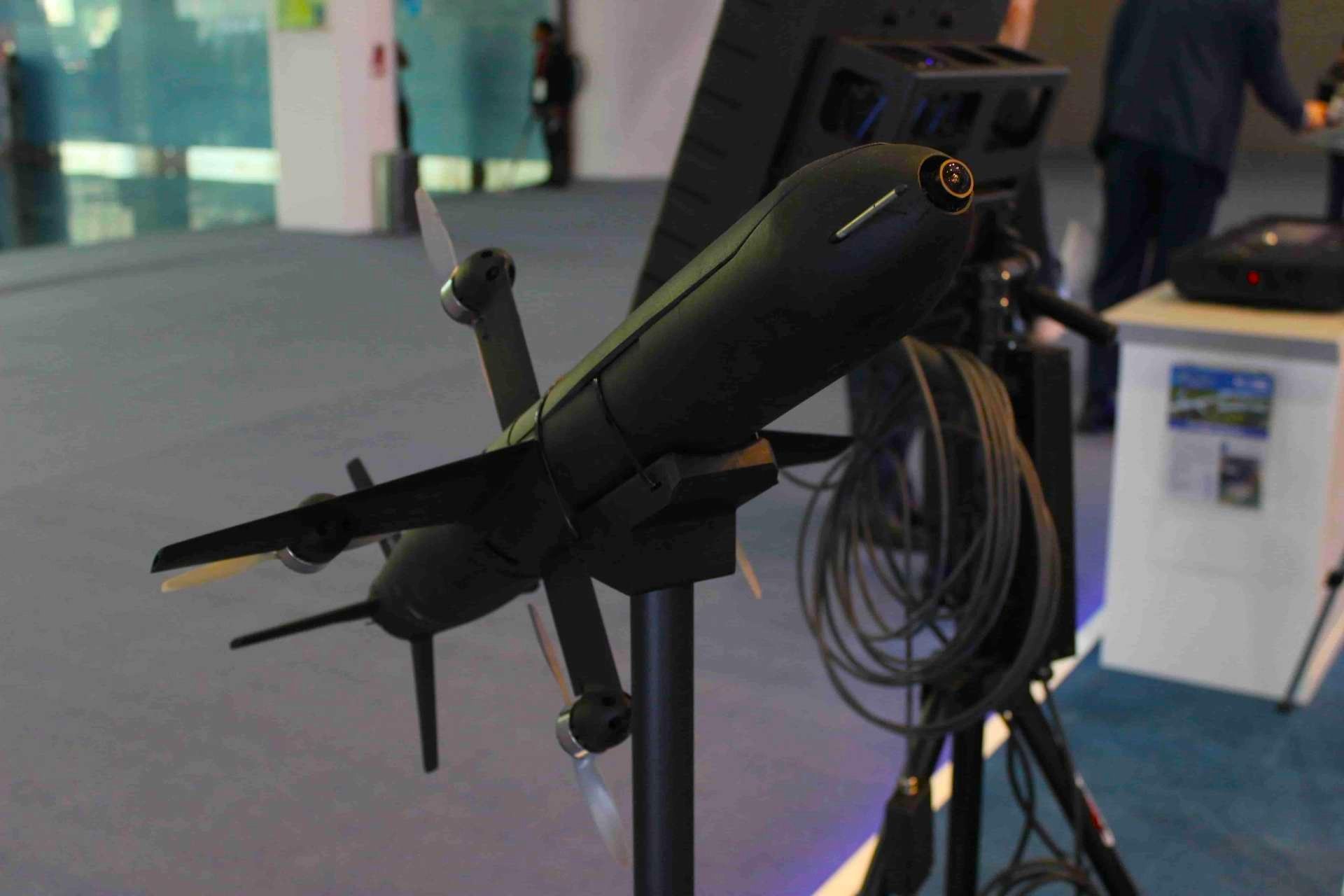
Ukraine’s Piranha Tech unveiled its combat-derived Riki interceptor drone at UMEX 2026, highlighting a low-cost, short-range point-defence solution shaped by Ukraine’s wartime counter-UAS experience (Picture Source: Army Recognition Group)
Displayed on the UMEX exhibition floor as a compact interceptor mounted on a static stand, Riki immediately drew attention due to its unconventional hybrid layout. The airframe is built around an elongated, torpedo-like fuselage with a matte dark finish, shaped to reduce aerodynamic drag and visual signature. Rather than relying on large wings, the design incorporates multiple short control surfaces and propulsion arms positioned close to the fuselage, each fitted with small electric propellers. This configuration prioritises thrust vectoring, agility and rapid attitude changes over endurance or sustained cruising performance. A forward-facing electro-optical sensor integrated into the nose provides target detection and terminal guidance, clearly indicating the drone’s role as a dedicated short-range interceptor rather than an intelligence or reconnaissance platform.
Riki represents the latest step in Piranha Tech’s evolution from a specialist in electronic warfare into a broader supplier of integrated air-defence solutions. Founded in western Ukraine and active in radio-electronic warfare since the mid-2010s, the company has developed a wide portfolio of jamming systems and dome-type EW complexes designed to protect vehicles, military positions and critical infrastructure against hostile drones. In 2025, Piranha Tech presented a unified control complex capable of displaying interceptor drones, EW assets and external sensors on a single interface, signalling a move toward tighter integration between kinetic and non-kinetic counter-UAS measures. Within this emerging ecosystem, Riki is intended to function as a kinetic “last layer” when electronic attack or conventional air-defence systems fail to neutralise an incoming threat.
From a technical perspective, Riki is an electrically powered, kamikaze-type interceptor optimised for short-range engagements against unmanned aerial vehicles, including reconnaissance platforms and Shahed-type one-way attack drones when interception geometry permits. According to information released during UMEX, the latest configuration is capable of climbing to approximately 6,000 metres, reaching speeds of up to 340 km/h and operating at distances of up to 30 km from its launch point. The compact hybrid airframe enables rapid vertical or near-vertical acceleration, abrupt manoeuvres and tight pursuit profiles in complex, low-altitude environments. Its onboard guidance architecture is designed to support fast autonomous interception within a compressed decision window, reflecting the realities of drone defence where reaction time is often measured in seconds.
While operators retain man-in-the-loop authority through a simplified control interface, much of the terminal phase can be handled by onboard algorithms that calculate intercept trajectories and reduce pilot workload during high-speed engagements. The system has also been designed with operational practicality in mind. Modular propulsion units, easily replaceable control surfaces and a straightforward battery architecture are intended to support rapid maintenance and short rearming cycles from forward or dispersed positions, an important consideration in high-tempo defensive operations.
At the tactical level, Riki directly reflects the dense and contested drone environment Ukraine has faced since the start of Russia’s full-scale invasion. Both sides have made extensive use of reconnaissance quadcopters, FPV strike drones and long-range loitering munitions, often deployed in large numbers and at low cost. Ukrainian industry has responded by moving toward mass production of interceptor drones, supported by state and private initiatives aimed at achieving very high daily output rates. Within this context, Riki is designed to protect specific objects and areas such as logistics hubs, command posts, energy infrastructure or even air-defence assets themselves. When cued by radar, acoustic sensors or EW detection systems, the interceptor can be launched within seconds to pursue targets at low altitude, at night or in poor weather, conditions under which gun systems or missiles may be less effective or economically inefficient. Its relatively small warhead and hit-to-kill engagement concept are also intended to limit collateral damage when interceptions occur over populated or sensitive areas.
From an industrial and strategic standpoint, Piranha Tech’s decision to present Riki at UMEX 2026 reflects Ukraine’s broader ambition to move beyond emergency wartime procurement toward a more sustainable defence-industrial posture with export potential. Abu Dhabi has positioned UMEX as a global platform for unmanned and autonomous technologies, and the 2026 edition features a growing number of counter-UAS solutions, including interceptor drones developed by manufacturers from Europe and beyond. By introducing Riki in this environment, Ukraine highlights a system shaped by continuous combat feedback in one of the world’s most demanding drone theatres, while inviting international partners to consider Ukrainian technology within their own layered air-defence concepts. For Middle Eastern states facing increasing UAV threats to critical infrastructure and dense urban areas, a compact and comparatively low-cost interceptor offers a potential complement to traditional missile-based defences.
More broadly, Riki illustrates how the Russo-Ukrainian war is accelerating a shift in global air-defence doctrine. The conflict has demonstrated that high-end surface-to-air missiles alone cannot economically counter massed attacks by inexpensive drones. As a result, many states are exploring tiered defence architectures combining long-range missiles, medium-range guns, electronic warfare and a new class of small, expendable interceptors. Ukrainian companies such as Piranha Tech, combining electronic warfare expertise with continuous operational feedback, are well positioned to contribute to these emerging layers. If Riki and its associated command-and-control tools can be integrated into NATO-compatible or regional C2 frameworks, they may influence future approaches to protecting air bases, naval facilities and mobile formations against small UAV threats. At the same time, Kyiv’s willingness to showcase such systems internationally signals a determination to remain an active participant in the global defence market despite sustained wartime pressure.
Seen from Abu Dhabi, the unveiling of Riki at UMEX 2026 encapsulates several converging trends: the maturation of Ukraine’s counter-drone industry under combat conditions, the growing international demand for practical and economically sustainable C-UAS solutions, and the central role of unmanned systems in contemporary security planning. By bringing a compact interceptor developed for front-line realities to one of the world’s key exhibitions for unmanned technology, Piranha Tech positions Riki as both a product of war and a candidate for future international air-defence architectures. How the system performs in further trials, export campaigns and potential operational evaluations with partner nations will be closely watched by armed forces seeking agile and affordable ways to counter the smallest yet increasingly decisive aerial threats.
Written by Teoman S. Nicanci – Defense Analyst, Army Recognition Group
Teoman S. Nicanci holds degrees in Political Science, Comparative and International Politics, and International Relations and Diplomacy from leading Belgian universities, with research focused on Russian strategic behavior, defense technology, and modern warfare. He is a defense analyst at Army Recognition, specializing in the global defense industry, military armament, and emerging defense technologies.