







Breaking News




UAE EDGE Develops New-Generation Counter-Drone Capability with VORTEX-E Autonomous Kinetic Interceptor.
UAE defense company EDGE Group has unveiled the VORTEX-E, a fully autonomous kinetic counter-drone interceptor, at the UMEX 2026 unmanned systems exhibition in Abu Dhabi. The system signals a push toward AI-driven air defense solutions designed to defeat hostile UAVs with precision while limiting collateral damage.
EDGE Group, based in the United Arab Emirates, has introduced its latest counter-unmanned aerial system, the VORTEX-E, at the UMEX 2026 defense exhibition in Abu Dhabi, presenting a fully autonomous kinetic interceptor intended to physically neutralize hostile drones. While the system was not demonstrated in a live intercept scenario, company officials positioned the unveiling as a milestone in EDGE’s broader strategy to field AI-enabled, high-performance unmanned systems tailored for the evolving aerial threat environment.
Follow Army Recognition on Google News at this link
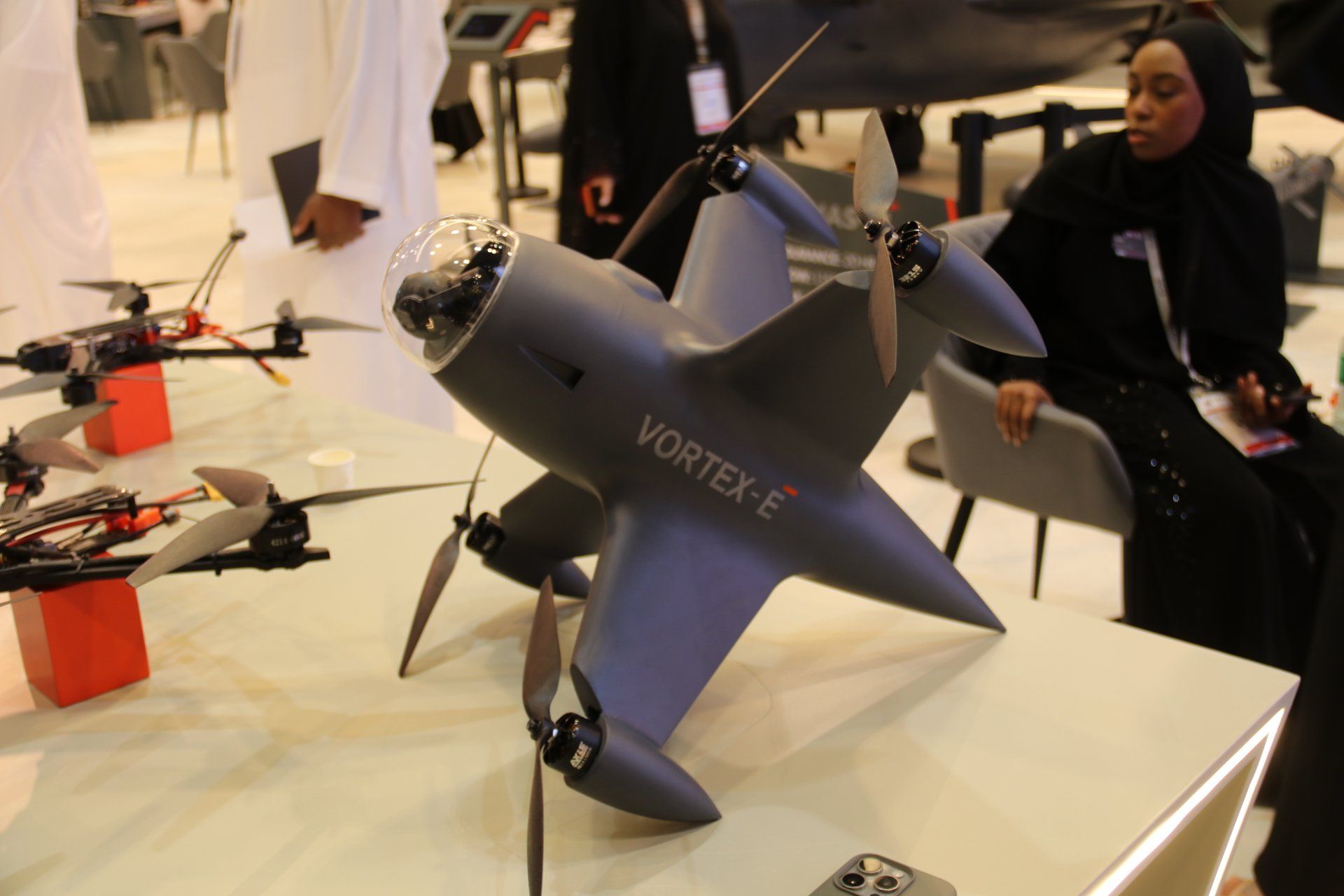
The EDGE VORTEX-E interceptor displayed at UMEX 2026, showcasing its front-mounted AI-tracking camera and aerodynamic profile designed for high-speed kinetic engagements. The system combines autonomous operation with manual control, reaching speeds of up to 350 km/h and a 24 km engagement range. (Picture source: Army Recognition Group)
VORTEX-E is engineered to intercept small to medium-sized drones using a non-explosive kinetic kill mechanism. Unlike traditional counter-UAS platforms that rely on jamming or fragmentation-based warheads, VORTEX-E delivers a direct impact strike guided by real-time radar and electro-optical tracking. This approach makes it ideally suited for engagements in urban terrain, civilian-sensitive zones, or near critical infrastructure, where any form of explosive interception poses unacceptable risks.
The system can operate in fully autonomous mode or under manual control, allowing operators to adapt to mission-specific requirements. A front-mounted AI-enabled camera system provides the interceptor with autonomous target recognition and tracking capabilities. This AI lock-on function allows the VORTEX-E to identify and pursue moving threats with high precision, even in cluttered or GPS-denied environments.
Weighing in with a 1 to 2 kg warhead, the drone delivers enough kinetic energy to destroy or disable its target without relying on fragmentation or blast damage. With a top speed of 350 km/h and an operational range of up to 24 km, VORTEX-E is designed for rapid response across wide defensive perimeters or mobile combat zones. Its compact design and high agility allow for vertical or launcher-based deployment, making it adaptable for both fixed installations and tactical field units.
At the core of the system is an advanced artificial intelligence engine coupled with machine learning algorithms, enabling VORTEX-E to autonomously detect, classify, and pursue airborne threats with minimal operator input. Its onboard sensor suite fuses radar and video tracking data, allowing the interceptor to make adaptive decisions mid-flight, even against fast-moving or evasive targets. EDGE confirms that VORTEX-E can be fielded as a standalone defensive solution or deployed in coordinated swarms, providing layered protection for fixed sites or maneuvering formations.
While exact specifications remain closely guarded beyond its key performance metrics, EDGE emphasized that the interceptor’s combination of speed, autonomy, and precision represents a paradigm shift in drone defense. The platform has been built with modularity in mind, allowing rapid integration into broader air defense networks or future swarm-based counter-UAS architectures.
VORTEX-E’s launch at UMEX 2026 also signals a strategic push by EDGE to establish itself as a frontrunner in kinetic counter-drone solutions amid rising global demand for effective anti-UAV technologies. From conflict zones in Eastern Europe to high-security infrastructure in the Gulf, the threat from low-cost commercial and military drones continues to escalate. EDGE’s answer is a homegrown, AI-native system that not only meets but anticipates the evolving needs of future battlefield and homeland security operations.
Though no live-fire demonstration accompanied the public reveal, EDGE insiders hinted at advanced field trials already underway in undisclosed environments, with operational deployment expected within the next 18 months. With VORTEX-E, EDGE is setting a new benchmark in precision drone defense - where speed meets intelligence, and control is matched by autonomy.
Written by Alain Servaes – Chief Editor, Army Recognition Group
Alain Servaes is a former infantry non-commissioned officer and the founder of Army Recognition. With over 20 years in defense journalism, he provides expert analysis on military equipment, NATO operations, and the global defense industry.