







Breaking News






Czech High-Speed Interceptor Drone Targets UAV and Helicopter Threats.
Czech defense company TRL Drones X unveiled a high-speed fixed-wing interceptor UAV at UMEX 2026 in Abu Dhabi, designed to defeat hostile aerial threats. The system reflects growing demand for layered counter-UAS solutions as militaries confront swarms, loitering munitions, and low-flying helicopters.
TRL Drones X, a Czech-based defense technology developer, revealed its latest fixed-wing unmanned aerial vehicle this week at the UMEX 2026 exhibition in the United Arab Emirates, positioning the platform as a dedicated aerial interceptor rather than a traditional surveillance drone. According to company representatives speaking at the show, the system is optimized for rapid launch, high-speed pursuit, and kinetic or non-kinetic engagement of targets ranging from small quadcopters to manned rotary-wing aircraft operating at low altitude.
Follow Army Recognition on Google News at this link
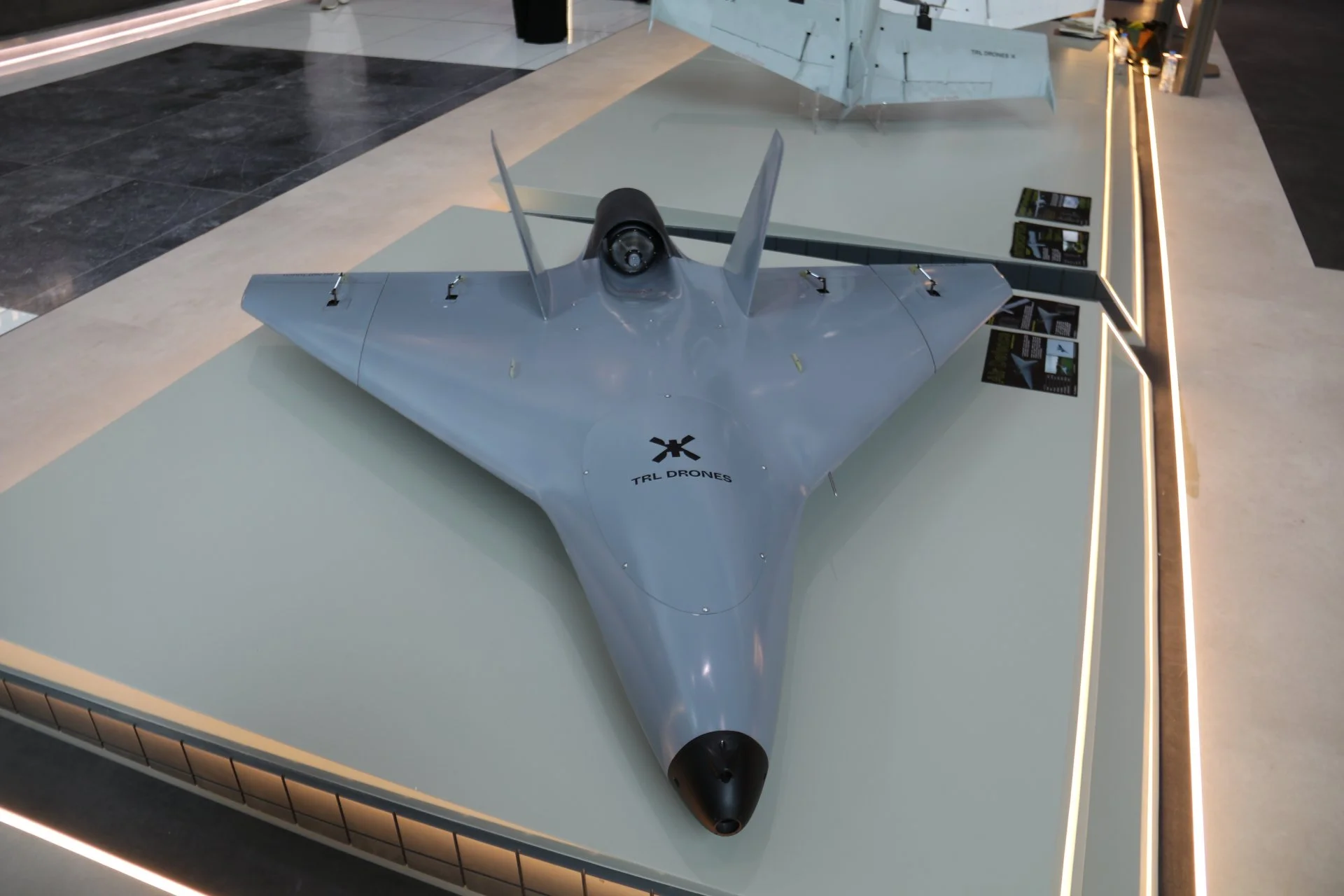
Czech high-speed fixed-wing air defense drone showcased by TRL Drones X during UMEX 2026 in Abu Dhabi, highlighting its rapid-launch capability and advanced AI-guided interception features. (Picture source: Army Recognition Group)
TRL Drones X’s unveiling marks a strategic move by the Czech defense sector into the domain of high-velocity unmanned aerial interceptors. Built with advanced aerodynamic contours and powered by AI-driven targeting systems, the drone promises rapid response, real-time threat analysis, and precision strike capability against aerial incursions in contested environments.
At the heart of this platform is a blend of high-performance engineering and modular operational design. The aircraft features a 1,740 mm wingspan and can carry payloads up to 10 kg, allowing it to integrate mission-specific sensors or kinetic payloads as needed. With a cruising speed of 450 km/h and a maximum flight speed exceeding 500 km/h, the UAV boasts the responsiveness needed for dynamic aerial engagements.
The drone’s endurance is marked at 45 minutes, supporting interception or reconnaissance missions within a tactical radius. Its effective range surpasses 200 kilometers, while a maximum operational ceiling of 4,500 meters gives it altitude superiority over low-flying threats. Though small in size, its performance envelope places it in a new category of fast-intercept drones designed to fill a growing gap in layered air defense systems.
At UMEX 2026, TRL Drones X demonstrated the UAV’s rapid catapult launch capability, enabling fast deployment in forward-operating conditions. Two launch images presented at the exhibition illustrated the platform’s takeoff procedure and in-flight maneuverability, underscoring its agility and responsive handling.
What sets this system apart is its AI-integrated guidance suite. The drone uses real-time data fusion to track and analyze aerial targets in congested or electronically degraded environments. This level of onboard autonomy allows it to make rapid navigation decisions, intercept intrusions with high accuracy, and re-task mid-flight if necessary. While its primary use is interception, TRL Drones X emphasized its adaptability for air-to-ground missions, suggesting future configurations may include loitering munition profiles or ISR roles.
The fixed-wing interceptor represents a timely solution amid rising concerns over drone swarms, low-cost loitering threats, and increasingly autonomous hostile aerial systems. As militaries worldwide race to adapt to faster, more numerous airborne threats, systems like TRL Drones X's new platform offer a nimble, high-speed countermeasure that can be integrated into both mobile and stationary air defense architectures.
While no formal procurement deals have been announced at the show, defense analysts note the growing interest from Middle Eastern and Eastern European militaries in compact UAV interceptors capable of defending high-value assets and border zones from irregular drone activity.
TRL Drones X’s platform could signal a shift toward lower-cost, high-speed interceptor drones that operate on the edge of the battlefield and can act autonomously within a broader AI-enhanced air defense network. More than a drone, it represents a tactical concept - one that blends speed, autonomy, and modular payload flexibility in a world where the front line is increasingly airborne.
For Army Recognition, this drone is not just another platform debuting at UMEX - it is a harbinger of a growing paradigm in UAV-based air defense, offering militaries a quick-reaction, AI-powered solution to the emerging drone warfare landscape.
Written by Alain Servaes – Chief Editor, Army Recognition Group
Alain Servaes is a former infantry non-commissioned officer and the founder of Army Recognition. With over 20 years in defense journalism, he provides expert analysis on military equipment, NATO operations, and the global defense industry.