







Breaking News







Australia's Matilda 1 stern landing vessel completes beach trials for US Marine Corps logistics.
The Australian-designed stern landing vessel Matilda 1 completed a successful stern-first beach landing and rapid powered withdrawal at Dundee Beach near Darwin on July 8, 2026, ahead of entering a three-year logistics lease with the U.S. Marine Corps. The tactical evaluation demonstrated the vessel's ability to lower its 12.7-meter-wide stern ramp, maintain positioning on the shoreline, and return to deeper water in less than 60 seconds without tug assistance. This test campaign directly supports the U.S. Marine Littoral Regiments by verifying a logistical transport solution capable of moving heavy vehicles and containerized supplies between dispersed coastal sites without relying on deep-water ports.
The 73-meter Matilda 1 features a 1,500-tonne deadweight capacity, a 550-tonne beaching payload, and a 4,000-nautical-mile operational range driven by a quad-screw diesel-electric propulsion system. Recent trials at Hudson Creek and Dundee Beach successfully validated the vessel's tri-hull stern geometry, which prevents seabed hull suction and protects steering gear during active dry-out and rapid beaching cycles.
Related topic: Australia begins sea trials of Stern Landing Vessel Matilda 1 for U.S. Indo-Pacific operations
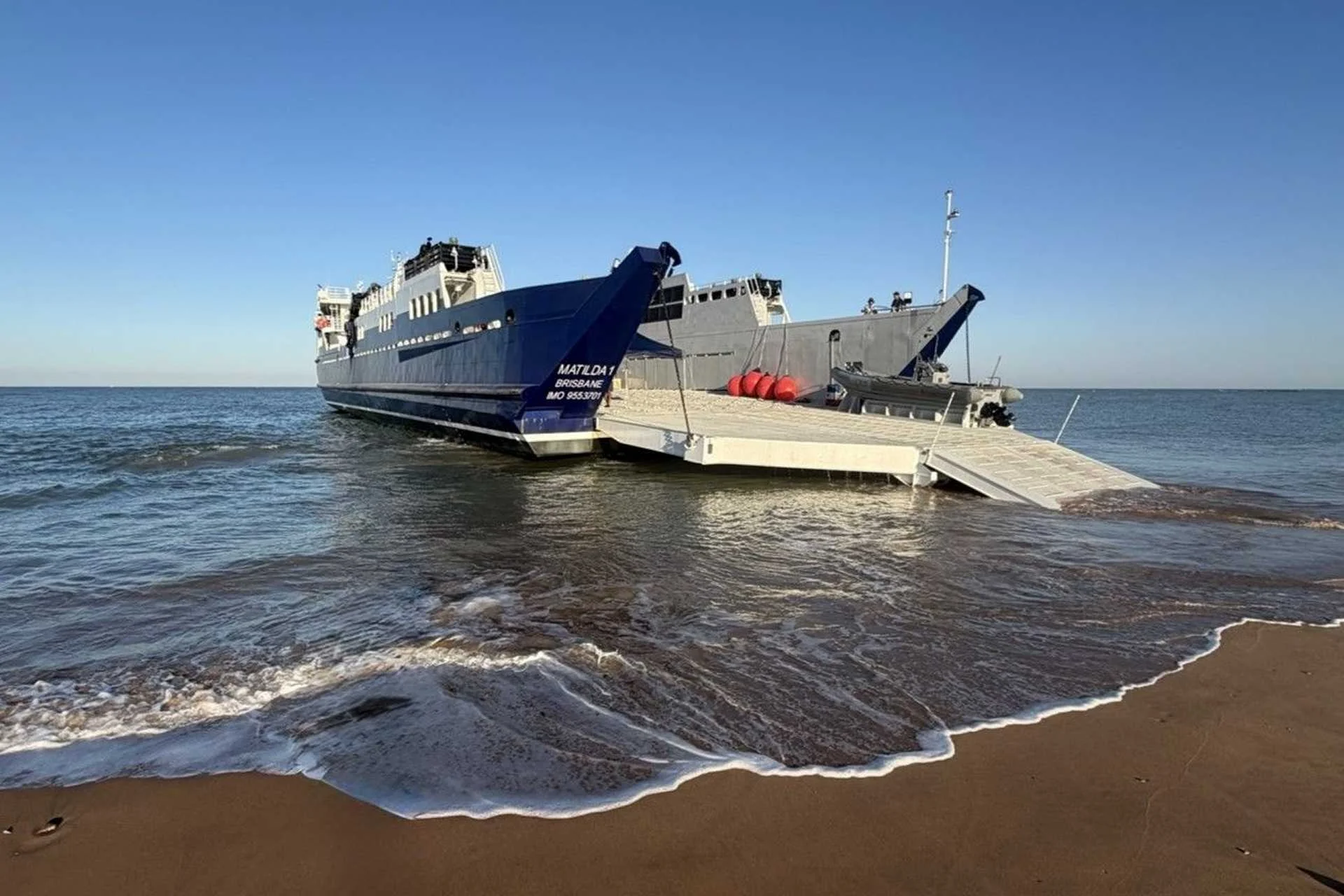
The stern landing arrangement addresses the hydrodynamic disadvantages of conventional bow-ramp craft, which normally combine a shallow draft, broad bow, and flat bottom to maximize beach access. (Picture source: Seatransport)
On July 8, 2026, the 73 m stern landing vessel Matilda 1 completed a stern-first beach landing and powered withdrawal at Dundee Beach, southwest of Darwin in Australia’s Northern Territory, before entering a three-year U.S. Marine Corps lease for Indo-Pacific logistics experimentation. As reported by Baird Maritime, the vessel reversed onto the shoreline, lowered its 12.7 m-wide stern ramp, maintained its position during a simulated unloading sequence, and returned to deeper water in less than 60 seconds. The operation followed dry-out berthing trials conducted one week earlier in the mangrove mudflats of Hudson Creek near Darwin, where the vessel settled onto soft sediment during a tidal cycle and subsequently refloated.
U.S. Marine Corps personnel participated in both trials, while Australian Defence Force personnel observed the vessel’s beach interface, hull behavior, propulsion protection and recovery sequence. The test campaign addresses a specific operational problem for U.S. Marine Littoral Regiments: transporting vehicles, ammunition, fuel, engineering equipment and containerized supplies between dispersed coastal positions without requiring a deep-water port, a large amphibious warship or a separate landing craft for the final movement ashore. During the Dundee Beach trial, the Matilda 1 approached the coast stern-first rather than grounding its bow, allowing the ship-shaped forward hull and bridge to remain oriented toward open water.
The crew used four independently driven propellers and the bow-thruster arrangement to control alignment during the reverse approach, then placed the stern ramp directly onto the beach. The ramp’s 12.7 m width is more than twice the 5 m to 6 m width found on many similarly sized bow-loading landing craft, while the absence of bow doors removes the overhead clearance restriction that can prevent tall vehicles, loaded container handlers or engineering machinery from passing through a conventional forward opening. After holding position for the simulated discharge, the vessel powered away from the shoreline in under one minute, a relevant measure because tide, wave action and sediment movement can rapidly change the grounding load acting on a ship.
The trial therefore examined not only beach access, but also the ability to repeat the landing cycle without tug assistance, mooring infrastructure or a rising tide to free the hull. The Matilda 1 (IMO 9553701) has an overall length of 73 m, a deadweight of 1,500 tonnes and an actual beaching payload of 550 tonnes. Its operational range is 4,000 nautical miles, equivalent to 7,408 km, which permits independent movement from northern Australia to much of Southeast Asia, Melanesia and the central approaches to the western Pacific without transport aboard another ship. The 670 m² cargo deck provides 42 TEU ground positions and can carry 84 twenty-foot ISO containers when double stacked, with longitudinal or transverse stowage depending on weight distribution and unloading order.
The deck can instead be configured for 20 JLTVs, 18 M142 HIMARS launchers, 16 MTVR trucks or 12 Amphibious Combat Vehicles. These are maximum single-type configurations rather than complete operational packages, since a deployable HIMARS detachment would also require rocket resupply vehicles, command-and-control equipment, maintenance assets, fuel and personnel. Permanent accommodation is provided for eight crew members, while up to 36 additional personnel can embark, giving the vessel capacity for vehicle operators, US Marines, communications teams, engineers and cargo-handling personnel. The hull architecture of this stern landing vessel (SLV) combines a conventional high bow for open-water transit with a tri-hull stern optimized for beaching.
Two side pods, off-center shafts and protective aft skegs surround the propulsion and steering equipment, limiting the risk of propeller, rudder or shaft damage when the stern enters shallow water or contacts an uneven seabed. Four fixed-pitch propellers are driven by four electric motors in a quad-screw diesel-electric arrangement, while six 450 kW diesel generators provide a total installed generating capacity of 2,700 kW. The electric motors incorporate thrust blocks and drive the shafts without conventional mechanical reduction gearboxes, reducing the number of transmission components exposed to shock, alignment changes and maintenance demands. Independent propulsion lines allow the crew to vary thrust across the stern during reversing, correct an angled approach and retain partial mobility after a single generator, motor or shaft failure.
The ship can achieve 85 percent of its designed speed in head seas at Sea State 5, a performance criterion directly related to its ability to maintain regional schedules in weather conditions that would significantly reduce the speed of flat-bottomed landing craft. The stern landing arrangement addresses the hydrodynamic disadvantages of conventional bow-ramp craft, which normally combine a shallow draft, broad bow and flat bottom to maximize beach access. Those characteristics increase resistance in open water, worsen pitching in head seas and can generate a strong suction effect when a large flat hull settles onto sand or mud. The Matilda 1 reduces the continuous bottom area exposed to the seabed by using two side pods and a central stern geometry that preserves water channels around the hull during withdrawal.
Its propellers remain inside protected areas behind the pods and skegs, including during an angled approach, rather than becoming the lowest exposed components near the shoreline. The vessel also trims primarily through fuel distribution instead of relying on large quantities of seawater ballast to maintain propeller immersion, reducing ballast system complexity and the volume of seawater transferred during beach operations. These features are intended to shorten the time between cargo discharge and withdrawal while limiting the risk that unloading changes the ship’s trim enough to trap the stern on the seabed. The Hudson Creek and Dundee Beach trials tested different phases of the same littoral logistics cycle.
At Hudson Creek, the vessel dried out in mangrove mudflats as the tide receded, placing the hull, side pods and protective stern structures under static bottom loads on soft sediment. This allowed assessment of settling angle, local hull loading, watertight integrity, machinery alignment and the ability to refloat without external assistance after the tide returned. At Dundee Beach, the test shifted to a powered stern approach, active station keeping, ramp deployment and rapid de-beaching from an exposed shoreline. Together, the trials covered conditions common across northern Australia and parts of the Indo-Pacific, including shallow coastal gradients, tidal variation, river mouths, soft mud, sand movement and limited hydrographic certainty close to shore.
The sequence also provided information on whether the vessel can use landing sites outside the narrow range of gradients and seabed conditions normally required by bow-ramp landing craft. The U.S. Marine Corps intends to use the Matilda 1 for expeditionary logistics and distributed sustainment during the three-year lease, with initial activity centered on northern Australia before wider regional employment. The service requires vessels able to move heavy equipment between shore positions supporting US Marine Littoral Regiments, including anti-ship missile batteries, sensors, communications equipment, aviation-support teams and mobile logistics nodes.
Before the Matilda 1, the US Marine Corps tested the concept with the HOS Resolution, an offshore support vessel converted with a large stern ramp, reinforced cargo deck, landing legs and protection for its propellers and rudders. The HOS Resolution supported evaluations of ramp gradients, beach interaction, vehicle compatibility and shore-to-shore movement during events including Project Convergence Capstone 4. The Matilda 1 provides a different test case because its hull, propulsion protection, deck arrangement and stern geometry were developed for repeated beaching rather than added to an existing offshore vessel.
The lease will allow direct measurement of cargo throughput, fuel consumption, crew requirements, loading time, maintenance burden, beach availability and mission completion rates against the converted-vessel approach. The Matilda 1 was designed by Queensland-based SeaTransport and built by Karimun Anugrah Sejati in Batam, Indonesia, before completing contractor sea trials, end-user acceptance trials, transit to Darwin, dry-out berthing and live beaching. The design evolved from Australian commercial stern landing vessels used for nearly three decades to deliver passengers, vehicles, livestock, containers and bulk cargo to remote communities, mining sites and coastal areas without developed ports, with more than 20 related vessels entering commercial operation.
The military configuration adds reinforced beaching structure, protected propulsion equipment, distributed machinery, multiple watertight compartments, a collision bulkhead and a military communications room adjacent to the bridge. The cargo deck is separated from the bow by watertight subdivision intended to limit free surface flooding after hull damage, while fuel is stored in isolated units with redundant pumps and self-contained fire suppression. The three-year evaluation will determine whether the vessel can sustain repeated logistics missions rather than merely complete individual demonstrations, with the decisive metrics including days available at sea, cargo delivered per operating day, fuel burned per tonne-nautical mile, ramp cycle time, maintenance hours per sailing hour, number of accessible beaches under representative tidal conditions, and the frequency with which weather or seabed conditions prevent planned landings.
Written by Jérôme Brahy
Jérôme Brahy is a defense analyst and documentalist at Army Recognition. He specializes in naval modernization, aviation, drones, armored vehicles, and artillery, with a focus on strategic developments in the United States, China, Ukraine, Russia, Türkiye, and Belgium. His analyses go beyond the facts, providing context, identifying key actors, and explaining why defense news matters on a global scale.
Explore More Defense News
• Land Defense News
• Naval Defense News
• Defense Aerospace News