
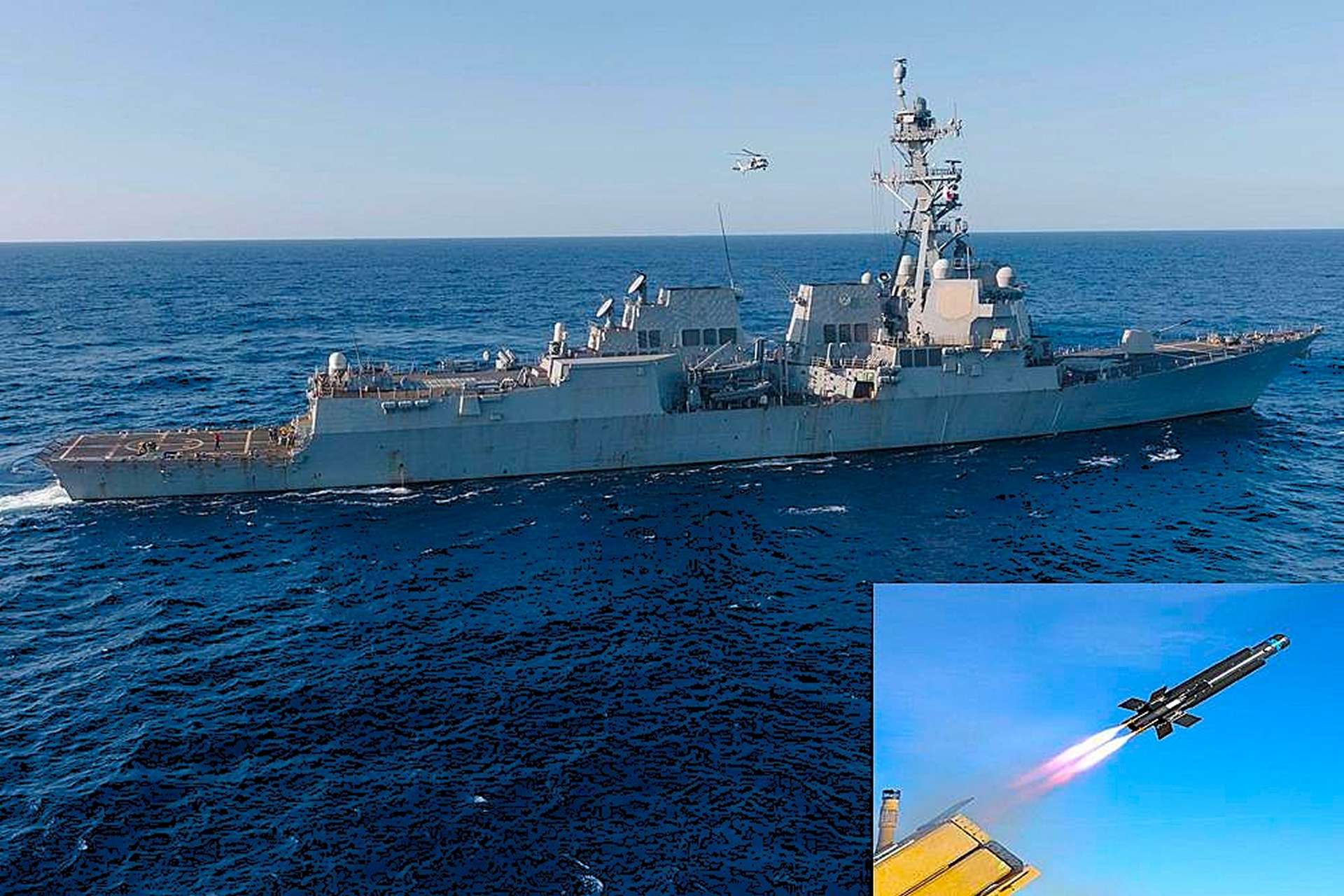










USS Bainbridge Destroyer Equipped with New Coyote Anti-Drone Launchers Signaling Major Shift in US Navy Fleet Defense.
On July 27, 2025, a photograph released by the US Navy via its DVIDS platform showed the presence of newly installed Coyote counter-drone launchers aboard the Arleigh Burke-class guided-missile destroyer USS Bainbridge (DDG 96). As noted by The War Zone on August 11, 2025, this is the first publicly available image confirming the system’s operational use on a destroyer. The picture, taken during a helicopter, board, search, and seizure drill in the Ionian Sea as part of NATO’s Neptune Strike exercise, provides a clear view of the installation in a real-world maritime setting. This addition reflects a growing shift within the US Navy toward countering unmanned aerial threats through more cost-effective and flexible defensive measures.
Follow Army Recognition on Google News at this link

The release of this image represents more than a visual update, it reflects an operational and doctrinal evolution in fleet defense. By adopting loitering interceptor technology, the Navy is adapting to a maritime threat environment where the boundaries between reconnaissance, attack, and massed drone saturation are increasingly blurred (Picture Source: US Army)
USS Bainbridge, a Flight IIA Arleigh Burke-class vessel assigned to the Gerald R. Ford Carrier Strike Group, is tasked with defending high-value naval assets in multi-domain operational environments. The Coyote interceptors, developed by Raytheon, are mounted near the aft Mk 41 Vertical Launch System cells and provide an additional protective layer against small, slow, and low-flying drones. Designed with loitering and maneuvering capabilities, these interceptors form part of a newer generation of ship-based counter-UAV systems meant to supplement the Navy’s long-range missile defenses.
The Coyote system has already been fielded extensively by the US Army, especially in its Block 2 form under the “Low, Slow, Unmanned Aircraft Integrated Disposal System” (LIDS) program. According to publicly available records, it has seen operational use in areas including the Middle East, Africa, and Europe, with documented engagements against drone threats. In comparison to long-range ship-launched interceptors such as the SM-2 Block IIIC and ESSM, which can cost around $2 million and $1.65 million per missile, the Coyote’s estimated $100,000 price tag offers a significant economic advantage. Its ability to remain airborne while searching for targets adds persistence to drone defense, allowing commanders to preserve more expensive munitions for high-priority threats.
From a strategic standpoint, integrating Coyotes on Arleigh Burke-class destroyers signals a recognition by the Navy that unmanned systems are becoming a primary maritime challenge. While surface-to-air missiles will remain essential for defending against larger aerial threats like cruise missiles and manned aircraft, they are not cost-efficient against large numbers of inexpensive drones. The Coyote launchers help bridge that gap, supporting continuous counter-drone coverage without depleting high-value missile inventories. This layered defense concept aligns with broader US military priorities for modular, scalable, and cost-conscious force protection, model that allied navies may find increasingly relevant.
The Navy has not formally stated whether Coyote launchers will be installed across the entire Arleigh Burke fleet, but images of a similar setup on USS Winston S. Churchill suggest that multiple ships are being evaluated. With Raytheon already under contract to supply Coyote Block 2 systems to the US Army, a naval procurement program could follow, potentially expanding the system’s role within the surface fleet.
The release of this image represents more than a visual update, it reflects an operational and doctrinal evolution in fleet defense. By adopting loitering interceptor technology, the Navy is adapting to a maritime threat environment where the boundaries between reconnaissance, attack, and massed drone saturation are increasingly blurred. USS Bainbridge now serves as a concrete example of how layered defense systems can balance cost-efficiency with operational readiness, a model that could guide future decisions on the armament of US surface combatants.