










US Navy Seeks to Transform Its Fleet with Armed Autonomous Modular Surface Drones.
As naval competition with China highlights the industrial and doctrinal limitations of the US Navy, the service has taken a decisive step in the transformation of its surface fleet by releasing, on July 28, 2025, an industry solicitation for the Modular Attack Surface Craft (MASC) program. Made public by the Program Executive Office Unmanned and Small Combatants (PEO USC), this initiative represents a strategic shift in the design and procurement of uncrewed surface vessels. It is based on a modular, flexible, and fast-track deployment model. The announcement was published on the official NAVSEA website in a solicitation open until August 11, aimed at gathering white papers and technical slide decks from industry stakeholders.
Follow Army Recognition on Google News at this link

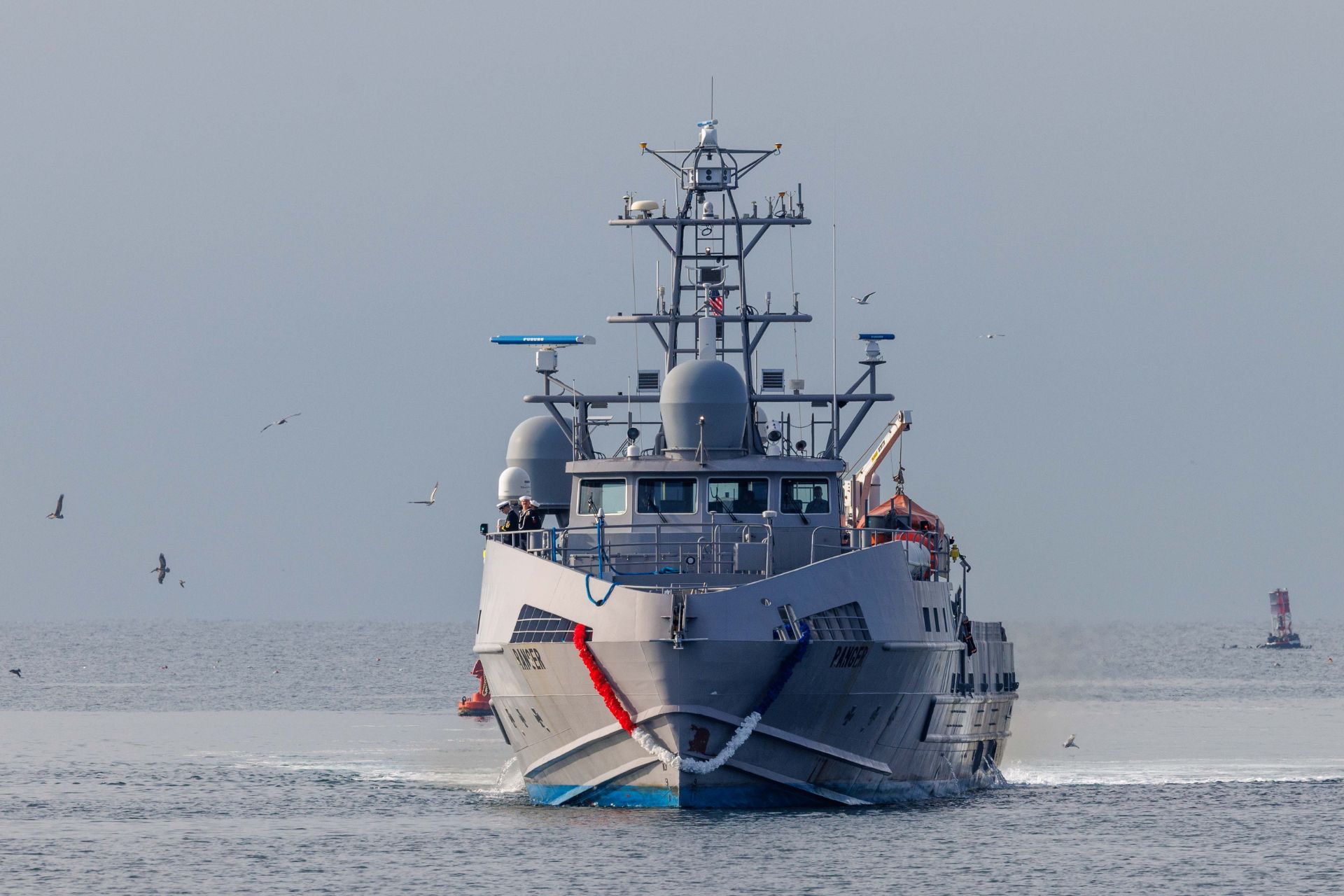
NAVSEA’s official release outlines the transformation logic underpinning the MASC initiative, emphasizing the opportunity for industry to co-develop viable solutions with the Navy that are deployable in the near term and adapted to 21st-century strategic challenges (Picture source: US DoD)
The MASC program seeks to consolidate previous experimental efforts involving Medium and Large Uncrewed Surface Vessels (MUSV and LUSV). Rather than continuing to develop separate categories based on vessel size, the Navy now favors a unified architecture built around ISO containerized payloads. This approach is intended to optimize platform versatility while simplifying large-scale production. The use of Other Transaction Agreements (OTA), a non-traditional acquisition mechanism, is expected to accelerate development by bypassing bureaucratic constraints and enabling integration of existing commercial technologies.
The Navy envisions this modularity to equip its fleet with a new generation of vessels capable of performing multiple missions, surface warfare, long-range strike, intelligence, electronic warfare, information operations, while reducing reliance on large, crewed, and costly platforms. The intent is to support distributed lethality and enhanced battlespace awareness through flexible, reconfigurable payloads.
NAVSEA’s official release outlines the transformation logic underpinning the MASC initiative, emphasizing the opportunity for industry to co-develop viable solutions with the Navy that are deployable in the near term and adapted to 21st-century strategic challenges. The solicitation highlights the need for speed, simplified production, cost control, and logistical agility. These features are meant to align with a distributed maritime operations doctrine that emphasizes dispersion, responsiveness, and platform redundancy.
The technical specifications provided in the contracting notice, analyzed in detail in an article published by The War Zone on July 31, confirm this direction. Three types of vessels are planned: a baseline version designed to carry two 40-foot ISO containers, a high-capacity version capable of carrying four, and a compact variant intended to carry a single 20-foot container. Each payload may weigh up to 36.3 metric tons (or 24 metric tons for the compact model) and consume up to 75 kilowatts of power, indicating compatibility with high-energy systems such as directed energy weapons or electronic warfare suites. Expected performance includes a minimum speed of 25 knots, a range of 2,500 nautical miles, and operational capability in Sea State 4, with Sea State 5 strongly preferred in more robust configurations.
These vessels must be capable of fully autonomous navigation without human intervention, even in cases of loss of communication, low visibility, or restricted radio emission environments. Compliance with international navigation regulations (COLREGS) is required. Automatic adjustment of electromagnetic emissions according to mission requirements is also part of the functional expectations. The goal is to create platforms capable of operating in contested or degraded environments without relying on continuous remote control.
The solicitation also specifies that the platforms should be producible within 18 months, quickly repairable using commercial standards, and capable of operating for extended periods without preventive maintenance. Exportability to allied forces and optional accommodation for a small crew are also mentioned as secondary but welcome features. These elements are intended to ensure interoperability with partner navies and provide added flexibility in lower-intensity missions.
The modular architecture also introduces tactical uncertainty for potential adversaries. By standardizing payloads within ISO containers, it becomes more difficult to determine whether a given platform is carrying weapons, jamming equipment, sensor suites, or an empty container. This ambiguity complicates enemy targeting decisions and contributes to operational unpredictability.
The MASC program builds on insights gained from current experimental platforms, including the Ranger, Mariner, Seahawk, Sea Hunter, and Defiant USVs, the latter developed by DARPA under the NOMARS initiative. Designed with a fully uncrewed philosophy, the Defiant already meets many of MASC’s baseline requirements. An enlarged derivative model called Dauntless is also under development, with expanded weapons capacity and integration of vertical launchers such as the Mk 70. This system has already demonstrated compatibility with missiles like the SM-6 and Tomahawk.
According to FY2026 budget documents, the Navy plans to begin a prototyping phase with support from the Defense Innovation Unit (DIU), using an incremental development model. The objective is to combine private sector agility, existing technologies, and the Navy’s operational expertise to deploy an operational fleet without delay. Ultimately, MASC is expected to become a central element of the Navy’s future force structure, offering an adaptable response to budgetary constraints, industrial challenges, and emerging threats.
By moving away from legacy frameworks, favoring modular standardization and autonomy, and relying on industry through streamlined acquisition models, the US Navy aims to make a strategic leap. MASC is not merely a technological development; it reflects a doctrinal evolution based on dispersion, responsiveness, redundancy, and cost efficiency. This transition is intended to materialize in upcoming fiscal cycles and will depend on industrial responsiveness and future operational decisions.