






Breaking News






US Navy air chief awaits decision on F/A-XX fighter jet to keep aircraft carriers dominant in future conflicts.
As reported by The War Zone on August 25, 2025, the US Navy’s F/A-XX program is at a critical juncture as naval leadership continues to stress its importance while budgetary and industrial uncertainties complicate its future. Vice Adm. Daniel Cheever, commander of Naval Air Forces, stated that the service is “eagerly awaiting” the downselect decision between Boeing and Northrop Grumman, the two remaining competitors after Lockheed Martin’s elimination in March 2025.
Follow Army Recognition on Google News at this link
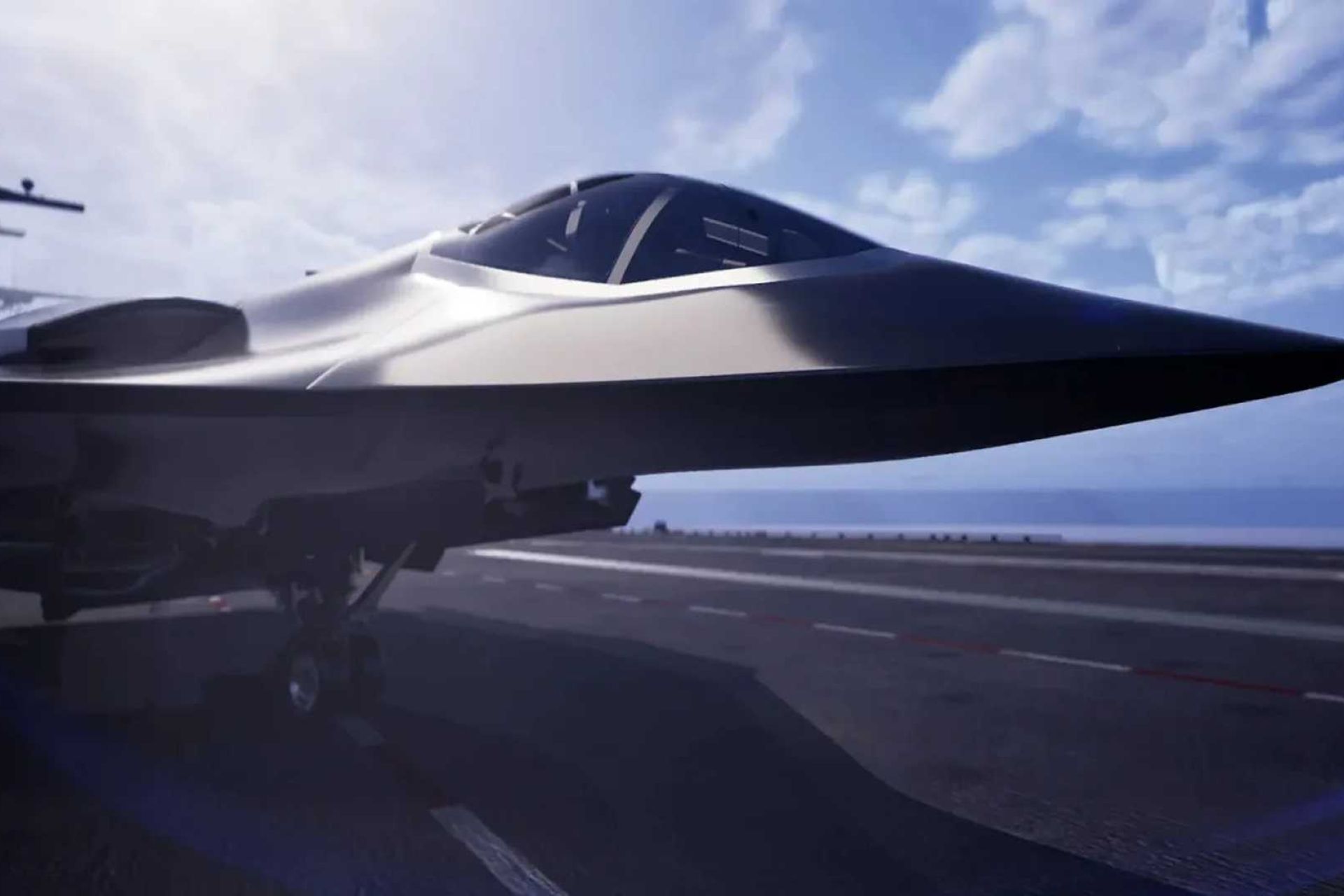
The latest rendering of the F/A-XX revealed a nose optimized for a large radar aperture, a bubble canopy suggesting a single-seat configuration, a robust twin-wheel nose landing gear suitable for carrier launches and recoveries, and a top-mounted intake on the fuselage spine that analysts described as a placeholder for a stealth-optimized design. (Picture source: Northrop Grumman)
The Pentagon’s fiscal year 2026 request allocated $74 million for F/A-XX to complete initial design work, but lawmakers have moved to reverse planned cuts, with the Senate Appropriations Committee advancing $1.4 billion and the House proposing $972 million. The Navy itself included $1.4 billion in its Unfunded Priorities List, underscoring the urgency of the program as the F/A-18E/F Super Hornet and EA-18G Growler approach the end of their service lives in the 2030s. Adm. Daryl Caudle, nominated as the next Chief of Naval Operations, told Congress that without a sixth-generation platform the Navy will be forced to extend fourth-generation aircraft and increase procurement of fifth-generation F-35Cs to compete against adversaries already flying sixth-generation aircraft.
The program has faced repeated delays and reversals. A contract award was expected soon after the Air Force selected Boeing’s F-47 as its Next Generation Air Dominance (NGAD) platform earlier in 2025, but the Navy’s effort was frozen to avoid competition for resources and concerns about the defense industrial base’s ability to handle two sixth-generation programs simultaneously. Industry leaders, however, have rejected claims that capacity cannot meet demand if both the F-47 and F/A-XX proceed. Cheever and other officials, including Adm. Caudle, emphasize that naval aviation must retain a balanced mix of fourth, fifth, and sixth-generation platforms to maintain both air superiority and sea control, which are considered inseparable for carrier strike group effectiveness. Statements from Cheever at the Tailhook Symposium and a subsequent Center for Strategic and International Studies event reinforced the Navy’s insistence that the program remain on track and that downselect is a high-level decision involving many stakeholders.
The requirement for F/A-XX dates back to 2008, with a formal request for information issued in 2012. It is defined as a multirole strike fighter to replace Super Hornets and Growlers and to complement the F-35C beginning in the 2030s, forming the crewed component of the Navy’s Next Generation Air Dominance (NGAD) family of systems. The service has identified a 25 percent range increase over current strike fighters as a target, with a combat radius exceeding 1,500 miles cited by analysts as necessary to operate from outside the range of advanced Chinese missiles such as the DF-21D anti-ship ballistic missile. Unlike the Air Force’s NGAD, which prioritizes air superiority, the Navy’s F/A-XX will emphasize long-range strike, surface warfare, survivability in anti-access/area denial environments, and integration with manned-unmanned teaming concepts. Secondary missions include aerial refueling, reconnaissance, electronic warfare, and intelligence, surveillance, and reconnaissance functions, reflecting its role as a modular strike fighter within a broader system-of-systems approach.
Northrop Grumman recently released official concept artwork showing the forward fuselage of its proposal with the phrase “Project Power Anywhere.” The rendering revealed a nose optimized for a large radar aperture, a bubble canopy suggesting a single-seat configuration, a robust twin-wheel nose landing gear suitable for carrier launches and recoveries, and a top-mounted intake on the fuselage spine that analysts described as a placeholder for a stealth-optimized design. Comparisons have been made to the YF-23 prototype from the Air Force’s Advanced Tactical Fighter competition, though the details remain speculative and may change. Boeing has released several notional designs since 2009, including a tailless configuration with manned and unmanned options, a blended wing-fuselage structure, and canards, with analysts noting that while canards can compromise frontal stealth signatures, software could mitigate those effects. Both manufacturers are expected to continue refining their designs as the Navy approaches its downselect decision.
The aircraft will need to integrate advanced technologies such as electronically configured “smart skins” with embedded sensors, open architecture mission systems, and artificial intelligence-assisted operations to enable greater connectivity across domains. F/A-XX is also expected to act as the quarterback for manned-unmanned teaming, coordinating Collaborative Combat Aircraft or “loyal wingmen” platforms. The Navy has described its intent to leverage the Air Force and Marine Corps’ CCA programs, including possible use of platforms such as Boeing Australia’s MQ-28 Ghost Bat. The program also emphasizes compatibility with carrier operations from both Nimitz-class and Gerald R. Ford-class carriers, and propulsion choices are being weighed between derivative turbofan designs, considered less risky for carrier use, and adaptive-cycle engines favored by the Air Force but viewed by the Navy as higher risk for deck operations.
Strategic analysis highlights the Indo-Pacific as the primary driver for the program, with China fielding long-range air-to-air missiles such as the PL-17, estimated at nearly 250 miles, compared to the AIM-120D’s 110 miles, and deploying layered air defense networks like the HQ-9B with a range of 155 miles. These threats, combined with anti-ship ballistic missiles capable of reaching 1,000 miles, place carrier strike groups at risk unless new aircraft extend operational reach and payload. Commentators argue that the F-35C’s internal weapons carriage limits its ability to carry long-range strike and air-to-air weapons, and that the F/A-18E/F lacks the range to operate effectively in this environment. Analysts compare the requirement to the F-14 Tomcat, which combined large radar capacity with long-range AIM-54 Phoenix missiles, suggesting that a similarly large carrier aircraft will be required for F/A-XX. Without such capabilities, the ability to fight into the first island chain would become more dangerous and uncertain.
The program’s timeline remains unsettled. The Navy received $454 million in FY2025 but only $76 million for FY2026, with Pentagon leaders prioritizing the Air Force’s F-47. Congress, however, has moved to restore funding through appropriations bills, while the Navy itself has stressed urgency by placing $1.4 billion on its Unfunded Priorities List. The Navy’s last new Super Hornets are scheduled for delivery in 2027, after which the service expects to rely increasingly on F-35Cs until F/A-XX can enter service in the 2030s. Some reporting indicates that a decision may be expected around 2028 if funding stabilizes. In parallel, naval aviation is pursuing replacement of the T-45 trainer and longer-term options beyond the MH-60R/S helicopters, which highlights that F/A-XX sits within a broader modernization cycle for the carrier air wing. Northrop Grumman has left the Air Force’s NGAD program to concentrate on F/A-XX and the B-21 bomber, while Boeing continues its dual role as F/A-XX competitor and F-47 prime contractor, keeping industrial considerations at the forefront.
Debates continue over whether F/A-XX should remain a multirole fighter or transition toward a dedicated attack aircraft, sometimes described as “A-XX.” Naval officers and analysts who support the latter argue that prioritizing range, payload, and survivability over maneuverability better fits the Indo-Pacific operational environment. Historical examples such as the A-3 Skywarrior, A-6 Intruder, and A-5 Vigilante showed that large attack aircraft could evolve into versatile platforms for refueling, electronic warfare, and reconnaissance. Advocates suggest an A-XX could similarly become a modular platform with multiple roles while preserving deep-strike capabilities. Others counter that the F/A-XX must retain multirole functionality to provide flexibility across mission sets. The debate underscores the broader uncertainty surrounding the program’s future, which depends on Congressional funding decisions, Pentagon priorities, industrial base capacity, and the Navy’s ability to align modernization of its carrier air wings with a contested strategic environment.