


HMS Prince of Wales and INS Vikrant conduct Exercise Konkan 25 in the Indian Ocean, marking the first dual carrier operations between the UK and India to enhance interoperability, air defense coordination, and maritime strike capabilities amid growing Indo-Pacific tensions (Picture source: UK Ministry of Defence).




Breaking News






UK and Indian navies stage first-time dual-carrier drills amid Indo-Pacific tensions.
The UK’s HMS Prince of Wales and India’s INS Vikrant have begun Exercise Konkan 2025 in the western Indian Ocean, the first time both nations have deployed full carrier strike groups together. The high-end drills highlight growing Indo-Pacific cooperation as London and New Delhi deepen maritime ties amid regional tensions.
The British High Commission in New Delhi announced on October 6, 2025, that the United Kingdom’s Carrier Strike Group led by HMS Prince of Wales has begun Exercise Konkan alongside the Indian Navy’s carrier-led formation built around INS Vikrant in the western Indian Ocean, the first instance of both nations deploying full carrier strike groups to train together. The four-day evolution blends air and maritime events, including submarine participation, and follows months of UK activity in the Indo-Pacific under Operation Highmast.
Follow Army Recognition on Google News at this link
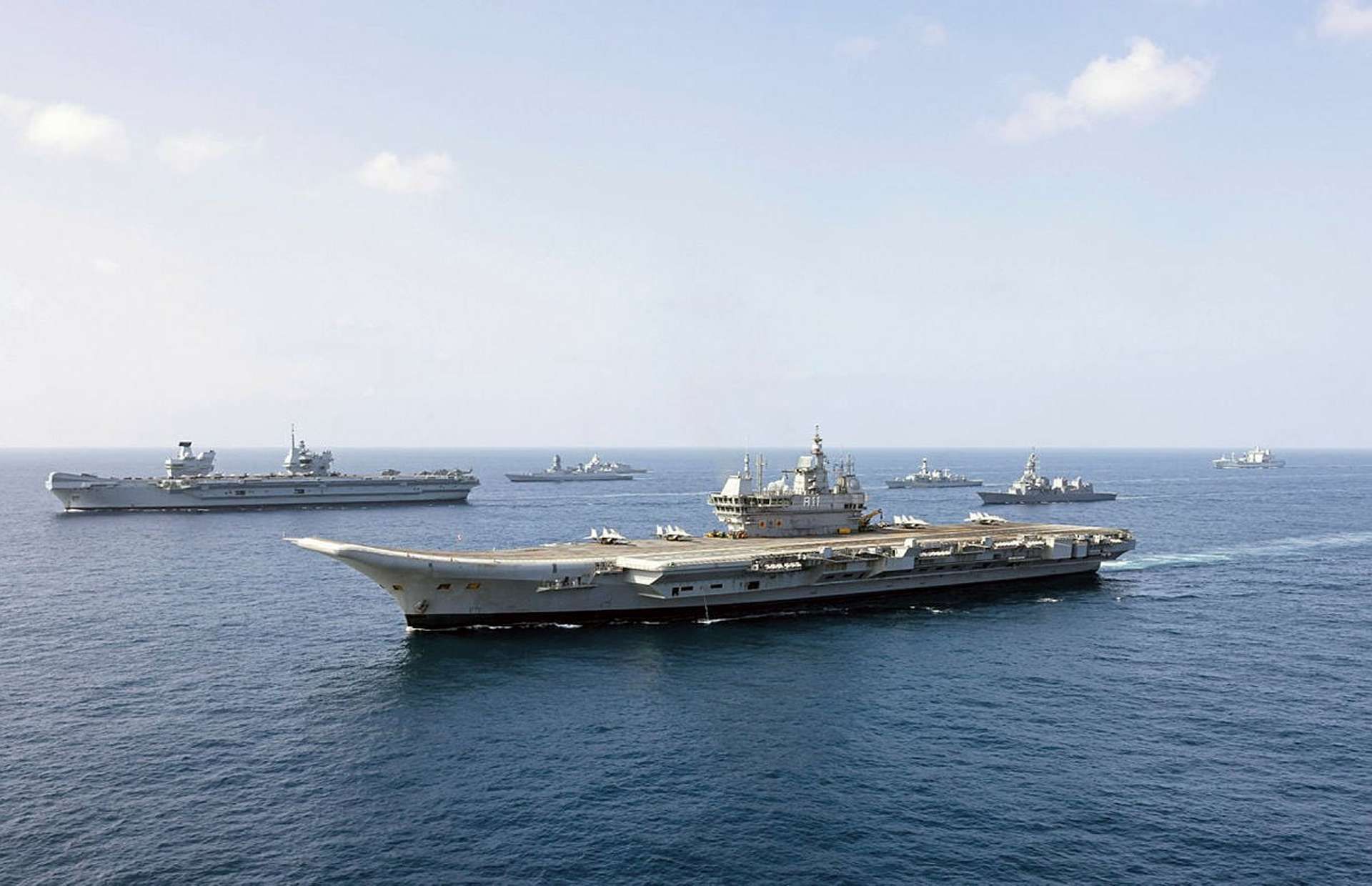
HMS Prince of Wales represents the Royal Navy’s 65,000-ton Queen Elizabeth class, with a 280-meter by 70-meter flight deck designed around short takeoff and vertical landing F-35B operations and a rotary mix led by Merlin helicopters. The ship’s air picture is built on the Type 997 Artisan 3D radar, while the task group now fields the Merlin HM.2 Crowsnest airborne surveillance system at full operating capability, restoring long-range early warning from the carrier deck. Defensive fit focuses on layered soft- and hard-kill protection anchored by Phalanx CIWS, with 30 mm mounts and a reliance on escorts for area air defense. The RN lists a surge capacity of up to 36 F-35Bs aboard the class, though typical peacetime loads are lower.
INS Vikrant, by contrast, is India’s indigenous 45,000-ton IAC-1, 262 meters long and 62 meters wide, using a ski-jump and arresting gear to launch and recover fighters under a STOBAR model. Propulsion comes from four GE LM2500+ gas turbines, and after a 2023–24 guarantee refit the carrier has been reported with EL/M-2248 MF-STAR AESA radar and Barak-8 medium-range SAM capability to strengthen organic self-defense. Vikrant currently embarks MiG-29K fighters and MH-60R Seahawks, with 26 Rafale M on order to backfill and expand the air wing later this decade. The program also symbolizes India’s industrial climb, with high indigenous content in structure and systems.
Konkan 25 lets both navies pressure-test the connective tissue of carrier warfare: composite air-maritime pictures, mutual air defense, and anti-submarine prosecution across a large water space. On the UK side, Crowsnest provides long-range detection and control cues to F-35Bs and Merlin HM.2s, while Indian MH-60Rs bring ALFS dipping sonar and APS-153 radar to prosecute subsurface threats with the P-8I Neptune extending wide-area search and strike. Because the carriers launch different aircraft types and methods, the payoff is not cross-decking jets but synchronizing deck cycles, datalinks, and deconfliction so escorts and aircraft mass effects at range. That is how two strike groups turn sensors and shooters into a single, fused scheme of maneuver.
The twin-CSG construct complicates any adversary’s targeting problem and shortens kill chains. A STOVL group can sprint and posture for strike while the STOBAR group maintains sustained cyclic sorties, both screened by AEW helicopters and outer-layer fighters. The UK’s F-35B sensor fusion and India’s maturing carrier aviation bring complementary strengths, and the presence of Barak-8 on Indian units and Phalanx on the British flattop illustrates a coherent inner-layer shield when working inside the same air defense umbrella. In practice, that means faster cueing to shooters, better redundancy against attrition, and a larger defended footprint over key sea lanes.
This exercise sits squarely in London’s Indo-Pacific “tilt” and the India-UK Vision 2035 roadmap that elevates maritime security cooperation and commits both to co-lead elements of India’s Indo-Pacific Oceans Initiative. It also lands amid a busier and more contested Indian Ocean where Chinese naval presence, research vessels, and dual-carrier drills in adjacent waters have sharpened New Delhi’s sense of urgency. For both democracies, demonstrating two carrier groups operating in concert signals the capacity to uphold open sea lines from the Arabian Sea to the Malacca chokepoints and to deter coercion without formal alliances.
Written by Evan Lerouvillois, Defense Analyst, Army Recognition Group.
Evan studied International Relations, and quickly specialized in defense and security. He is particularly interested in the influence of the defense sector on global geopolitics, and analyzes how technological innovations in defense, arms export contracts, and military strategies influence the international geopolitical scene.