






Breaking News





U.S. Navy SEALs rehearse live fire carrier defense missions from MH-60S helicopters.
U.S. Naval Special Warfare operators conducted a live fire demonstration with the carrier USS George H. W. Bush during the Titans of the Sea Presidential Review in the Atlantic. The event highlighted how SEAL teams, destroyers, and carrier aviation now train as one combat system for contested maritime environments.
U.S. Navy officials used this year’s Titans of the Sea Presidential Review to showcase an integrated, live fire rehearsal that pulled together East Coast SEAL teams, Arleigh Burke-class destroyers, and air assets operating around the Nimitz-class carrier USS George H. W. Bush. According to information released through DVIDS, the tightly choreographed scenario gave senior leaders a front-row look at how Naval Special Warfare units plug directly into fleet operations when a carrier strike group must control crowded waters and close on suspect vessels under real-world conditions.
Follow Army Recognition on Google News at this link
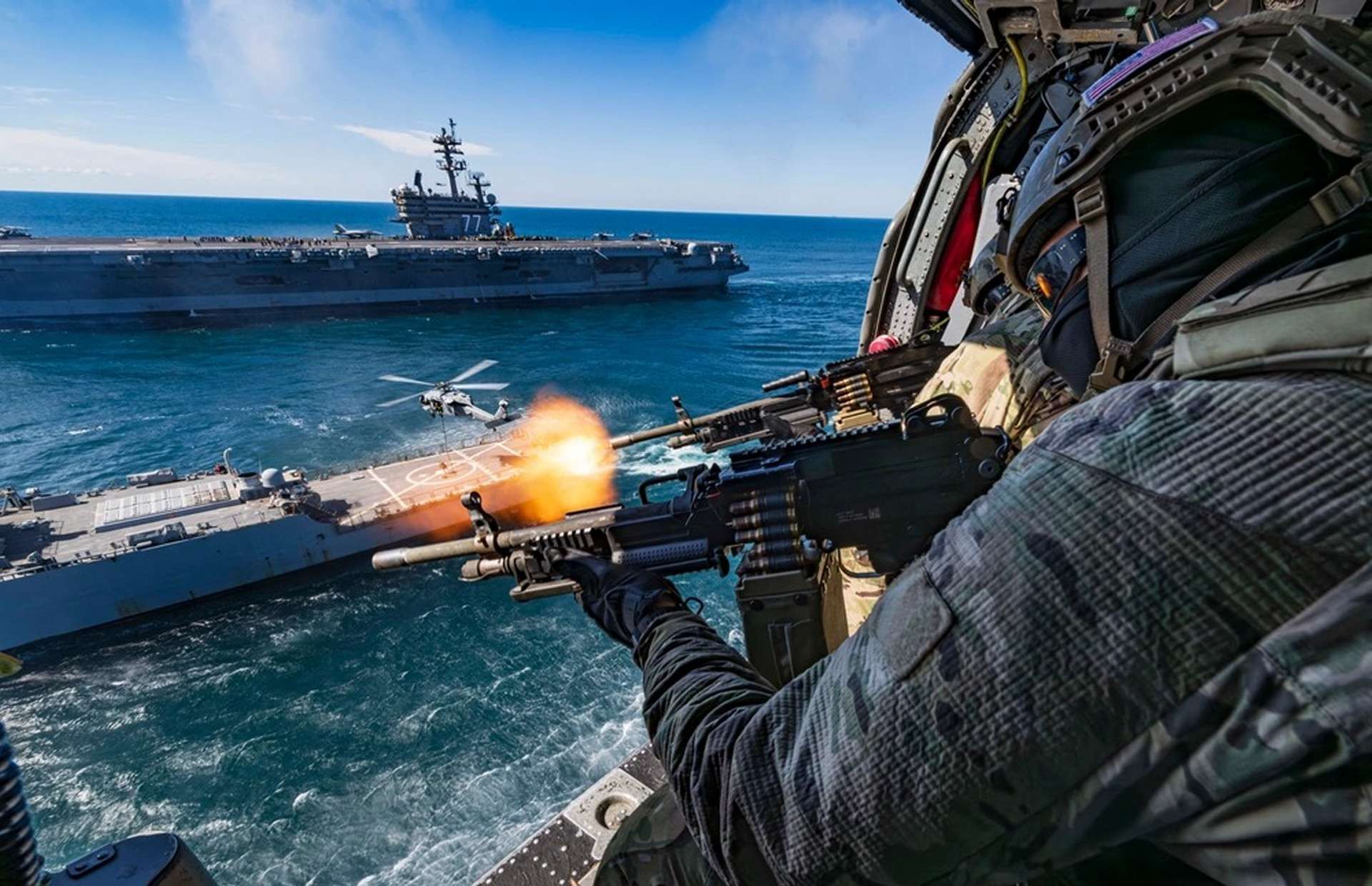
U.S. Navy SEALS fire from an MH-60S Seahawk during the Titans of the Sea Presidential Review, conducting live-fire gunnery over an Arleigh Burke-class destroyer as part of a Navy 250 demonstration showcasing integrated special operations and carrier strike group capabilities (Picture source: U.S. Navy).
In the featured segment, SEALs fired from an MH-60S Seahawk of Helicopter Sea Combat Squadron 11, the Dragonslayers, while the aircraft maneuvered over an Arleigh Burke-class guided missile destroyer executing a visit, board, search, and seizure scenario. Imagery from the event shows operators working from the helicopter and aboard the destroyer USS Ross, underscoring how Naval Special Warfare plugs directly into fleet surface warfare and maritime interdiction missions under a carrier air umbrella.
The scenario unfolded inside a crowded, live-fire battlespace controlled by Carrier Strike Group staff and U.S. 2nd Fleet. Destroyers, embarked air assets, and SEAL elements rehearsed the kind of tightly sequenced movements that would be required to screen a carrier, neutralize fast inshore attack craft, and support boarding teams closing on suspect vessels. For commanders, the review doubled as a rehearsal for complex command and control, with real aircraft, warships, and munitions operating in proximity under strict safety boundaries.
From the Naval Special Warfare perspective, Titans of the Sea was a live laboratory for Group TWO, which generates and deploys East Coast SEAL teams for maritime task forces. Operators refined communications procedures with fleet helicopters, practiced aircraft safe arcs and weapons discipline from an unstable firing platform, and rehearsed rapid transition from overwatch to boarding actions on the destroyer’s deck. These are the same skill sets SEALs apply in counter-piracy, counter-proliferation, and high-end sea control missions.
The centerpiece aviation asset was the MH-60S Seahawk, a multi-mission maritime helicopter with a maximum speed of about 180 knots and a typical range near 245 nautical miles, depending on load. In Naval Special Warfare support, the MH-60S is commonly outfitted with GAU-21/A .50 caliber heavy machine guns on the cabin doors, delivering roughly 950 rounds per minute out to nearly 1,850 meters, as well as M240D 7.62 mm machine guns where more controlled, precision fire is required. This mix allows crews to suppress small craft, punch through light cover, or provide discriminate overwatch for boarding teams closing on a contact of interest.
SEAL shooters typically complement the helicopter’s guns with their own small arms. In similar maritime profiles, teams field MK48 Mod 1 7.62 mm light machine guns developed for U.S. special operations forces, MK46 5.56 mm light machine guns for lower recoil and tighter control in confined spaces, and M4A1 carbines fitted with SOPMOD Block II optics, infrared lasers, and suppressors. Configured this way, a SEAL element moving from cabin to deck can shift seamlessly from area suppression to precision shots against exposed threats on a target vessel.
On the surface, Arleigh Burke-class destroyers provided the hard edge of the live fire perimeter. Their Mk 41 Vertical Launch System can host Standard Missiles for fleet air defense, Evolved Sea Sparrow Missiles for point protection, Tomahawk land attack missiles, and Vertical Launch ASROC for anti-submarine warfare, while the Mk 45 Mod 4 five-inch/62 caliber gun delivers rapid naval gunfire out to beyond 20 kilometers with modern ammunition. Close in, Phalanx 20 mm CIWS, Mk 38 25 mm autocannons, and crew-served .50 caliber and 7.62 mm mounts give the destroyers the layered short-range firepower now proven effective against drones and small boats.
USS George H. W. Bush functioned as the command and control hub. The carrier is armed with Mk 29 launchers for RIM 162 Evolved Sea Sparrow Missiles, RIM 116 Rolling Airframe Missile launchers, and multiple Phalanx CIWS mounts, forming a protective bubble around the flight deck and strike group. While the DVIDS segment highlights MH-60S and SEALs, the ship’s embarked air wing normally includes F/A-18E/F strike fighters, E-2D airborne command and control aircraft, and MH-60R anti-submarine helicopters, giving commanders options across the kill chain from early warning to precision strike.
For defense planners, the Titans of the Sea Presidential Review was far more than a ceremonial anniversary pass. It placed high-value units, escorts, and special operations forces into a single, heavily instrumented scenario that stress tested distributed maritime operations, resilient C2, and layered defense at sea against a backdrop of growing anti-access and area denial capabilities.
By tying Navy 250 celebrations to demanding live fire evolution, the U.S. Navy and Naval Special Warfare community signaled that public demonstrations still serve a hard operational purpose. U.S. SEALs, carrier aviation, and guided missile destroyers are training together as an integrated maritime strike and interdiction system, optimized for the next contested ocean, not the last one.