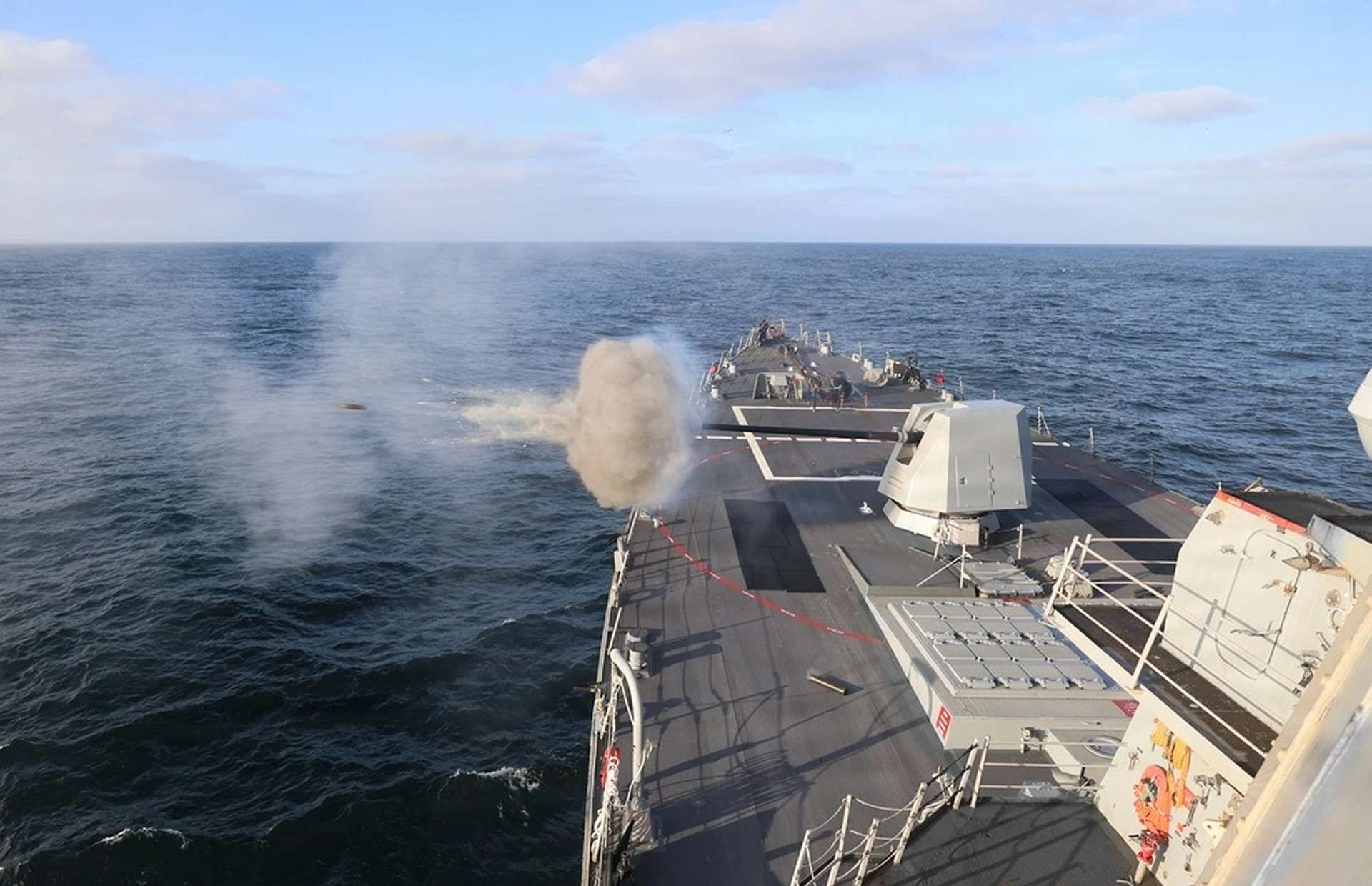
USS Paul Ignatius carried out a forceful Naval Surface Fire Support drill in the Atlantic while deployed under U.S. Sixth Fleet. The event highlighted the Navy’s push to maintain affordable, sustained firepower as missile stockpiles and contested littorals shape modern planning.
On December 4, 2025, the Arleigh Burke class guided missile destroyer USS Paul Ignatius (DDG 117) executed a forceful Naval Surface Firing Support live fire in the Atlantic Ocean while deployed in the U.S. Sixth Fleet area of operations. The event underscored the ship’s role as a forward-positioned combatant capable of delivering precise naval gunfire across Europe and Africa. During the drill, Paul Ignatius shifted from quiet patrol to deliberate action, using its Mk 45 naval gun to engage training targets under operational conditions that mirrored real-world tasking.
Follow Army Recognition on Google News at this link
USS Paul Ignatus (DDG 117) conducts a Naval Surface firing Support live fire in the Atlantic, showcasing the destroyer's readiness and the continued relevance of 5-inch naval gunfire during Sixth Fleet operations (Picture source: U.S. DoW).
The Arleigh Burke class destroyer represents one of the most technically advanced and combat-proven surface combatants in the U.S. Navy, built around the powerful Aegis Combat System and the AN/SPY radar that enables simultaneous tracking of air, surface, and ballistic threats. USS Paul Ignatius, a Flight IIA variant, carries a 96-cell Vertical Launch System capable of firing Standard Missiles, Tomahawk land attack weapons, and ASROC anti-submarine rockets, giving the ship deep strike, area air defense, and undersea warfare reach in a single platform. Its propulsion comes from four General Electric LM2500 gas turbines driving the ship to speeds above 30 knots, while an integrated suite of hull-mounted and towed array sonars provides persistent undersea surveillance.
The destroyer’s Mk 45 5-inch gun adds versatile fire support from coastal bombardment to counter drone use, complemented by the Mk 15 Phalanx close-in weapon system for point defense. Designed for survivability through extensive compartmentalization, armored bulkheads, and reduced radar cross-section shaping, the ship operates as a multi-mission node capable of independent action or integration into carrier strike groups, amphibious task forces, and NATO combined operations.
Sailors aboard the destroyer conducted the firing sequence while maintaining the maneuvering profile and communication tempo expected of a deployed warship. The emphasis was on tightening the connection between the bridge, the combat information center, and the gun mount team to ensure rapid call for fire computation and adjustment. The Atlantic scenario demanded that the crew demonstrate not only marksmanship but also the multitasking agility that defines the Arleigh Burke class, a ship expected to conduct air defense, surface warfare, and limited ballistic missile defense while delivering effects ashore.
For a Navy increasingly defined by missile salvos and counter-drone engagements, the return of attention to heavy naval guns signals a shift rooted in practicality. U.S. and NATO planners have warned that extended conflicts could strain high-end missile inventories. In such cases, sustained, low-cost firepower delivered by naval artillery becomes a strategic asset. Analysts at RAND have noted that in dense littoral environments where coastal defenses and unmanned systems proliferate, the responsiveness and magazine depth of naval guns fill a crucial gap that precision missiles alone cannot solve. The Paul Ignatius shoot provided a visible demonstration that the Navy is not allowing this traditional capability to atrophy.
The destroyer’s operational pedigree reinforces that message. Forward deployed to Rota, Spain, Paul Ignatius serves under the Sixth Fleet framework that positions U.S. surface forces close to potential flashpoints from the Mediterranean to the North Atlantic. Regular patrols bring the ship into joint and allied exercises where gunnery remains a core component of combined operations. Officers in the region have repeatedly stated that credible deterrence depends on tangible demonstrations of readiness at sea.
Central to that readiness is the Mk 45 5-inch gun. Although overshadowed by the radar arrays and missile cells that dominate an Arleigh Burke silhouette, the gun continues to prove its value in real-world operations. NATO crews have used similar systems to counter small surface threats and drones at far lower cost than expending advanced interceptors. With a firing rate approaching twenty rounds per minute and deep ammunition stores, the Mk 45 offers a level of sustained fire that missile-based systems cannot match.
Navy leaders have long pushed for realistic live fire training as a non-negotiable component of forward deployment. Exercises such as this one fold destroyers into the broader architecture of joint fires, supporting concepts like distributed maritime operations and integrated deterrence. In an era defined by stockpile management and contested littorals, the Atlantic live fire by Paul Ignatius serves as a reminder that the steel gun barrel on a destroyer deck remains a relevant instrument of American sea power.