






Breaking News






U.S. Conducts Two More Lethal Strikes on Drug-Smuggling Boats in Eastern Pacific.
U.S. Secretary of War Pete Hegseth announced on November 10, 2025, that American forces conducted two lethal strikes a day earlier against suspected drug-smuggling vessels in the Eastern Pacific. The Pentagon has not confirmed the operation, which Hegseth said killed six people and caused no U.S. casualties.
U.S. Secretary of War Pete Hegseth stated on November 10, 2025, that the U.S. had launched two lethal strikes the day before against vessels suspected of drug trafficking linked to terrorist groups. He reported six killed, three per vessel, all under President Trump's direction. The Pentagon has not confirmed the operation or released further details.
Follow Army Recognition on Google News at this link
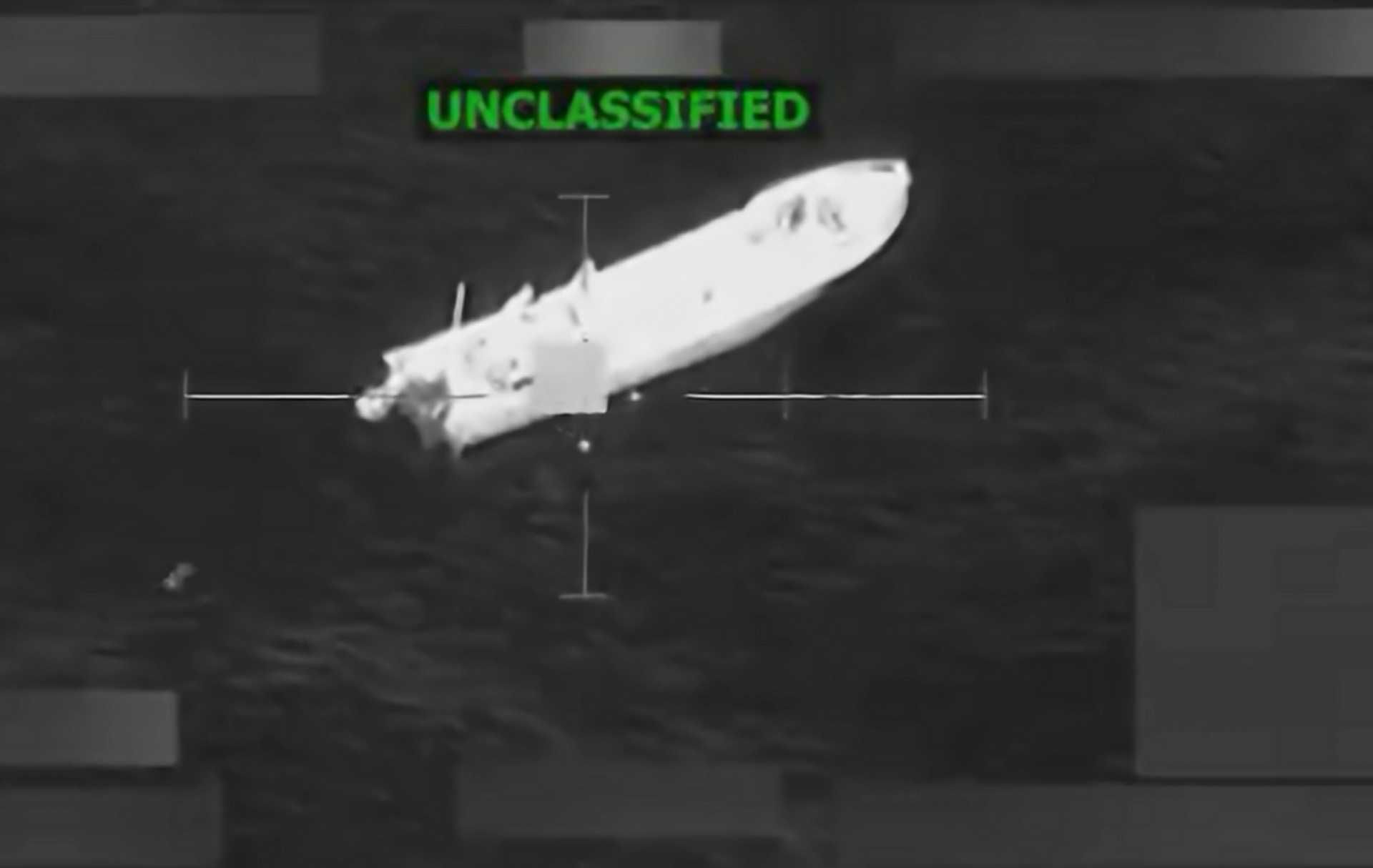
Suspected narco-trafficking vessels operated by designated terrorist groups were seen transiting a known smuggling corridor in the Eastern Pacific shortly before being targeted in U.S. military strikes authorized by President Trump on November 9, 2025. (Picture source: U.S. Department of War)
According to U.S. intelligence, two vessels navigated a known narcotics corridor in international waters. Surveillance confirmed drug transport by hostile actors linked to terrorist-designated criminal networks. Authorities struck after confirming the vessels threatened national security by trafficking narcotics toward the U.S. mainland.
Secretary Hegseth stated that intelligence identified the vessels in advance and that the boats, carrying three male operatives each, were engaged in active smuggling. All operatives were killed instantly in the strikes. No American forces were harmed. He emphasized that the action was carried out in defense of the homeland, under President Trump's orders to eliminate individuals who intended to harm the United States and its citizens.
This operation reflects a significant shift in U.S. national security doctrine under President Trump, who has declared that drug cartels are not merely criminal enterprises but terrorist networks that must be confronted with military force. Since returning to the office in January 2025, the president has issued a series of executive directives reclassifying transnational drug cartels as terrorist threats. This legal redefinition has enabled the Department of Defense to engage cartel-linked actors under wartime authorities, thereby bypassing the restrictions imposed by traditional law enforcement frameworks.
President Trump has described the flow of narcotics into the United States as a national emergency. He has said in many public statements that cartels are carrying out an indirect form of warfare through the mass export of synthetic opioids and fentanyl precursors. His administration’s position is that if these organizations are responsible for the deaths of tens of thousands of Americans, then they are an armed threat that warrants preemptive lethal force.
Selecting the Eastern Pacific as the strike zone suggests that U.S. intelligence has identified a strategic shift in cartel logistics. While previous military interdictions focused heavily on the Caribbean and Central American corridors, smuggling operations have increasingly moved westward into the open waters of the Pacific. This change has prompted the deployment of advanced maritime surveillance assets and increased naval presence across the region to detect and strike high-value trafficking targets before they can reach North American coastlines.
Military analysts see this approach as a hybrid warfare model applied to counter-narcotics. It blends intelligence-driven targeting, long-range surveillance, and precision strikes. The goal is to dismantle smuggling infrastructure while denying the cartels freedom of movement. This policy shift is expected to accelerate defense spending on maritime ISR platforms, unmanned aerial systems, and low-collateral kinetic weapons optimized for naval interdiction missions.
The Department of War has not disclosed which platforms were used in the November 9 strikes. Defense sources suggest that long-endurance drones, like MQ-9 Reapers equipped with maritime targeting sensors, played a central role. The vessels were likely tracked in real time by a layered intelligence network. Targeting packages were confirmed before engagement.
This strategy is more than a tactical innovation. It marks a political and operational redefinition of the U.S. approach to the drug crisis: shifting from a law enforcement-focused policy to a militarized response. By declaring a military campaign against drug trafficking organizations, the Trump administration initiated a long-term conflict, broadening the rules of engagement beyond national borders and traditional definitions of criminal activity.
Diplomatic consequences are possible, especially with Latin American coastal states concerned about U.S. military action in nearby international waters. The administration, however, maintains that the urgency of the narcotics threat justifies preemptive action wherever hostile actors are identified.
For the U.S. defense community, this new mission profile requires faster integration into the kill chain, deeper ISR penetration across maritime zones, and real-time intelligence fusion. Defense contractors involved in maritime domain awareness, precision-guided strike systems, and counter-terror targeting solutions are expected to play a growing role in supporting this campaign.
Army Recognition will continue to monitor developments as the Pentagon expands its campaign against narco-terrorist organizations across the Eastern Pacific and beyond. This signals a new era in the intersection of defense operations and transnational criminal disruption.
Written by Alain Servaes – Chief Editor, Army Recognition Group
Alain Servaes is a former infantry non-commissioned officer and the founder of Army Recognition. With over 20 years in defense journalism, he provides expert analysis on military equipment, NATO operations, and the global defense industry.
Yesterday, at the direction of President Trump, two lethal kinetic strikes were conducted on two vessels operated by Designated Terrorist Organizations.
— Secretary of War Pete Hegseth (@SecWar) November 10, 2025
These vessels were known by our intelligence to be associated with illicit narcotics smuggling, were carrying narcotics, and… pic.twitter.com/ocUoGzwwDO