






Breaking News






U.S. Companies Lockheed and Saildrone Team Up to Weaponize Sea Drones With JAGM Missiles.
Lockheed Martin announced a $50 million investment in Saildrone and will act as lead mission integrator to field weaponized unmanned surface vessels, with on-water live-fire demonstrations slated for 2026.
Lockheed Martin announced via its newsroom on October 29, 2025, alongside a message by Saildrone CEO Richard Jenkins on the same day, that the company will invest 50 million dollars in Saildrone and act as lead mission integrator to field weaponized unmanned surface vessels, with on-water live-fire demonstrations planned in 2026. Near-term work starts with marinizing Lockheed’s JAGM Quad Launcher on the 22-meter Saildrone Surveyor; larger Saildrone hulls now in development are being sized for the Mk 70 containerized vertical launcher and thin-line towed arrays.
Follow Army Recognition on Google News at this link
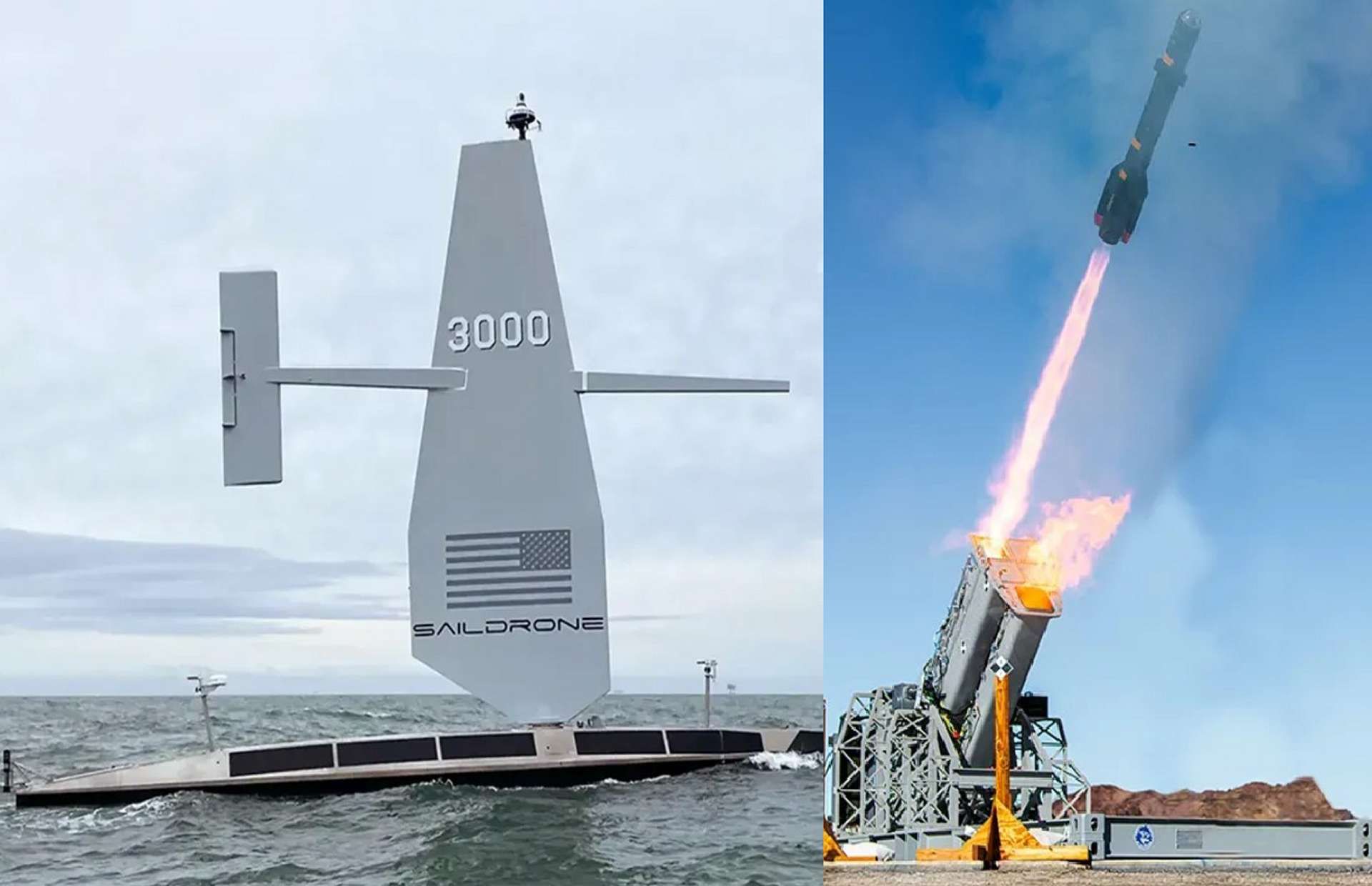
Saildrone Surveyor, backed by $50M from Lockheed, shifts from mapper to armed USV with missiles and an ASW towed array (Picture source: Saildrone/Lockheed Martin).
The JAGM Quad Launcher is a compact, modular canister system derived from the M299/JAGM ecosystem and validated in an August test campaign at Yuma. It supports angled or true vertical shots and is pitched for naval counter-UAS and fast-inshore attack threats. Pairing JQL with JAGM gives Surveyor a dual-seeker effector whose baseline round weighs roughly 49 kilograms, while the JAGM-MR upgrade adds a near-infrared third mode and extends static-launch range beyond 16 kilometers. In practice, that converts Surveyor from a persistent sensor into a supervised hunter-killer that can prosecute tracks without waiting for a manned shooter.
Lockheed’s Mk 70 Mod 1 Payload Delivery System packages four strike-length Mk 41 cells in a 40-foot ISO container. Navy and industry documentation confirm compatibility with Mk 41-qualified munitions such as Tomahawk, SM-6, Evolved SeaSparrow, and ASROC, enabling a “distributed magazine” role if fitted to the planned larger Saildrone. In effect, Saildrone evolves from a picket skirmisher into an expeditionary strike or layered-defense node that can be craned aboard auxiliaries, barges, or small combatants at speed.
The platform can carry it: Surveyor is a 72-foot, roughly 14-ton USV built to ABS Light Warship standards, sailing primarily on wind with solar and a diesel genset for sprint and hotel loads. It maps at up to 10 knots, carries deep-water and shelf multi-beam sonars, and supports sustained payload power around 2 kilowatts (3 kilowatts peak). Standard sensors include Kongsberg EM 304/2040 multi-beams, ADCPs, and fisheries acoustics, while secure satellite communications and an automated collision-avoidance stack allow months-long missions consistent with COLREGs behavior. That electrical margin and topside volume are exactly what a marinized launcher, compact radar/EW, and secure fire-control links require.
Lockheed’s release explicitly ties the larger Saildrone hull to “thin line towed arrays,” aligning with the company’s long production history on TB-29A and the TB-37 Multi-Function Towed Array for surface ships. A quiet, endurance USV towing a thin-line array becomes an ASW tripwire that can hold contact for manned shooters or cue an ASROC from a containerized launcher, accelerating kill-chains in waters where submarine ambush and seabed sabotage are now routine concerns.
The partners are selling urgency: “We will deliver a lethal naval solution at speed and scale,” said Lockheed RMS president Stephanie Hill, while Saildrone’s CEO framed the pivot bluntly: the tech is “mission ready,” it is time to add electronic warfare, ASW, ISR, and “kinetic effects.” Construction of the upsized Saildrone will begin at Austal USA in the first quarter of 2026, with Lockheed noting economic benefits and potential expansion beyond a single yard as volumes grow. These lines need to be read as an industrial signal: field-relevant capability fast, then scale.
Command and control will define what “armed autonomy” actually means. DoD Directive 3000.09 requires “appropriate levels of human judgment over the use of force,” rigorous test and evaluation, and cyber-resilient designs. Expect a supervised autonomy model with human-in-the-loop release authority, geofencing, remote safing, and abort control, and a data link architecture that can plug into fleet combat systems for track custody and engagement orders without granting independent lethal authority. Lockheed’s release promises “secure command and control” and an “open architecture approach,” which will be essential to connect with Aegis-family networks and coalition C2.
Vulnerabilities are real and solvable. USVs are tempting targets for jamming, spoofing, and kinetic harassment. Saildrone says it has engineered around GNSS-denied environments during Middle East operations, augmenting navigation and hardening C2. Add inertial and visual nav, multi-path satcom, and basic EW self-protection, and a weaponized Surveyor becomes far harder to bully or blind. Thin-line arrays impose towing loads and sea-state limits, but the trade is acceptable for persistent ASW pickets that keep manned escorts out of harm’s way.
The U.S. Navy is first in line, pursuing Distributed Maritime Operations and fresh magazine depth against massed threats. Denmark’s current three-month deployment of Saildrone Voyagers from Danish bases underscores a Baltic use case: 24/7 hybrid-fleet surveillance around pipelines, cables, and approaches, now with a near-term path to organic effectors. In the Indo-Pacific, Japan has shown interest in Mk 70 containerized VLS, a natural pairing with armed USVs for First Island Chain defense. In the Gulf, navies that worked Saildrone with U.S. Fifth Fleet’s Task Force 59 can quickly absorb a JQL-equipped Surveyor for infrastructure protection and swarm defense.
Why this matters for product development: the JQL integration forces a disciplined power, thermal, and topside integration on Surveyor; the result is a weapon-ready mission bay with growth headroom for JAGM-MR, lightweight EW pods, and compact surface-search radars. The larger Saildrone’s Mk 70 fit would validate containerized deep magazines at the USV scale, unlocking strike, air-defense, and ASW weapons commonality with destroyers. Together, those moves compress time to fleet relevance by grafting proven effectors onto a platform with millions of mission miles and an existing Navy user base. Or, as Jenkins put it in his note to readers, “now is the right time to augment Saildrone USVs with sophisticated payloads to meet warfighter needs.”
Two policy and safety points should be tracked as the program advances. First, weaponized USVs must demonstrate COLREGs-compliant behaviors under a wide range of sea states and traffic densities; second, the Navy will have to codify kill-chain safeguards, including rules of engagement and positive control, to satisfy both 3000.09 and allied political risk thresholds. Both are solvable with careful V&V and realistic fleet exercises, and both are prerequisites for export. Lockheed’s checkbook is accelerating a shift already visible from Bahrain to the Baltic: uncrewed ships that sense, decide, and, with human authorization, shoot. If 2026 live-fires and the Austal build go to plan, Saildrone’s armed variants will give the fleet a new class of ASW tripwire and distributed magazine that arrives in containers, not a decade-long shipbuilding queue.
Written by Evan Lerouvillois, Defense Analyst, Army Recognition Group.
Evan studied International Relations, and quickly specialized in defense and security. He is particularly interested in the influence of the defense sector on global geopolitics, and analyzes how technological innovations in defense, arms export contracts, and military strategies influence the international geopolitical scene.