






Breaking News






Taiwan Reopens Talks with US on MH-60R Seahawk Deal for at Least 13 Anti-Sub Helicopters.
Taiwan’s navy has resumed negotiations with the U.S. on a package of MH-60R Seahawk anti-submarine helicopters, with local reports pointing to at least 13 aircraft. If finalized, the buy would strengthen Taiwan’s undersea defense and deepen U.S.–Taiwan security ties amid rising PLA naval activity.
Local media in Taiwan reported on Oct. 7 that the navy has returned to talks with Washington on acquiring MH-60R Seahawk anti-submarine helicopters, citing a senior official and sources familiar with the discussions; the notional quantity is 13 or more. The move follows months of mixed signals. Coverage earlier this year noted Taipei’s revived interest in MH-60Rs amid a bigger defense budget push, even as prior requests reportedly stalled or were declined on asymmetric-warfare grounds. The MH-60Rs would markedly improve Taiwan’s ability to detect and counter submarines in the Taiwan Strait and integrate more tightly with U.S. and allied naval operations.
Follow Army Recognition on Google News at this link
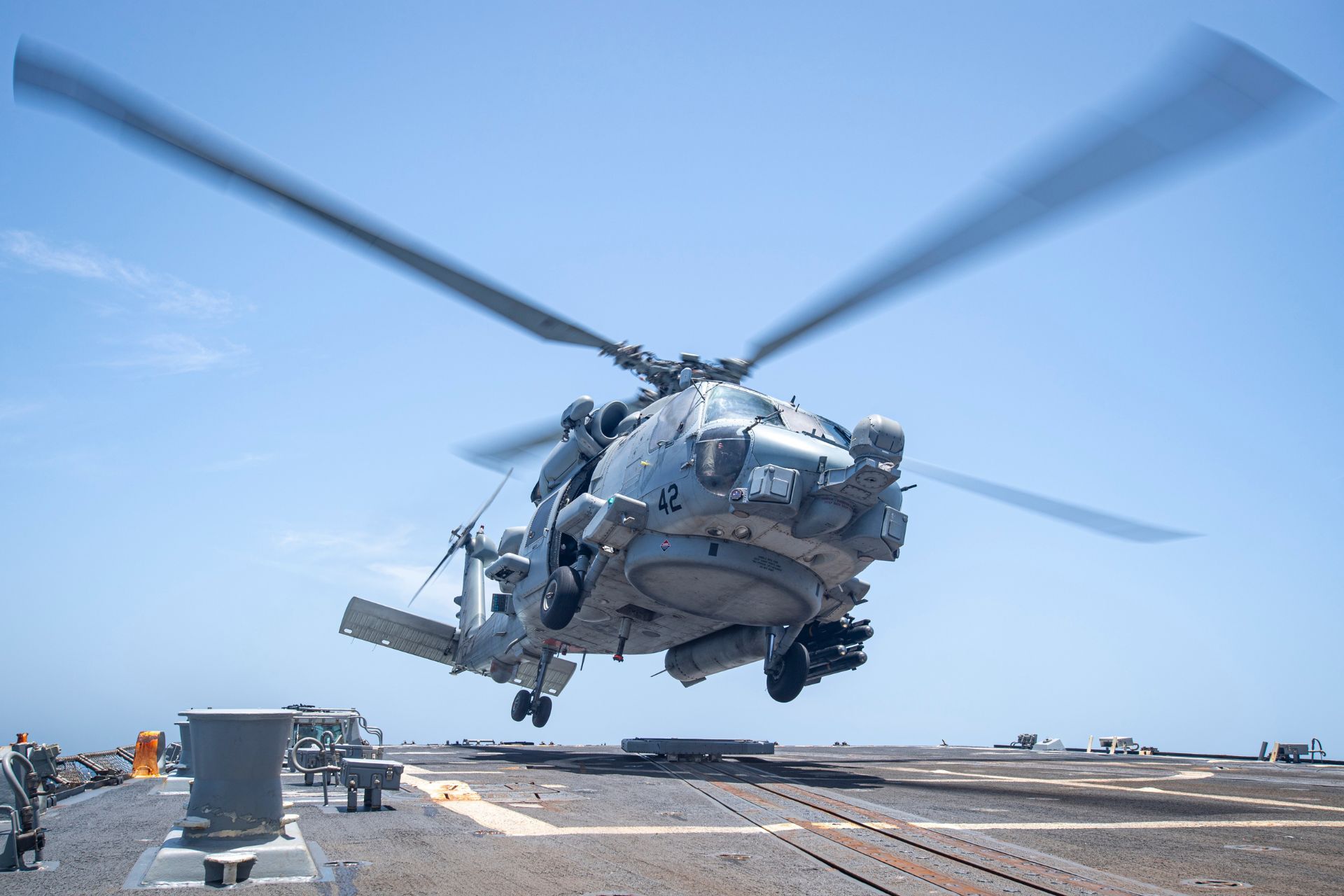
An MH-60R Sea Hawk from HSM 49 lands on USS Lenah Sutcliffe Higbee (DDG 123) in the U.S. Central Command area. (Picture source: US DoD)
This procurement plan is not limited to airframes. It includes an airborne dipping sonar, updated avionics, MK54 or MK50 lightweight torpedoes, AGM-114 Hellfire anti-ship missiles, laser-guided rockets, and onboard machine guns. Taiwan’s navy has formed a dedicated team to address quantities, total cost, implementation schedule, and performance requirements, with cautious expectations that the deal could be placed in a special defense procurement budget. The context is a fleet in need of renewal. The service once operated 21 S-70C helicopters for ASW and now fields 17 after four major accidents. The purchase would therefore restore numbers and add capability, rather than replace like for like.
The MH-60R is the US Navy’s reference platform for anti-submarine operations from surface combatants, while also conducting maritime strike from destroyers and frigates. Based on the multi-mission Seahawk, the Romeo variant integrates a sensor suite designed to detect and classify contacts in complex littoral waters. At its core is the AN/AQS-22 Airborne Low Frequency Sonar, a high-power dipping system that searches variable depths to catch targets hidden beneath thermal layers. It works in conjunction with expendable sonobuoys, a multi-mode maritime radar for surface and periscope detection, a day-night electro-optical turret, and an electronic support measures set to detect hostile emissions. Data flows over Link 16 and other datalinks so the helicopter can push tracks to a ship’s combat system or receive cueing from other platforms. A typical crew is a pilot, a copilot, and one or two sensor operators who manage sonar, radar, and weapons.
The weapons fit aligns with Taiwan’s requirements. The MK54 lightweight torpedo is the standard option against diesel-electric and nuclear targets, combining proven hardware with updated guidance for shallow-water performance. For short-range surface threats, the MH-60R carries Hellfire missiles already used at sea to disable fast craft. Door-mounted machine guns provide self-protection and limited overwatch for hoist or interception tasks. The avionics suite, with a fully digital cockpit, embedded GPS, and current navigation aids, improves safety in poor weather and reduces pilot workload during extended hovers with the sonar in the water.
South Korea received its first MH-60R last year, and New Zealand announced in August the purchase of five aircraft. These acquisitions matter for Taiwan because a regional user community can facilitate training, shared lessons, and occasionally arrangements for spare parts during exercises. The US Navy remains the lead user and provides a stable training syllabus and an established contractor support model, which tends to shorten the path from delivery to operational service. For Taiwan, this reduces program risk. Even so, the project team will need to phase deliveries, reinforce maintenance capacity, and verify hangar compatibility and deck handling aboard surface ships.
Tactically, the MH-60R’s value lies in the triangle it forms with surface vessels and maritime patrol aircraft. In the Taiwan Strait and nearby waters, sea conditions shift quickly and background noise complicates detection. A dipping-sonar helicopter can sprint to a datum, lower the transducer, and hold a hover while a frigate maneuvers to contain the contact with passive sensors. If a submarine tries to escape in shallow water, the aircraft can lay a buoy pattern, maintain pressure, and relay bearings via datalink. Once a firing solution is achieved, it can deliver a torpedo itself or pass the engagement to the ship for a longer-range shot. The same aircraft can conduct maritime strike, since a Hellfire shot against a fast craft can prevent harassment of a convoy. These tasks are routine but demanding, requiring crews able to sustain long hovers, process acoustic data in real time, and coordinate on crowded networks. Training and sustainment will determine how much capability translates to patrols.
China’s People’s Liberation Army Navy has expanded both its diesel-electric and nuclear attack submarine fleets, with quieter hulls fitted with improved sonar and weapons. It trains more often in the Philippine Sea and around the Bashi Channel, which places pressure on the sea lanes that supply Taiwan. Diesel-electric submarines operating on batteries for extended periods pose a particular challenge in the noisy shallows west of the island. For Taiwan, which faces near-daily air and maritime activity around the median line, adding modern airborne ASW complicates any undersea approach and supports surface groups without committing fixed-wing patrol aircraft on every sortie. A separate request for the E-2D Advanced Hawkeye remains off the table for now due to perceived overlap with land-based radar coverage. The Seahawk track appears more straightforward. Negotiations will set the final quantity and schedule, but the direction is consistent with choices made by other Asia-Pacific navies.
Taiwan examined new ASW helicopters as early as 2014, selected the Seahawk, then allowed the project to slip behind other priorities. The current renewal rests on a clearer operational case, an acquisition team in place, and a munitions list aligned to the mission. Numbers will matter, as will the training pipeline and parts inventory. If the special budget line is approved, Taiwan would not only replace lost airframes but also add a tool able to reach a contact quickly and keep it from disappearing in the clutter of a busy strait.