






Breaking News






Sweden’s New Mariner Unmanned Boat Test Signals NATO-Ready Shift in Baltic Defense.
Sweden’s Defence Materiel Administration (FMV) has conducted sea trials of a small unmanned surface vessel near Berga to explore autonomous naval operations. The project builds operational knowledge for future NATO-aligned maritime systems as Sweden expands its defense capabilities in the Baltic.
The Swedish Defence Materiel Administration (FMV) announced on October 27, 2025, that Sweden carried out sea trials of a small unmanned surface vessel in Hårsfjärden outside Berga. The three-year research and technology project, ordered by the Swedish Armed Forces, is meant to build operational knowledge of naval USVs rather than field a weaponized platform today. Initial runs evaluated software stability, range, steering and emergency-stop behavior, with the craft teleoperated from a nearby group boat.
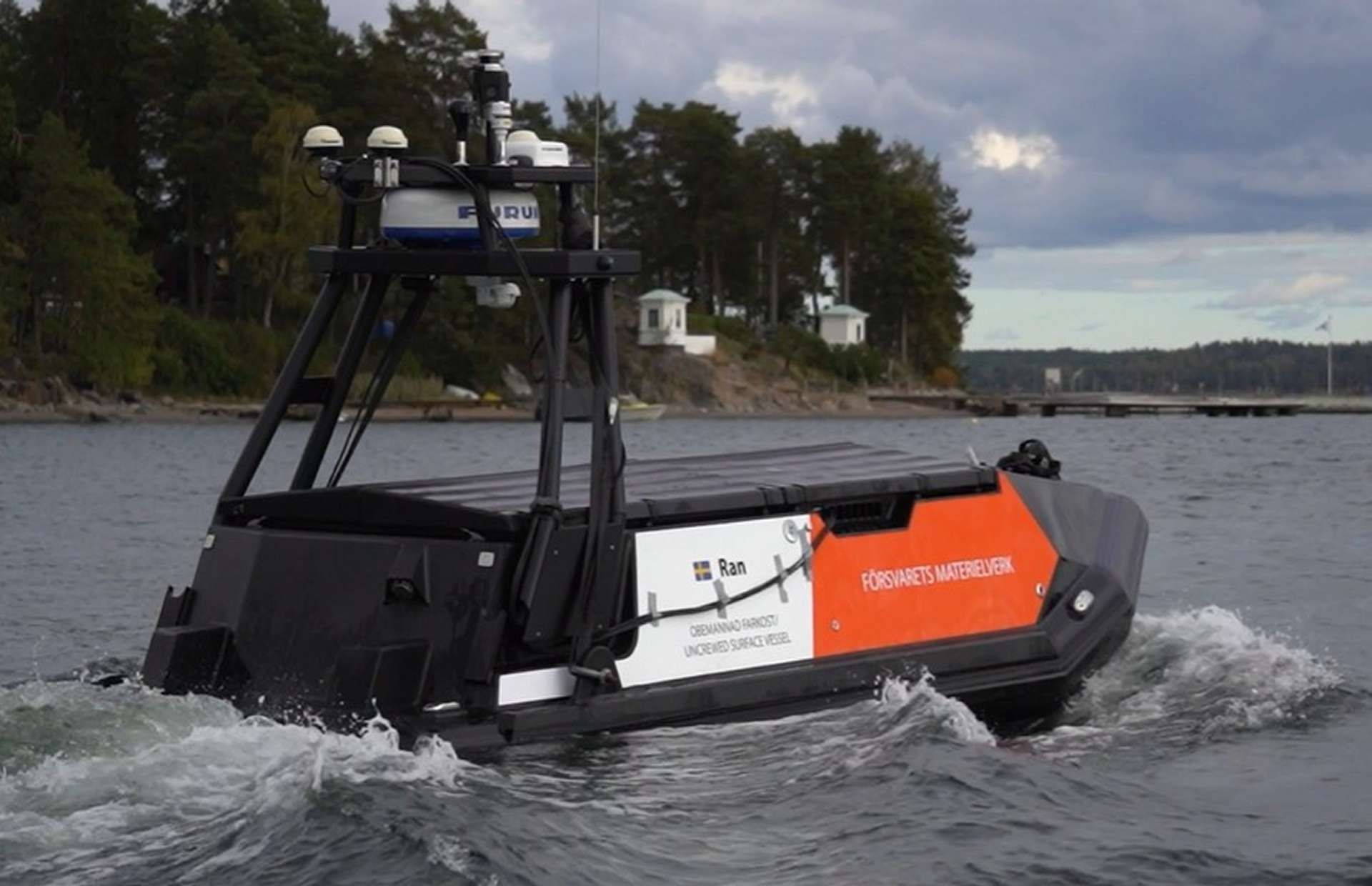
FMV’s Ran unmanned surface vessel, trialed near Berga, is a 6-meter, 2-ton platform that reaches 24 knots, carries 400 kg for up to 50 hours, uses 360° cameras and lidar, and operates teleoperated or autonomously for ISR and logistics (Picture source: FMV).
FMV does not name the model, but multiple industry reports identify the boat as the Mariner USV built by Norway’s Maritime Robotics, a mid-sized platform already in service with the Norwegian Home Guard and the navies of Spain, Denmark and Portugal. That attribution aligns with FMV’s note that the Swedish boat is a Norwegian type used by those fleets and with specifications typical of Mariner. Public data list a length of about 6 meters, 2,000 kilograms dry weight, 24-knot top speed, up to 50 hours endurance at 4 knots, and a 400-kilogram payload capacity. The hull is durable polyethylene and maneuverability comes from waterjet propulsion with bow thrusters, with documented survey and transit limits up to Beaufort 4 and 6, respectively.
The Swedish test boat is a flexible concept demonstrator. FMV confirms 360-degree cameras and Lidar providing a 3D picture for safe navigation, with either manual control via handheld or laptop or pre-programmed waypoint routes. The test team is deliberately exploring collision-avoidance functions that remain at a lower maturity level, and communications ride on Wi-Fi or 4G links during trials. FMV has named the vessel Ran after the Norse goddess of the deep. Beyond autonomy, the craft can be fitted to simulate a patrol boat profile, carry useful cargo to island positions, or host sensors lowered to map the seabed.
An unmanned surface vessel of this class answers Sweden’s Baltic problem set: contested littorals, tight archipelagos and the need to disperse forces while keeping logistics and surveillance going. A 24-knot, shallow-draft USV with a 400-kilogram payload can push sensors forward, shadow suspicious contacts, sweep approach lanes for mines, or serve as an expendable radar reflector to complicate targeting. The endurance profile invites low-and-slow maritime ISR and hydrography, while the speed margin enables quick runs between dispersed coastal nodes. The United Kingdom’s adoption of ARCIMS-based autonomous mine countermeasures underscores how USVs are moving from experiments to fleet work, a path Sweden can follow on its own terms.
The program also lands at a strategic inflection point. Sweden became NATO’s 32nd member on March 7, 2024, and aligning tactics, techniques and procedures for autonomous maritime systems with allies is now a practical necessity. Maritime Robotics’ USVs have matured through NATO’s REPMUS and Dynamic Messenger campaigns in Portugal, where allied navies iterate autonomy, command-and-control and payloads in realistic sea states. That shared venue shortens Sweden’s learning curve and eases future interoperability.
FMV’s acquisition strategy looks deliberately cautious. Project leaders say the aim is to understand what the Armed Forces want to do with USVs, what is technically realistic, and which requirements to prioritize, while FMV runs market scans and regulatory analysis in parallel. Testing in the open lets the team validate autonomy and safety cases, including detect-and-avoid behavior, before any scaled purchase. This approach mirrors allied best practice and reduces schedule risk by avoiding bespoke choices before doctrine and rules of the road settle.
If early results track with allied experience, the first operational roles for Sweden’s unmanned surface vessel will be intelligence, surveillance and reconnaissance, route reconnaissance and hydrography in the archipelagos that frame Stockholm and Gotland. As the collision-avoidance stack matures and resilient beyond-line-of-sight communications are layered in, mission sets can expand to mine countermeasures teaming, decoy operations and armed coastal defense in concert with manned fast boats and shore-based fires. Above all, Ran gives the Swedish Armed Forces a low-risk way to train operators, write procedures and develop a NATO-ready unmanned maritime playbook.