






Breaking News






Spain to launch construction of two Meteoro-class patrol ships to strengthen maritime security.
Spain has initiated design and build for two additional Meteoro, Buques de Acción Marítima, with work centered at Puerto Real and production slated for the first half of 2027. The ships add upgraded combat and platform management systems, stronger comms and navigation, UxV interfaces, expanded medical spaces, and more berths to extend presence while freeing high-end escorts for deterrence and sea control.
With the execution order signed in early October, Madrid has moved the Meteoro expansion from approval to construction planning. Design starts now, and production is expected to begin in the first half of 2027 at Puerto Real. Valued at €716 million and totaling approximately four million work hours, the program is structured to enhance availability for law enforcement missions, streamline decision-making cycles at sea, and sustain an average of 2,000 jobs per year through 2030.
Follow Army Recognition on Google News at this link
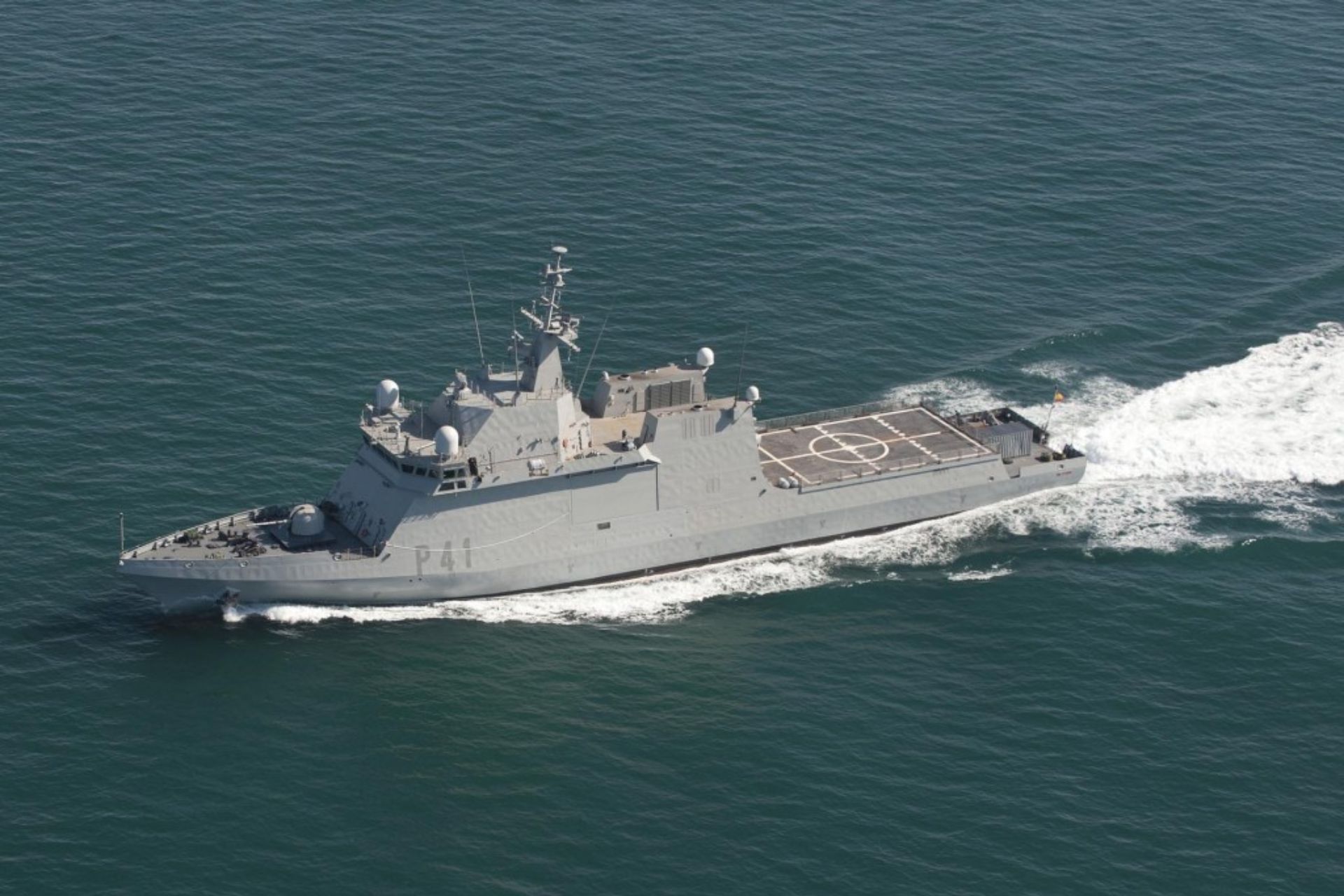
ESPS Meteoro P-41 on patrol with 76 mm gun and flight deck as Spain orders two more Meteoro-class OPVs. (Picture source: Eunavfor)
Navantia highlights an updated combat system, an Integrated Platform Management System (IPMS), reinforced communications and navigation suites, and cybersecurity measures adapted to current threat vectors. Provision for integrating uncrewed vehicles widens the mission set, while redesigned workspaces, expanded medical facilities, and greater berthing capacity improve crew endurance during prolonged deployments. The objective is to shorten decision loops at sea and increase availability for constabulary tasks so first-rank escorts remain focused on deterrence and sea control.
The Meteoro class is a medium-displacement design optimized for presence and persistence. Current units are approximately 93.9 meters long and 14.2 meters wide, displace around 2,840 tons, and carry a main 76 mm naval gun supported by two 25 mm remote mounts. Spanish Navy data also cite the Indra Skyfender surface-search radar, the SCOMBA combat system, and the Link 11 data link. This coherent fit provides a cost-controlled basis for maritime security.
Navantia’s engineering plan again features the Integrated Platform Management System (IPMS). The yard emphasizes a digital-first workflow via the ELCANO environment, based on Siemens solutions, covering design, modeling, simulation, and construction. This model-based approach aims to reduce rework, tighten configuration control, and streamline the transition from yard to fleet support, with expected effects on maintenance and training. For a platform that logs thousands of sea hours in fisheries control, interdiction, and search and rescue, better-structured technical documentation and cleaner sensor-data integration translate into higher operational availability.
This type sits between coastal patrol craft and complex frigates. In February 2022, ESPS Meteoro (P-41) operated with allied units during Neptune Strike, showing how an OPV integrates into a group scheme without tying up high-end hulls. In this role, the vessels feed the Recognized Maritime Picture (RMP) and the Common Operational Picture (COP), pass tracks to commanders, and conduct boardings with two rigid-hulled inflatables and a flight deck sized for medium helicopters or uncrewed aircraft. When radio discretion is required, Emissions Control (EMCON) procedures and disciplined sensor management preserve a low profile while maintaining surveillance through passive means and cueing.
From a capability standpoint, the combination of sensors, effectors, and small craft covers day-to-day maritime security tasks. Identification and tracking at range in congested lanes, warning shots and disabling fire against non-compliant small craft, rapid deployment of boarding teams, and casualty evacuation form the core mission set. With an updated combat system and modernized electro-optics, watch teams classify small contacts more reliably, correlate tracks, and trigger cleaner intercepts. Interfaces prepared for surface and aerial uncrewed systems extend reach around approaches and offshore infrastructure, improve pattern-of-life analysis, and shorten the time from detection to interception.
The government presents the decision as support for Spain’s defense industrial and technological base (BITD), with work concentrated at Puerto Real and a ramp sustaining employment through the end of the decade. Official communications note automated block-production lines and a closer link between digital engineering and shop-floor execution, in line with efforts to secure naval supply chains. For the fleet, new hulls reduce maintenance pressure on the first six units and stabilize patrol coverage in the Canary Islands area, the Gulf of Cádiz, and the approaches to the Strait of Gibraltar.
The timeline aligns with a European trend to recapitalize sovereignty assets at sea in the face of gray-zone challenges, from irregular migration and trafficking to risks to subsea infrastructure. Taken alone, OPVs do not alter a balance of power, but they increase allied presence in the Western Mediterranean, enable more continuous situational awareness, and allow faster responses to low-intensity incidents. In practice, this yields a more stable RMP/COP, more credible burden sharing, and better preservation of high-end escorts for deterrence, air defense, and sea-line protection when strategic tensions rise.