






Breaking News






Singapore launches RSN’s first Multi-Role Combat Vessel a mothership for unmanned operations.
ST Engineering has launched the Republic of Singapore Navy’s first Multi-Role Combat Vessel, MRCV Victory, at Benoi yard during a ceremony officiated by Defence Minister Chan Chun Sing. The six-ship program emphasizes manned-unmanned teaming and will start deliveries from 2028, a shift that expands regional maritime reach while limiting crew risk.
Singapore, on October 21, 2025, launched MRCV Victory, the first of six locally built Multi-Role Combat Vessels that will operate as a mothership for air, surface, and subsurface uncrewed systems, according to officials and company statements. The program, awarded in 2023 and led by ST Engineering with support from DSTA and the RSN, is slated to deliver the class progressively from 2028. Early disclosures describe a large combatant, about 150 meters long and around 8,000 tons, optimized for distributed sensors, vertical launch capacity, and a robust cyber-secure network to control off-board vehicles.
Follow Army Recognition on Google News at this link
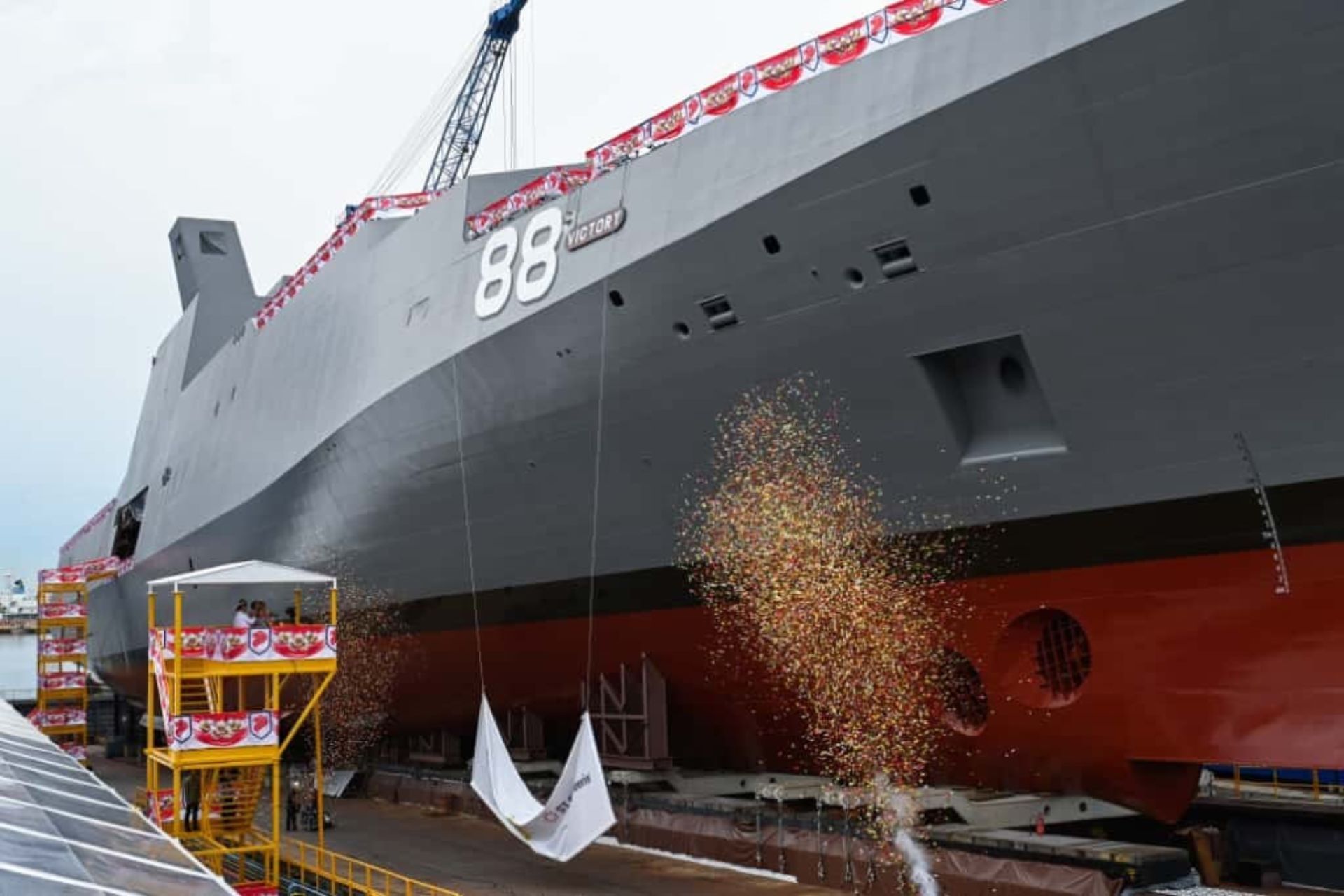
At ST Engineering’s Benoi Shipyard today, the Republic of Singapore Navy launched its first Multi-Role Combat Vessel, Victory. (Picture source: Singapore Navy)
At 150 meters in length, MRCV Victory sits among the larger surface combatants in Southeast Asia, while being designed around air, surface, and subsurface uncrewed payloads that are integrated from the outset. ST Engineering describes an end to end approach, from detailed design and construction to cyber-secured communications networks and the integration of multiple weapon systems. The company also highlights model-based engineering using a 3D digital twin validated before cutting, which reduced rework, material consumption, and delivery time.
The ship features a fixed panel electronically steered multi-function radar, the first of its type in RSN service. A composite superstructure is used to lower the center of gravity and improve stability. The flight deck is sized for one medium helicopter and multiple UAVs. Mission modules can be loaded as containers or rigid hull boats, with internal handling by an elevator and tractors to reduce manual operations. Launch and recovery for mission payloads is supported by a side crane-type LARS to speed loading and unloading. On sensors and protection, the package includes an electro-optical system, a fire control radar, a hull-mounted sonar, and dedicated cybersecurity capabilities. For gunnery, materials refer to a STRALES 76 mm guided gun and an MK30 C 30 mm remotely controlled weapon station. Missile labels shown in the concept graphics include MICA surface-to-air, Aster surface-to-air and a surface-to-surface missile system. These labels describe the intended layers rather than a final public fit. The ship also adopts integrated full electric propulsion to generate large power margins for current and future systems. Training simulators are embedded to support crew readiness. Taken together, these features align with the mothership role and the need to operate UAVs, USVs, and UUVs in parallel.
According to the schedule, Victory has been launched, will be transferred to Gul yard for completion, and will then begin sea trials before acceptance. ST Engineering indicates deliveries will be staggered from 2028. This phasing allows time to qualify uncrewed payloads, train crews for multi-domain operations, and refine tactics that combine crewed ships with off-board systems in the Singapore Strait and farther afield.
The MRCV aims to extend operational reach while limiting crew exposure. Acting as a controller of controllers, the ship can deploy UAVs for intelligence, surveillance and targeting, while USVs provide close-in screening, visit support or decoy tasks, and UUVs survey choke points or conduct mine search. The combat system is intended to correlate these inputs to support air defence, anti-surface and anti-submarine decisions at tempo. Because sensors are distributed across a constellation of vehicles, the targeting problem becomes more complex for an adversary. The ship can limit its main radar emissions, rely on off-board sensing, and still engage with effectors cued by the uncrewed layer. In peacetime, the same toolset supports maritime security, interdiction, and incident response, with flexible presence and lower risk boarding support.
At the operational level, the focus is endurance and orchestration. A 150-meter hull provides deck area, internal volume, and electrical margins for mission modules and upgrades. The digital twin approach should also yield benefits after commissioning in configuration control, faster troubleshooting, and data-driven maintenance, all useful for a navy with a compact fleet. The architecture anticipates coalition activity. If the MRCV can ingest and share tracks over standard tactical data links while managing a mixed family of uncrewed vehicles, it becomes a useful node within multinational task groups that frequently operate around Singapore’s sea lanes.
ST Engineering outlines a method based on virtualisation and digital integration to limit trial and error on the shop floor. Automated panel lines and robotic welding raise throughput, and predictive maintenance reduces stoppages that can disrupt a long production run. For the customer, this supports steadier cost and schedule control across six hulls. For the prime contractor, it indicates a mature local supply chain that could be adapted for allied navies working on similar concepts.
The final weapons outfit has not been detailed publicly. However, the emphasis on multiple weapon systems and a layered radar and sensor suite, together with vertical launch options suggested by program material, points to an area defence and strike capacity consistent with a large combatant, complemented by a 76 mm main gun, a 30 mm remote station, and close-in protection. The key point remains integration. The value lies less in any single launcher than in the fusion of sensors, effectors, and off-board platforms into a coherent chain from detection to engagement.
Victory enters service planning at a time when navies in the South China Sea and the wider Indo-Pacific are moving toward distributed and uncrewed heavy operations. Platforms that deliver persistent surveillance, denial options, and quick coordination with partners are in demand. Singapore’s choice, a domestically built mothership optimised for uncrewed teaming, reflects a preference for scalable presence and coalition interoperability over raw tonnage. If deliveries begin in 2028, the class is likely to inform Southeast Asian naval practice through the 2030s and add resilience to the regional maritime balance as decision cycles compress and grey zone activity becomes more common.