






Breaking News






Pakistan Navy announces successful test of Smash anti-ship ballistic missile.
Pakistan’s Navy carried out a new test of the Smash ship-launched ballistic missile in the Arabian Sea in late November 2025.
As reported by the ISPR on November 25, 2025, the Pakistani Navy has successfully conducted a new test of the Smash ship-launched anti-ship ballistic missile, described as an indigenously produced system capable of engaging both sea and land targets with high precision and advanced manoeuvrability. The launch took place from a Pakistani warship in the Arabian Sea and was observed by the Chief of Naval Staff together with senior officers, engineers, and scientists associated with the project, with official statements stressing that the missile can strike maritime and ground targets accurately at long distances and is intended to support the defence of national maritime boundaries and wider maritime interests.
Follow Army Recognition on Google News at this link
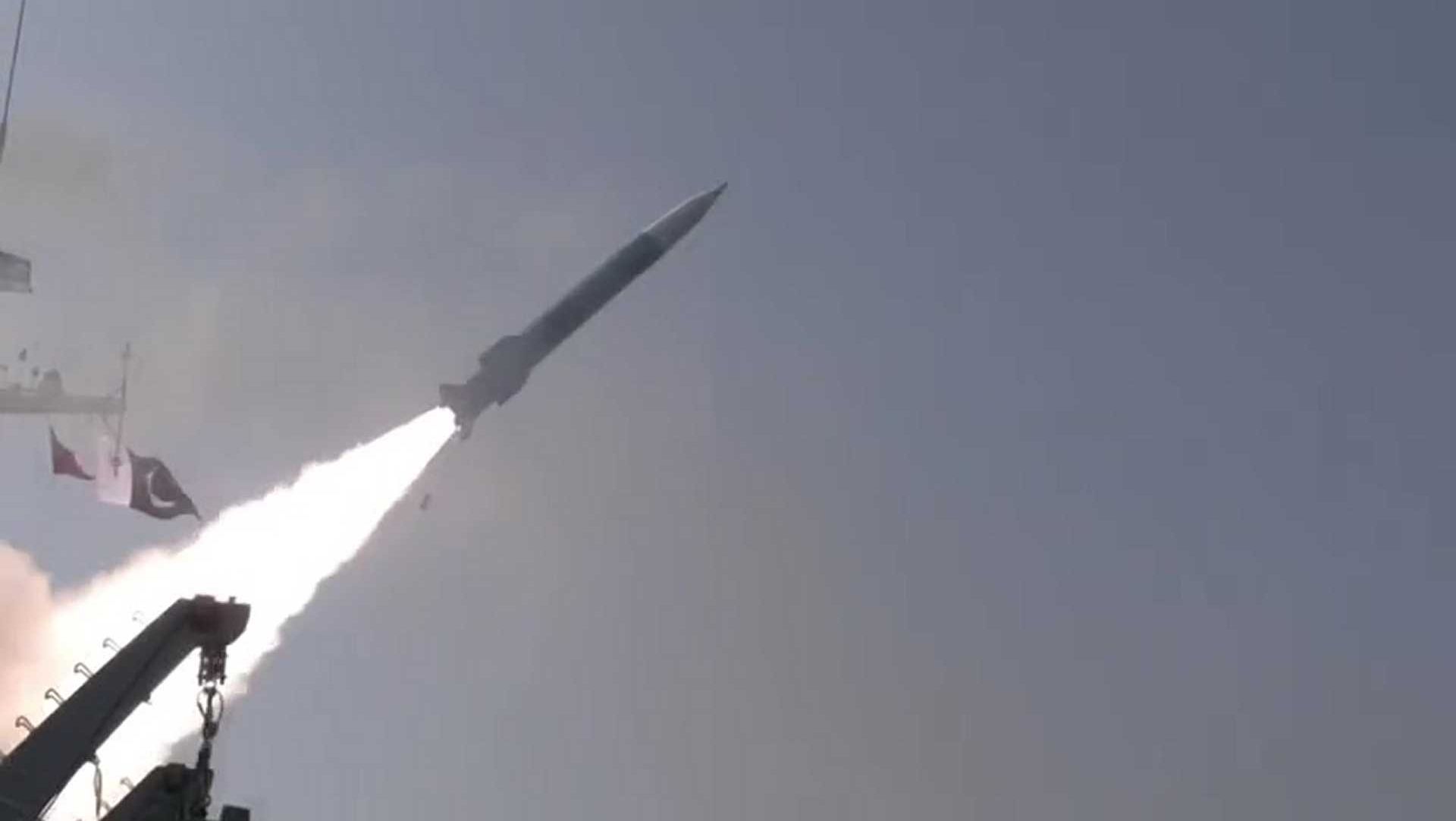
The P282 Smash missile is said to measure approximately nine metres long, with a diameter between 85 and 90 centimetres, giving it a form factor that allows integration on frigate-sized warships using either inclined launchers or vertical launch cells. (Picture source: ISPR)
Some sources, such as the Patriotic Pakistan Organization (PPO), referred to this missile as Smash-2; it is unclear if this designation represents, or does not represent, an evolution or extended-range variant of the P282 Smash missile that entered service in 2024. In October 2020, a senior naval leader publicly indicated that the Pakistani Navy was working on a ship-based, long-range, anti-ship and land-attack ballistic missile identified as P282, describing it as a key part of a strategy to restrict an adversary’s operational freedom near Pakistan’s coast and exclusive economic zone. This concept aligns with anti-access and area denial thinking, in which anti-ship warfare is used to create a buffer zone that complicates the approach of aircraft carriers, large surface combatants, and amphibious forces, rather than trying to match fleet size or tonnage directly. The development drive coincided with attention to the security of the China-Pakistan Economic Corridor, the operationalisation of Gwadar port, and a wider recognition that maritime and blue economy interests require stronger conventional deterrent tools at sea.
Within this framework, the P282 Smash project was framed as a means to reinforce the Navy’s contribution to national defence without shifting to parity with the Indian Navy, which has invested in carriers, nuclear submarines, and a large surface fleet. Later technical commentary suggested that the Smash missile could reach at least several hundred kilometres and might eventually develop toward 1,000 kilometres or more, although early public references fixed its range at about 350 kilometres and emphasised its role in coastal defence and regional sea denial rather than long-range power projection. In November 2024, the Pakistan Navy carried out the first public test of the P282 Smash missile from a Zulfiquar-class (F-22P) multi-mission frigate, when the missile was launched from an inclined deck launcher toward a land target and successfully demonstrated the ability to carry out a ballistic trajectory strike at an officially stated range of approximately 350 kilometres.
The Navy described that weapon as a ship-launched ballistic missile capable of hitting land and sea targets with high precision and mid-flight manoeuvring, and noted that the trial was observed by senior naval officers and the engineering team, indicating that the system had moved beyond a purely conceptual stage. Subsequent information indicated that by November 2025, at least one additional test had been conducted from a Chinese-built Tughril-class (Type 054A/P) frigate against a sea surface target, showing that the missile could also be used against moving vessels, and other material referred to multiple test events possibly totalling two or three launches. Some technical descriptions of the November 2025 firing stated that the missile was cold-launched from a universal vertical launch system on the PNS Tippu Sultan and that the flight profile included a high altitude boost and a steep terminal dive, with all mission parameters such as ejection, guidance updates, terminal manoeuvres, and impact apparently behaving as designed. Alongside these, the label Smash-2 began circulating in Pakistani media as a way to refer to the latest variant or test configuration, while the earlier P282 Smash remained associated with the 350-kilometre range figure and initial Zulfiquar-class launch.
The P282 Smash missile is said to measure approximately nine metres long, with a diameter between 85 and 90 centimetres, giving it a form factor that allows integration on frigate-sized warships using either inclined launchers or vertical launch cells, and it is assessed to have a range of about 350 kilometres in its baseline version, which aligns with Pakistan Navy statements about land and sea target engagement at this distance. It is presented as a supersonic or hypersonic missile that boosts to high altitude before diving onto its target on a steep path, with a near-vertical terminal angle and a manoeuvrable re-entry phase intended to reduce the reaction time of ship defences and complicate tracking. Guidance is described as inertial navigation corrected by satellite signals in mid-course, with a terminal seeker that may combine active radar and electro-optical or imaging infrared sensors, possibly with a home-on-jam mode designed to use opposing electronic warfare emissions for final targeting.
Some technical evaluations of a fuller Smash configuration, often linked to Smash-2, propose an 11.5 to 12 metre missile with a diameter of about 0.88 metres and a launch weight of around 16 to 18 tons, compatible with the universal vertical launch systems used for HQ-16 surface-to-air missiles, suggesting that the same cells could host either defensive interceptors or ballistic missiles. These descriptions also mention a cold-launch gas generator that ejects the missile from the cell before main motor ignition, which reduces stress on the ship structure and allows 360-degree engagements without physically turning the launcher, and a warhead mass in the 500 to 700 kilogram range optimised for penetrating ship hulls and critical compartments or striking hardened land targets.
Several Pakistani publications attribute terminal speeds of around Mach 8 to Smash, sometimes with a skip-glide or limited gliding component during descent, and employ terms like “Supersonic Missile Anti-SHip” to explain the Smash acronym, although such performance and flight mode details have not been formally specified in Pakistan Navy communiqués. Before the P282 Smash, Pakistan relied on a portfolio of anti-ship cruise missiles, including the subsonic Babur cruise missile, the coastal defence system Zarb (derived from China's C-602), the ship and land-launched Harbah, and Chinese supersonic missiles such as CM-302 and CM-400AKG. Cruise missiles like Babur are limited to about Mach 0.9, and Pakistan seems to lack domestic ramjet propulsion, advanced thermal protection materials, and other technologies needed for a supersonic cruise comparable to the BrahMos used by the Indian Navy and Air Force. The Smash is therefore positioned as a way to compensate for this gap by using ballistic rather than cruise trajectories, combining higher terminal speed and steep impact angles with a range that already extends the Pakistani Navy’s reach beyond many shipborne surface-to-air missile systems and provides a stand-off option against high-value targets approaching Pakistan’s coast.
Commentaries describing the more ambitious versions of the P282 claim that an extended range variant, sometimes referred to as Smash-ER, could reach 1,500 to 1,800 kilometres and that present or near-future modifications already stretch the range to 700 to 850 kilometres, which would allow Pakistani ships to hold at risk carrier battle groups, amphibious formations, logistics vessels, and land targets deep into the Arabian Sea and parts of the wider Indian Ocean. The same discussions outline a potential doctrine in which a frigate equipped with 32 Smash missiles could fire a salvo at an approaching carrier group and then rapidly reposition, seeking to impose a level of risk that discourages close carrier operations without requiring Pakistan to field carriers of its own. Online debates have examined whether P282 is essentially a ship-launched variant of Fatah-II or a distinct design that shares only certain engineering inputs, and whether its planned trajectory includes a hypersonic glide phase or a more conventional manoeuvring ballistic profile, but the Pakistan Navy’s public material continues to characterise it as a ship-launched ballistic missile with high precision and manoeuvrability rather than specifying glide vehicle terminology.
Written by Jérôme Brahy
Jérôme Brahy is a defense analyst and documentalist at Army Recognition. He specializes in naval modernization, aviation, drones, armored vehicles, and artillery, with a focus on strategic developments in the United States, China, Ukraine, Russia, Türkiye, and Belgium. His analyses go beyond the facts, providing context, identifying key actors, and explaining why defense news matters on a global scale.