







Breaking News




New HMAS Pilbara offshore patrol vessel strengthens Australia’s coastal defence.
The Royal Australian Navy launched the new HMAS Pilbara offshore patrol vessel on October 31, 2025, at the Henderson Maritime Precinct in Western Australia. The ship is the third Arafura-class Offshore Patrol Vessel and the first constructed in Western Australia
On October 31, 2025, the Royal Australian Navy (RAN) launched its third Arafura-class Offshore Patrol Vessel (OPV), the HMAS Pilbara, at Henderson, Western Australia, under the SEA 1180 Phase 1 program. The ship was built by Civmec Defence Industries following its acquisition of Luerssen Australia and will undergo fitting out and sea trials before delivery in 2026. Its introduction reflects the shift of Australia’s patrol vessel construction from South Australia to Western Australia to support long-term maritime security operations.
Follow Army Recognition on Google News at this link
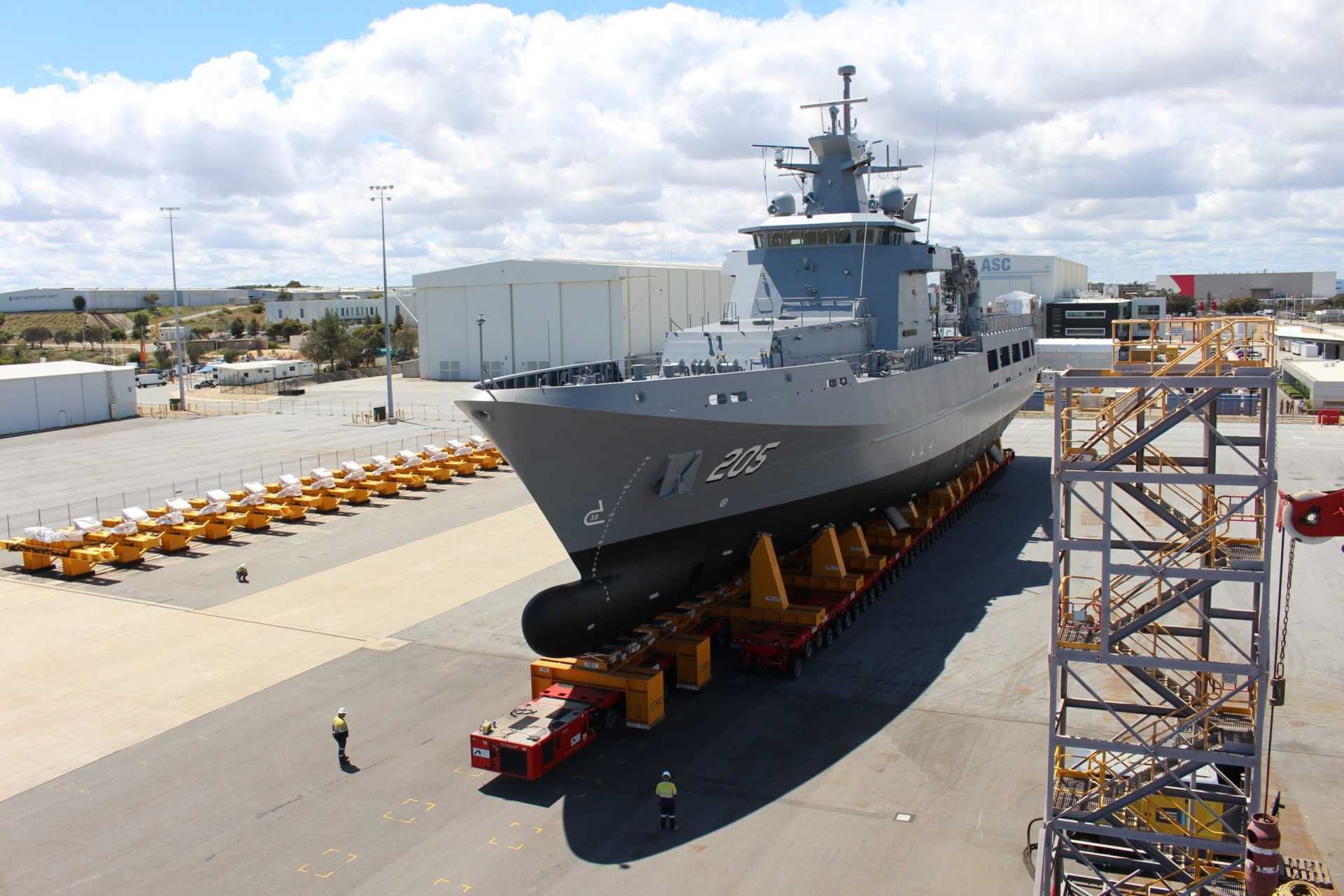
The Arafura-class program was initially introduced under the 2009 Defence White Paper as part of a plan to rationalize Australia’s patrol, hydrographic, and minehunting fleets under one modular ship class. (Picture source: Civmec)
The event marked an important stage in the SEA 1180 Phase 1 program, with Civmec Defence Industries leading the construction after acquiring Luerssen Australia on 1 July 2025 and renaming the company on 1 October 2025. The ship’s sponsor, Jessica Shaw, Chief Commissioner of Port Hedland, christened the vessel during the ceremony, reflecting the regional connection to the Pilbara area. The HMAS Pilbara is the first Royal Australian Navy vessel to bear the name of the region. It was rolled out from the assembly hall to the hardstand at the Australian Marine Complex on 22 October 2025 in preparation for the launch. Following fitting out and sea trials, the ship is scheduled for delivery in 2026.
The HMAS Pilbara’s launch is a major development for Western Australian shipbuilding, marking the first time an Arafura-class vessel has been constructed entirely at Henderson. The Arafura-class program originally began in South Australia, where the first two ships, HMAS Arafura and HMAS Eyre, were completed at the Osborne Naval Shipyard near Adelaide before production transitioned westward. The ship is part of a six-vessel series that includes HMASs Gippsland, Illawarra, and Carpentaria, all currently under construction at Civmec’s facilities. Each ship is built within Civmec’s 53,000 square meter undercover assembly and sustainment hall. The transition of production from Adelaide to Henderson consolidated manufacturing and sustainment within a single industrial precinct. Civmec’s acquisition of Luerssen Australia allowed it to manage all design, production, and integration tasks internally, contributing to steady production continuity.
Officials attending the ceremony emphasized the industrial and naval cooperation represented by the SEA 1180 project. Chief of Navy Vice Admiral Mark Hammond stated that the Arafura-class OPV fleet demonstrates partnership between the Navy and Australian industry and will operate alongside the Evolved Cape-class patrol boats in maritime security, regional engagement, and humanitarian support roles. Deputy Secretary for Naval Shipbuilding and Sustainment David Hanley described the launch as the result of a combined effort from Defence and industry teams, underlining the capabilities of the Australian naval shipbuilding workforce. Civmec Defence Industries General Manager Mark Clay noted that constructing the largest naval ship ever built in Western Australia using local steel was consistent with the region’s history as one of the world’s richest iron ore producers. He added that the launch marked the start of the on-water phase of the Western Australian component of the OPV project.
The Arafura-class OPVs are designed for constabulary and patrol missions and are based on the Lürssen OPV80 design previously used for the Royal Brunei Navy’s Darussalam-class. Each ship measures 80 meters in length, has a beam of 13 meters, and a draught of 4 meters. Displacement varies between 1,625 and 1,640 tonnes. Propulsion is provided by two MTU 16V diesel engines producing a combined 4,250 to 4,440 kW, allowing a top speed of 20 to 22 knots. Range reaches 4,000 nautical miles with an endurance of 21 days. The crew consists of 40, with accommodation for up to 60 personnel. The OPV’s operational equipment includes two 8.5 meter Boomeranger FRB 850 rigid hull inflatable boats launched by davit cranes and one 10.5 meter Boomeranger C1100 launched from a stern ramp. The ships feature the Saab Situational Awareness System integrating the EOS500 electro-optical fire control director, Terma SCANTER 6002 radar, Furuno navigation radars, and the Safran Vigy Engage multisensor suite.
The HMAS Pilbara and its sister ships carry one 25 mm M242 Bushmaster autocannon on a Rafael Typhoon mount and two 12.7 mm machine guns, with provisions for future armament or mission modules. Earlier plans for a 40 mm OTO Marlin gun were cancelled in 2021 following performance reassessment. The design includes space for modular payloads to support operations such as unmanned aerial surveillance, mine countermeasures, and rapid environmental assessment. Although the 2024 Enhanced Lethality Surface Combatant Fleet Review led to the reduction of the class from 12 to six units, the vessels remain central to the Royal Australian Navy’s maritime patrol framework. Their roles include border security, fisheries enforcement, and regional engagement. The ships’ endurance and sea-keeping allow extended operations in the Southwest Pacific and maritime Southeast Asia, providing coverage for long-range constabulary missions.
The Arafura-class program was initially introduced under the 2009 Defence White Paper as part of a plan to rationalize Australia’s patrol, hydrographic, and minehunting fleets under one modular platform. After several revisions, the scope was reduced to six OPVs due to cost and capability reassessment. Despite schedule challenges and pandemic-related restrictions during 2020–2022, the acceptance of HMAS Arafura and HMAS Eyre in 2025 indicates steady progress. These ships form part of the Navy’s Minor War Vessel fleet alongside the Evolved Cape-class patrol boats, replacing the Armidale-class. The Arafura-class will also integrate with the Australian Border Force and other agencies through Operation Resolute. The vessels’ long endurance and modular adaptability are intended to increase patrol coverage while larger combatants concentrate on high-end warfighting missions.
At the ceremony, Navy representatives acknowledged that the OPVs enhance Australia’s maritime border protection capabilities and reflect a continuous naval shipbuilding effort in Western Australia. The launch of the HMAS Pilbara occurred after early project delays and restructuring within the SEA 1180 framework. The Royal Australian Navy plans to operate six ships by 2029, supported by sustained construction at Civmec’s facility. The ship’s launch coincides with the Navy’s broader modernization strategy under the 2024 National Defence Strategy, which prioritizes sovereign shipbuilding capacity and regional engagement. The combination of industrial consolidation, long-range patrol capacity, and future mission flexibility establishes the Arafura-class as a key element of Australia’s national objectives of protecting territorial waters and maintaining stability across the Indo-Pacific region.
Written by Jérôme Brahy
Jérôme Brahy is a defense analyst and documentalist at Army Recognition. He specializes in naval modernization, aviation, drones, armored vehicles, and artillery, with a focus on strategic developments in the United States, China, Ukraine, Russia, Türkiye, and Belgium. His analyses go beyond the facts, providing context, identifying key actors, and explaining why defense news matters on a global scale.