






Breaking News






Leonardo Validates Air and Missile Defence Capabilities within NATO at Formidable Shield 2025.
In a statement released on 21 July 2025, Leonardo confirmed the capabilities of its integrated air and missile defence systems during NATO’s Formidable Shield 2025 exercise, a large-scale demonstration of advanced military technologies tested under operational conditions. Held from 3 to 23 May in the challenging environment of the North Sea, the exercise was planned by the United States Sixth Fleet and coordinated by STRIKFORNATO, NATO’s operational command based in Lisbon. Formidable Shield is a biennial event aimed at testing the interoperability and performance of air and missile defence systems in multi-domain scenarios.
Follow Army Recognition on Google News at this link
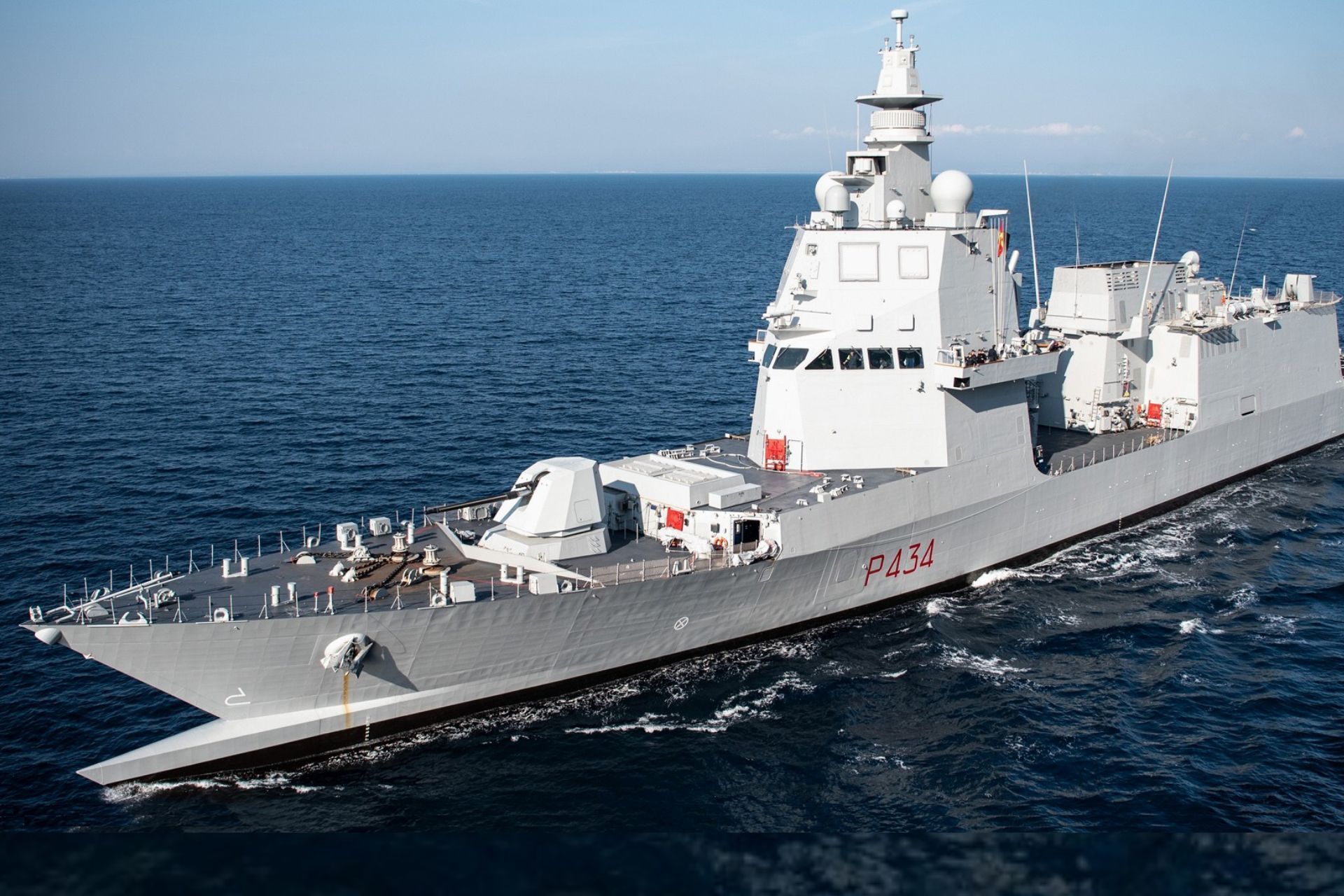
The Giovanni delle Bande Nere (P434) is an offshore patrol vessel of the Thaon di Revel class, built by Fincantieri for the Italian Navy and commissioned in October 2024. (Picture source: Italian Navy)
The central element of the 2025 edition was the Italian Navy’s Giovanni delle Bande Nere, the first ship of the PPA (Pattugliatore Polivalente d’Altura) class configured for full multi-mission combat capabilities. The vessel was equipped with systems developed by Leonardo, including the latest version of the SADOC 4 command and control platform and the Dual Band Radar. These technologies were tested in scenarios involving live-fire exercises and complex threat simulations to assess their effectiveness in real conditions.
The Giovanni delle Bande Nere (P434) is an offshore patrol vessel of the Thaon di Revel class, built by Fincantieri for the Italian Navy and commissioned in October 2024. As the first unit of its class in the “full” configuration, it displaces 6,270 tons fully loaded and measures 143 meters in length. Powered by a CODAG propulsion system combining gas turbines and diesel engines, the ship can reach 27 knots with a range of 5,000 nautical miles at 15 knots. It is designed for extended capabilities in anti-air, anti-surface, and anti-submarine warfare, with a core crew of 120 and the modularity to accommodate embarked forces or a command staff.
Its armament includes a 127 mm Oto Melara gun, a 76 mm Strales gun, two remote-controlled 25 mm turrets, 16 Aster 15/30 surface-to-air missiles, eight Teseo Mk2/E anti-ship and land-attack missiles with a range of over 360 km, and MU90 torpedoes. The ship is equipped with advanced sensors such as the AESA 3D Dual Band Radar (C and X-band), the SADOC Mk4 combat management system, and the fixed-panel Kronos radar. Electronic warfare is provided by the ZEUS system along with decoy launchers against missiles and torpedoes. Designed for multi-domain operations, the Giovanni delle Bande Nere combines detection capability, enhanced protection, and interoperability with NATO forces.
Leonardo describes SADOC 4 as the ship’s central system, capable of rapidly and efficiently coordinating the defence against complex air and missile threats. It features an advanced human-machine interface designed to improve situational awareness and accelerate decision-making. This interface aims to reduce the time between threat detection and response, a critical factor in contemporary military engagements.
Additionally, the Dual Band Radar demonstrated its versatility and resilience under various operational demands. It can simultaneously perform surveillance, target tracking, missile guidance, fire support, and electronic attack missions. During the exercise, the radar proved capable of tracking ballistic missiles at supersonic speeds over several hundred kilometres. Its radar panel configuration ensures full coverage while minimizing electromagnetic interference, which is essential in complex environments.
The Giovanni delle Bande Nere contributed by operating seamlessly within allied forces. The onboard sensors continuously tracked a short-range ballistic target to sea impact and identified medium-range missiles launched from both land and sea. This data was shared in real time via tactical links, enhancing situational awareness among NATO naval forces.
Leonardo noted that its Dual Band Radar distinguished itself by initiating target tracking within seconds of launch and maintaining accuracy over long distances. This performance, combined with SADOC 4’s interoperability with allied systems, particularly those of the United States, led to the Italian Navy being recognized during the exercise’s closing forum. The Navy was acknowledged as one of the world’s most advanced naval forces in terms of integrated air and missile defence capabilities.