






Breaking News






How Does US Plan to Replace Destroyers with Drones to Protect Cargo Ships?.
According to information published by the Defense Advanced Research Projects Agency (DARPA) on its official website on May 26, 2025, the Pentagon has launched an ambitious program to develop autonomous maritime platforms designed to escort commercial vessels against asymmetric threats such as uncrewed surface vehicles (USVs). Named “Pulling Guard,” the initiative aims to reduce reliance on costly and limited traditional escort options such as guided missile destroyers and carrier strike groups, while enhancing the security of global maritime trade in the face of rising risks.
Follow Army Recognition on Google News at this link
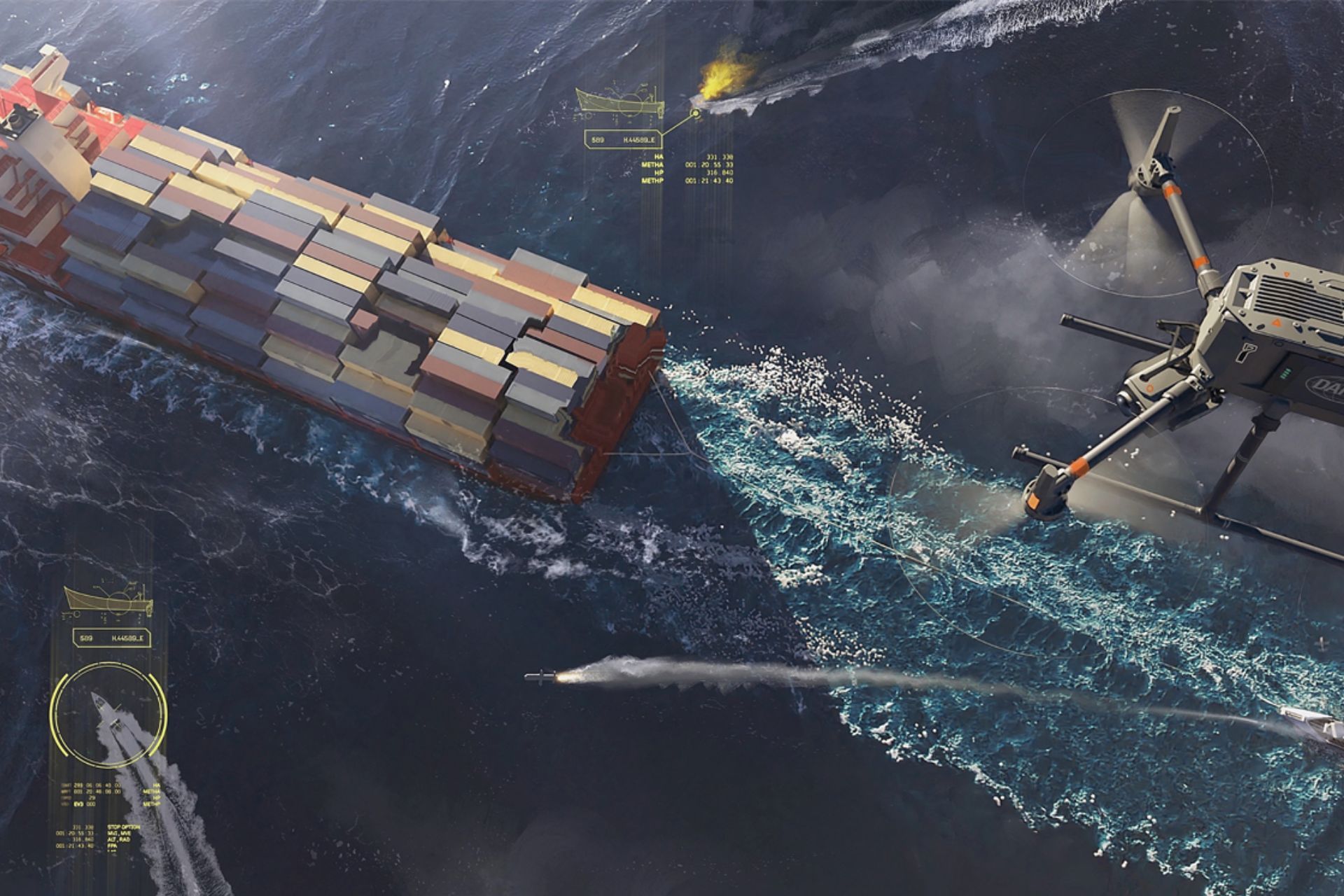
An overwatch drone and a remotely operated surface vessel protect a cargo ship from pirate threats in this DARPA concept (Picture source: DARPA)
The Pulling Guard program is based on autonomous systems remotely supervised by human operators via secure communications links. These maritime platforms will incorporate existing sensors and effectors, assembled within a modular framework to support continuous updates to software and hardware in response to evolving threats. The emphasis on modularity is intended to speed up development cycles and ease adaptation to export requirements and various regulatory environments. DARPA, which oversees the program, notes that this approach is crucial for producing versions suited to different markets and operational contexts.
The global maritime context provides a strong rationale for such a program. Maritime shipping accounts for approximately 80% of world trade volume and 70% of its value. Commercial ships often pass through narrow strategic chokepoints, such as the Strait of Hormuz or the Red Sea, where they are vulnerable to attacks by pirates, non-state actors, or hostile forces. The increasing availability of low-cost commercial technologies, including remote command systems, autonomy, and remote sensing, has enhanced the capabilities of asymmetric threats and complicated security efforts.
Traditionally, the U.S. Navy has responded to such threats by deploying high-value platforms such as destroyers and aircraft carriers to protect key maritime routes. However, the growing volume of commercial traffic, the expanding range of military missions, and rising operational costs are making this approach less sustainable. The Pulling Guard model proposes a more flexible and cost-effective alternative, offering “protection as a service” through commercial providers under contract with the U.S. military. This approach requires no permanent modifications to the escorted vessels, and the protection systems would be fully detachable. The commercial ship’s captain would remain involved in the decision-making process, while engagement authority would be retained by remote military operators.
The program is structured in two phases. The first phase, lasting 18 months, focuses on platform and sensor development by multiple industrial partners. This stage will require close collaboration among participants to define both physical and digital interfaces and to adopt an iterative design approach. The second phase, extending over 21 months, will concentrate on systems integration, manufacturing, and preparing the technology for commercial deployment.
This effort coincides with a global increase in maritime security threats. In the first quarter of 2025, 45 piracy incidents were reported worldwide, marking a 35% increase over the same period in 2024. Of these incidents, 37 involved vessel boardings, four ships were hijacked, and four others were targeted in failed attempts. Thirty-seven crew members were taken hostage, thirteen were kidnapped, two were threatened, and one was injured. Firearm-related incidents also increased, with 14 recorded in the first three months of 2025 alone.
The situation in the Red Sea remains especially tense. Houthi rebels in Yemen have continued their attacks on commercial shipping since late 2023. Although they claim to be targeting Israeli-linked vessels in support of Palestine, many of the targeted ships have no ties to Israel. On January 9, 2024, a coordinated attack involving kamikaze drones, anti-ship missiles, and a ballistic missile was repelled by U.S. and U.K. naval forces. However, a March 7 attack resulted in the deaths of three civilian mariners. The economic impact has been substantial: Suez Canal revenues fell by 50% in January 2024, and insurance premiums for vessels transiting the region increased tenfold, prompting many companies to reroute ships around Africa.
The Pulling Guard program reflects the Pentagon’s effort to rethink traditional maritime security strategies in an era of hybrid threats. By leveraging autonomy, modularity, and a flexible public-private partnership model, the initiative may redefine commercial vessel protection standards while enhancing the resilience of global supply chains in the face of emerging forms of naval conflict.