






Breaking News






French Navy to extend naval reach with delivery of BRF Jacques Stosskopf Replenishment Ship.
The French Navy is set to take delivery of its second Force Replenishment Ship, BRF Jacques Stosskopf, at Toulon in late 2025, under the Franco-Italian FLOTLOG logistics fleet program. This large replenishment oiler, based on the Italian Vulcano design, significantly increases France's ability to sustain carrier strike and amphibious groups at a distance and within NATO task forces.
At the end of 2025, the French Navy plans to formally take delivery of the Force Replenishment Ship Jacques Stosskopf at the Toulon naval base, marking the entry of its second new-generation logistics vessel under the FLOTLOG program. The 194-meter ship, derived from the Italian Vulcano class under OCCAR-managed Franco-Italian cooperation, will join lead ship Jacques Chevallier to replace aging Durance-derived replenishment tankers and restore depth to France's blue-water support fleet.
Follow Army Recognition on Google News at this link
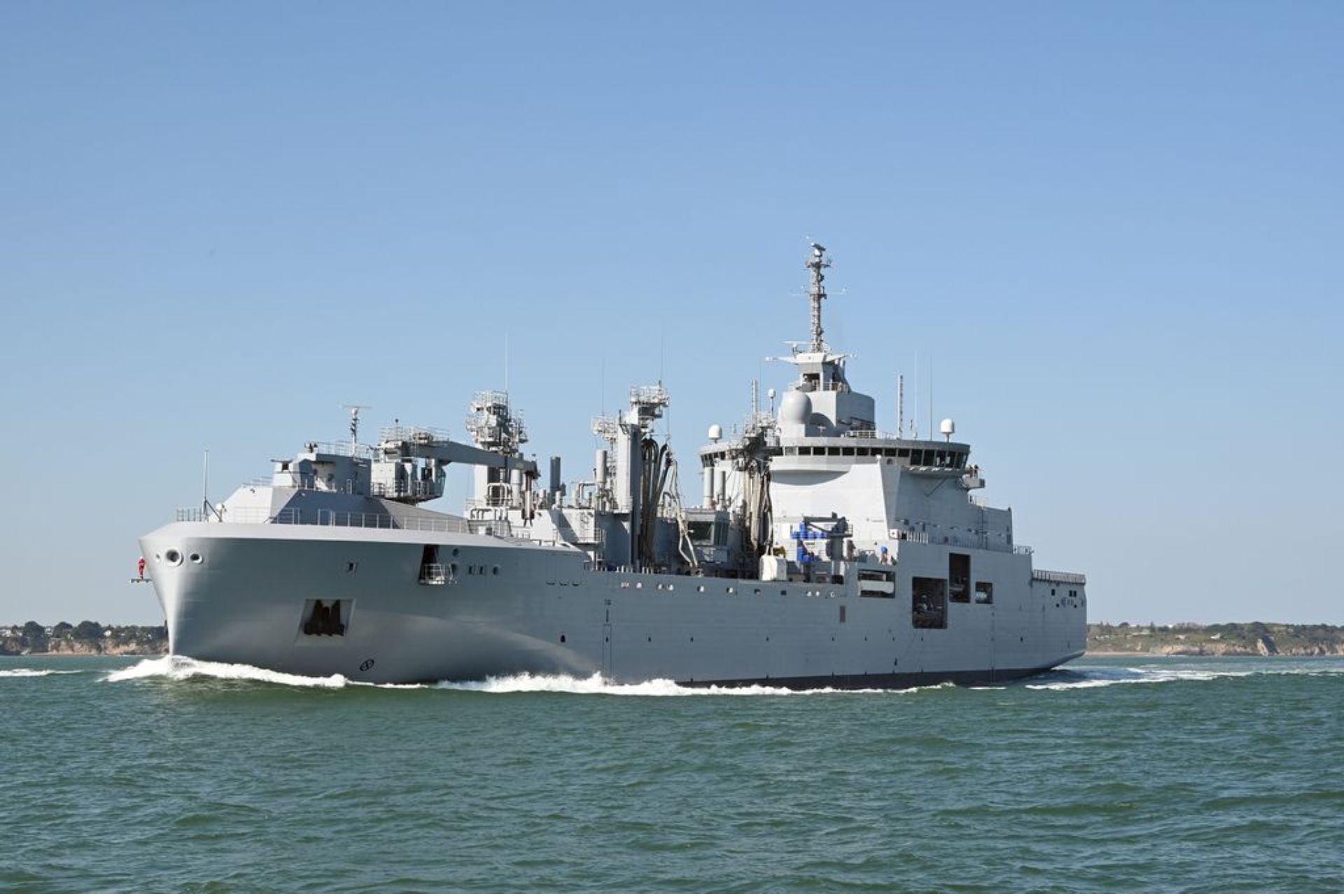
With a length of 194 metres and a beam of 27.6 metres, it displaces around 31,000 tonnes at full load, which makes it, after the aircraft carrier Charles de Gaulle and ahead of the Mistral-class amphibious assault ships (PHA), one of the largest surface units in the fleet. (Picture source: OCCAR)
Derived from the Italian replenishment oiler Vulcano, under a Franco-Italian cooperation led by OCCAR on behalf of the DGA and the shipbuilder Fincantieri, Jacques Stosskopf is the second in a series of four Force Replenishment Ships (BRF) intended to replace the ageing Command and Replenishment Ships (BCR) Var, Marne, and Somme.
With a length of 194 metres and a beam of 27.6 metres, it displaces around 31,000 tonnes at full load, which makes it, after the aircraft carrier Charles de Gaulle and ahead of the Mistral-class amphibious assault ships (PHA), one of the largest surface units in the fleet. Having arrived in Toulon on 31 July 2025 after an initial trial campaign from Saint-Nazaire, it fits into a gradual build-up alongside the lead ship Jacques Chevallier, delivered in 2023 and commissioned in 2024, followed by Émile Bertin in Brest and Gustave Zédé in Toulon in the early 2030s.
The technical characteristics of Jacques Stosskopf illustrate the change in scale sought by the French Navy. The ship can carry nearly 13,000 m³ of fuel, including both marine diesel and aviation fuel, which it can transfer at sea at a rate of up to 1,200 m³ per hour, while also transporting around 1,500 tonnes of solid cargo in its holds and containers.
Its diesel-electric propulsion is based on four MAN engines delivering about 24 MW, allowing the vessel to maintain a speed close to 20 knots and to accompany combat groups over long distances. The double hull complies with international environmental protection standards and allows replenishment operations in sensitive areas, while the Polaris combat management system, combined with the Terma Scanter 6002 air-surveillance radar and Safran Paseo XLR optronic systems, enables the BRF to contribute to the tactical picture and to ensure its own close-in protection.
The arrival of Jacques Stosskopf strengthens the logistical posture of the French ocean-going fleet. With two BRFs in service, the French Navy can support over time the carrier strike group built around Charles de Gaulle, but also amphibious groups centred on the PHA and combined deployments with first-rank frigates.
The ability to transfer fuel, supplies, ammunition and spare parts simultaneously, including in favour of allied ships, increases interoperability within naval groups of the North Atlantic Treaty Organization (NATO) and the European Union, in the Mediterranean, the North Atlantic and, in the longer term, the Indo-Pacific. The capacity to host an embarked staff, the presence of maintenance workshops and the option to operate under Emission Control (EMCON) make the BRF a forward logistical command platform and a useful support node for allied aeromaritime forces, able to operate in contested environments where continuity of support is a critical condition for freedom of action.
Beyond the day-to-day manoeuvre of the fleet, the FLOTLOG programme carries a broader strategic dimension. By replacing life-expired BCRs with vessels designed for high-intensity operations and extended deployments, France maintains an autonomous ocean-projection capability consistent with the objectives set by successive Military Programming Laws. The close link between the French Navy, the French naval Defence Industrial and Technological Base (BITD), and Italian partners contributes to shaping a European offer of logistic support ships for export, available to navies seeking to increase their operational endurance without depending exclusively on United States assets.
In a context of growing competition at sea, from the North Atlantic to the Indo-Pacific, the entry into service of Jacques Stosskopf complements the build-up of Jacques Chevallier and prepares the arrival of the future next-generation aircraft carrier, helping to sustain French naval credibility over the long term.