






Breaking News






France reinforces presence in the Indian Ocean with third POM-class offshore patrol vessel Auguste Techer.
On August 25, 2025, the French Navy’s third Félix Éboué-class overseas patrol vessel, Auguste Techer, arrived at its homeport of Port-des-Galets on La Réunion, marking the end of its first long deployment and joining the Armed Forces in the Southern Indian Ocean Zone (FAZSOI). This deployment was used to complete phase-one Verification of Military Characteristics before the vessel’s formal reception by the French Navy.
Follow Army Recognition on Google News at this link
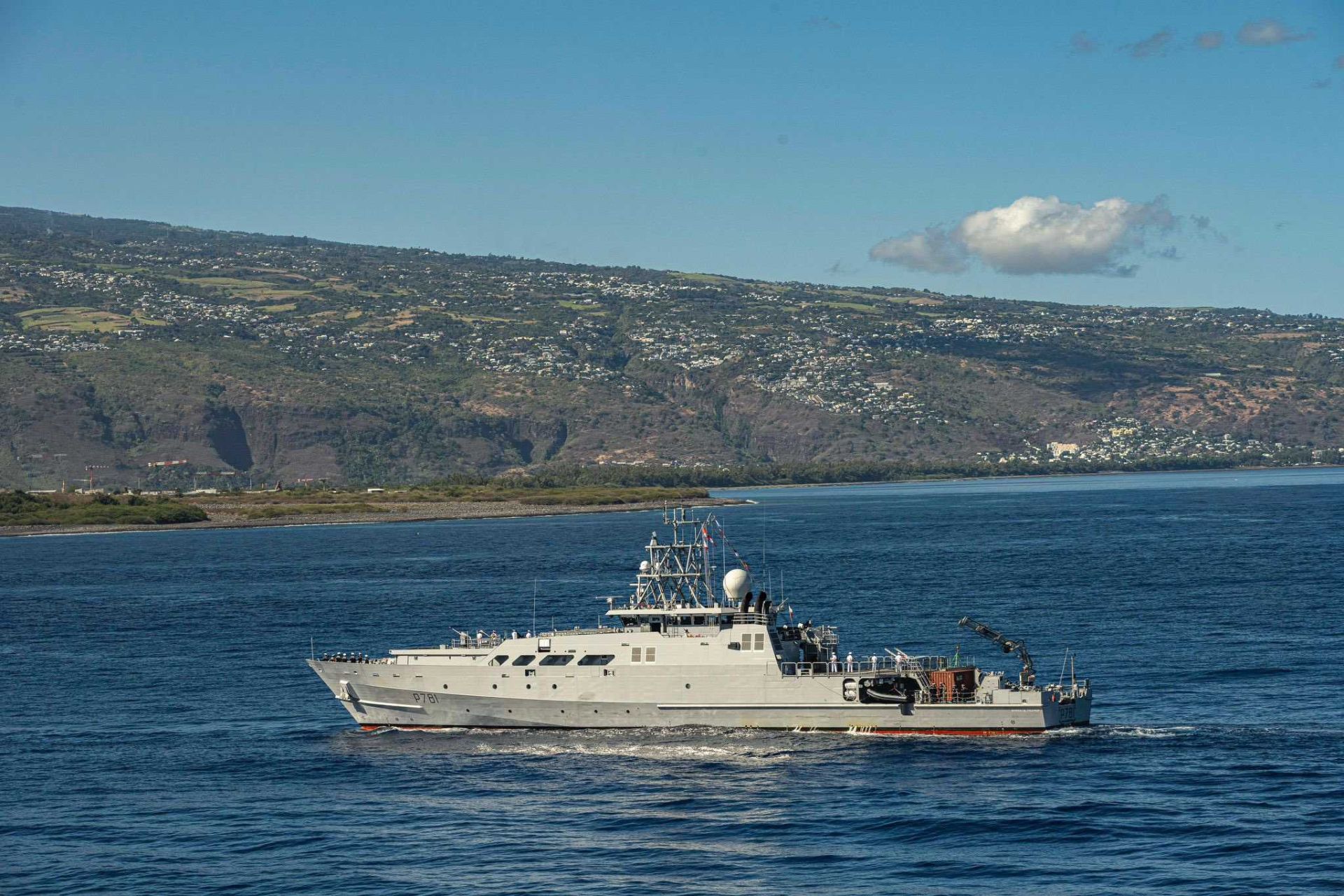
After initial crewing and armament at Boulogne-sur-Mer and months of sea trials off Brittany, the Auguste Techer departed mainland France in early July to reach its new base of Port-des-Galets on La Réunion. (Picture source: French Navy)
The Auguste Techer was constructed in metropolitan France by Socarenam and designed by Mauric, and it is named after Auguste Techer, a Réunion-born Compagnon de la Libération. The unit was ordered under the 2019 contract for six Patrouilleurs Outre-mer (POM), valued at 223,939,897 euros excluding VAT, which was awarded jointly to Socarenam and CNN-MCO. The program, which follows from the BATSIMAR framework and the 2017 Strategic Review for National Defence and Security, defines patrol vessels intended for overseas deployment, designed for sovereignty and coast guard duties rather than offensive missions.
After its launch at Saint-Malo on 22 December 2023 and transfer to Boulogne-sur-Mer for fitting out, Auguste Techer was moved to Brest on 4 November 2024 to complete systems integration and the VCM process. This period lasted longer than for the first two ships of the class. The vessel departed from Brittany on 10 July 2025 and began a two-month transit to La Réunion. The voyage included its first equator crossing and a port call in South Africa, a location rarely visited by French Navy vessels, which provided an opportunity to evaluate its performance in heavy weather. The deployment also allowed the crew to conduct extensive trials of onboard systems. On arrival, the vessel was formally welcomed in the presence of civil and military authorities, family members of the crew, and representatives of the local community. BSAOM Champlain greeted the ship with water jets, highlighting the significance of the event for the island’s naval infrastructure.
The Félix Éboué-class, also known as POM-class (for "Patrouilleur Outre-mer", or Overseas Patrol Vessel) displaces about 1,300 tonnes at full load, is 80 meters in length, 11.8 meters in beam, and has a draught of 3.5 meters. Propulsion is diesel-electric, with two ABC 16DZC diesels of 3,880 kW and two ENAG/ABB electric motors of 550 kW, providing a maximum speed of 24 knots and a range of 5,500 nautical miles at 12 knots. The hybrid propulsion system allows operations at up to 12 knots on electric power alone, reducing engine wear. The ships are designed for operations of up to thirty days without resupply in areas of high heat and humidity. The complement is 30 sailors with accommodation for 29 additional personnel, including the possibility of embarked divers or special forces. The ships carry two 8-meter RHIBs, launched by stern ramp and davit, which support boarding and interception missions. The hull incorporates a hard-chine form, anti-roll tanks and keels, and an optimized beam that improves seakeeping, characteristics confirmed during the vessel’s passage via the Cape of Good Hope.
Sensors and combat systems on board include the Lyncea combat management system from Nexeya, a Kelvin Hughes SharpEye Mk II X-band air and surface surveillance radar from Hensoldt, Sperry Marine navigation radars, and an electro-optical Sae Eagle surveillance system. Satellite communication systems and HF links provide long-range connectivity. The ships are equipped with a remotely operated 20 mm Nexter Narwhal autocannon on the bow, two 12.7 mm machine guns, and two 7.62 mm machine guns, with provisions for mounting Mistral or Akeron missiles on a tripod and the option of employing an 81 mm mortar. For aerial surveillance, the ships can deploy a Survey Copter Aliaca unmanned aircraft, with a mission endurance of three hours and a range of 50 kilometers, launched by catapult and recovered by net. Eleven of these UAV systems were planned for delivery to the Navy by 2023 and thirteen more by 2025. Each ship also has facilities for additional VTOL unmanned aerial systems.
The POM class is replacing the P400-class patrol vessels, which had been withdrawn by 2023, as well as local stopgap assets such as Le Malin and Arago. The Auguste Techer now operates alongside the surveillance frigates Floréal and Nivôse, in service since 1992, which will be replaced in the early 2030s by new corvettes, and BSAOM Champlain, which entered service in 2017. The polar logistics vessel L’Astrolabe, introduced in 2017 and operated in support of the French Southern and Antarctic Lands, is also based at La Réunion for part of the year. With its arrival, La Réunion regains a two-patrol ship posture for the first time in over a decade. The Félix Éboué, the sixth and last of the series, is scheduled to replace Le Malin at La Réunion in 2027, ensuring continuity of patrol capability. The region’s exclusive economic zones include 317,000 km² around La Réunion, 69,000 km² around Mayotte, and 635,000 km² around the Îles Éparses, forming part of the 2.8 million km² under FAZSOI responsibility.
Auguste Techer is the third unit of the six-ship series. The first, Auguste Bénébig, was delivered in May 2023 and commissioned in July 2023 at Nouméa. The second, Teriieroo a Teriierooiterai, was delivered in May 2024 and commissioned in July 2024 at Papeete. The fourth ship, Jean Tranape, is expected to undergo trials at the end of 2025 and is planned for service in New Caledonia in 2026. The fifth, Philippe Bernardino, is being assembled at Saint-Malo and will be assigned to Polynesia, while the sixth, Félix Éboué, will be delivered to La Réunion in 2026 and is scheduled to enter service in 2027. All six vessels carry names honoring Compagnons de la Libération from the territories where they are based. Administrative tracking lists Auguste Techer under MMSI 228867100, with call sign FAUR, and IMO number 4765646, and records a gross tonnage of 1,506 tonnes. The vessel is now officially integrated into FAZSOI and tasked with surveillance, fisheries enforcement, environmental monitoring, counter-trafficking, and humanitarian assistance operations across the southwest Indian Ocean.
The French FAZSOI (Forces armées de la zone sud de l’océan Indien, translated to Armed Forces in the Southern Indian Ocean Zone) itself fields about 1,700 personnel at La Réunion and Mayotte, providing defense of populations and French overseas territories, protection of maritime resources, and support for joint operations with partner countries. These responsibilities include sovereignty patrols, countering piracy, and ensuring maritime safety across a wide area of operations. In this context, Auguste Techer fills a role as a multi-mission platform with greater autonomy, endurance, and flexibility than the P400-class patrol vessels it replaces. Its design allows extended deployments, integrated unmanned systems, and enhanced constabulary capabilities while retaining modest armament suited to maritime policing. Its introduction addresses capability gaps that had existed since the decommissioning of La Boudeuse and La Rieuse in 2011, which were only partially offset by the use of Le Malin. With Auguste Techer in service and Félix Éboué to follow, La Réunion will host two POMs as originally planned, reinforcing French naval posture in the southwest Indian Ocean.