






Breaking News






Exclusive: USS Nimitz and USS Carl Vinson Aircraft Carriers Conduct Joint Maneuvers to Reinforce U.S. Deterrence in the Gulf.
On July 5, 2025, the U.S. Navy’s dual deployment of USS Nimitz and USS Carl Vinson in the U.S. 5th Fleet area showcased a rare and potent demonstration of carrier strike capabilities. Operating together in the Central Command region, these two aircraft carriers carried out coordinated flight operations and formation maneuvers, reinforcing American maritime presence across some of the world’s most contested waterways. Their joint activities come amid renewed tensions involving Iran and Israel, raising questions about regional security balances and the reach of U.S. sea power. This significant development was reported by the U.S. Navy at DVIDS.
Follow Army Recognition on Google News at this link
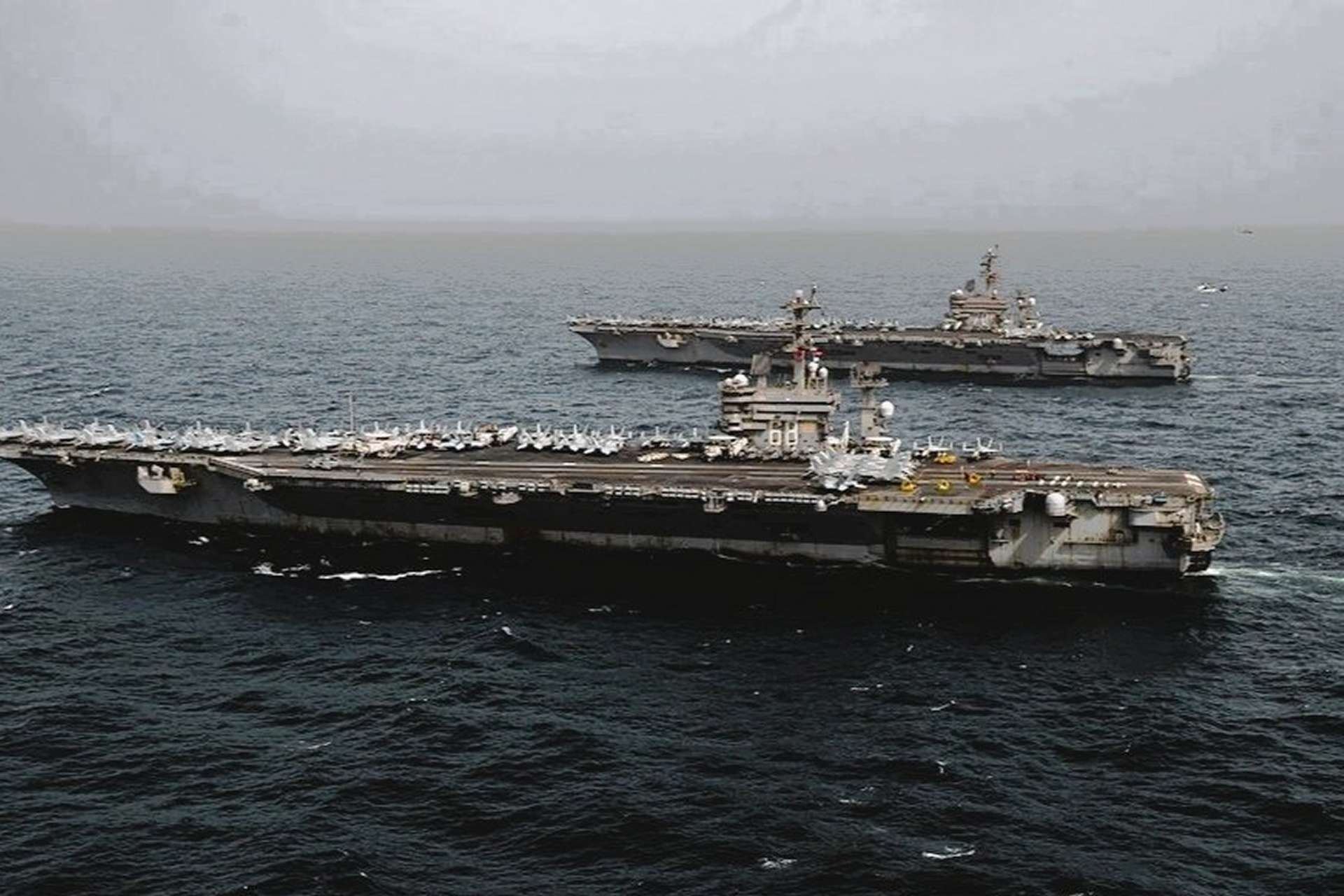
The rare sight of USS Nimitz and USS Carl Vinson maneuvering side by side in the U.S. 5th Fleet area marks more than just a routine exercise (Picture source: U.S. Navy)
The USS Nimitz (CVN 68) and USS Carl Vinson (CVN 70) are both Nimitz-class nuclear-powered supercarriers, yet they differ in operational configurations and embarked air wings. The Nimitz can typically launch a diverse complement of F/A-18E/F Super Hornets, EA-18G Growlers, E-2C Hawkeyes, and MH-60R/S Seahawks, boasting a total aircraft capacity of around 60–70. Carl Vinson has undergone more recent upgrades, allowing it to deploy the newer F-35C Lightning II stealth fighters alongside traditional Super Hornets and advanced electronic warfare platforms. This blend of legacy and cutting-edge aircraft highlights how each carrier strike group brings unique tactical options to regional operations.
Throughout modern naval history, U.S. aircraft carriers have occasionally converged in contested waters as a clear signal of American deterrence. One notable example was in 2020, when the Nimitz and Ronald Reagan strike groups operated together in the South China Sea, conducting joint exercises to underscore freedom of navigation. Such dual-carrier operations remain relatively rare, underlining the weight of this recent maneuver in the Central Command’s volatile waters.
Strategically, the presence of two carrier strike groups in the Persian Gulf and surrounding seas cannot be understated. The region encompasses vital chokepoints like the Strait of Hormuz, Bab al-Mandeb, and the Suez Canal, arteries through which much of the world’s energy supply flows. By staging high-visibility operations here, the U.S. signals its readiness to secure global trade routes and reassure partners amid geopolitical frictions, including Iranian maritime threats and broader Middle Eastern instability. Militarily, the deployment demonstrates the enduring relevance of carrier-based power projection in areas where shore-based assets may be limited or politically constrained.
The rare sight of USS Nimitz and USS Carl Vinson maneuvering side by side in the U.S. 5th Fleet area marks more than just a routine exercise. It signals to both allies and potential adversaries that the United States remains committed to projecting credible naval force wherever vital sea lanes, regional balances, and global energy security intersect.