










Exclusive: U.S. Marines demonstrate rapid HIMARS rocket delivery with MV-22B aircraft at Talisman Sabre 2025.
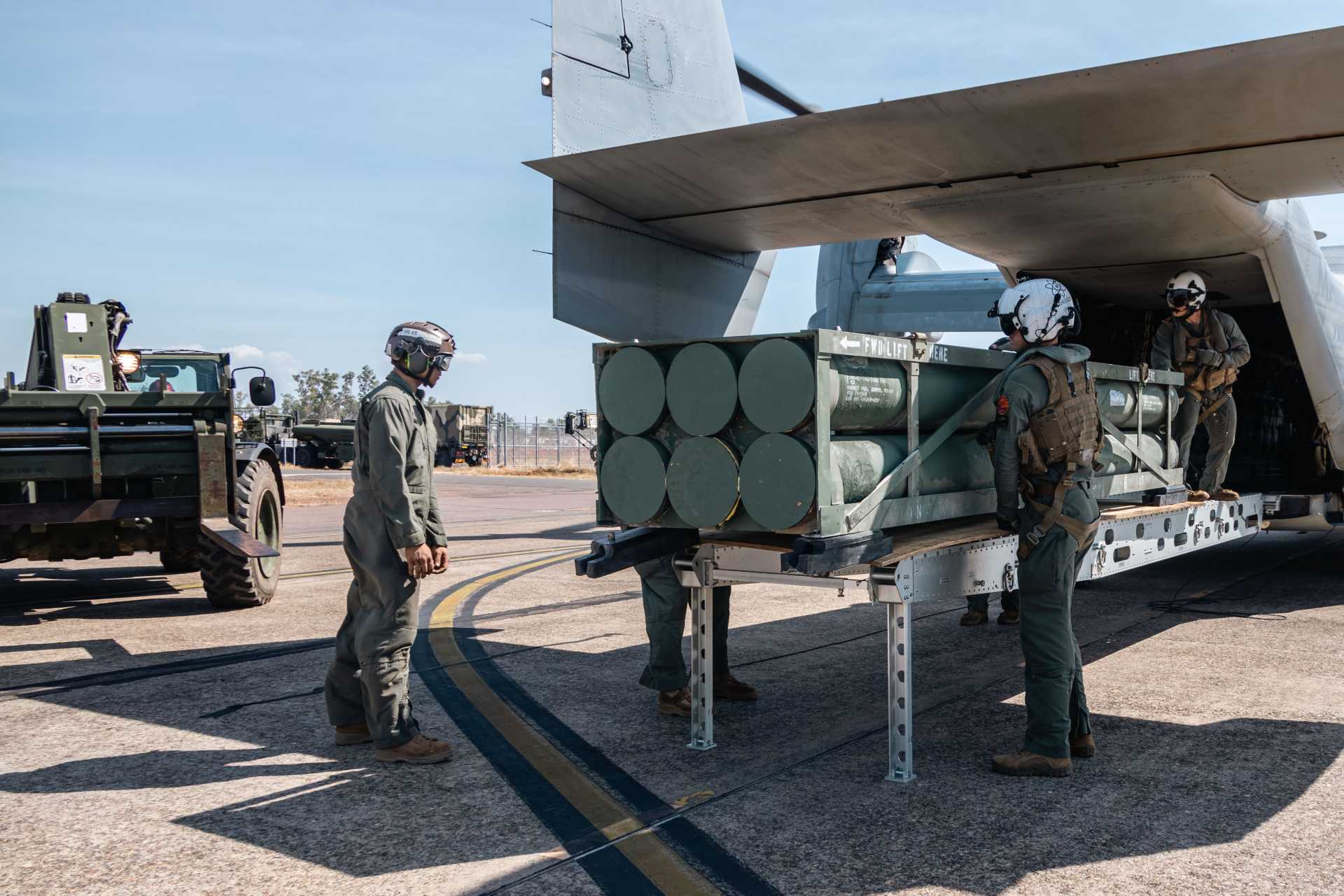
During Talisman Sabre 2025, the largest bilateral military exercise between Australia and the United States, U.S. Marines with Marine Medium Tiltrotor Squadron 363 (VMM‑363), part of Marine Rotational Force–Darwin 25.3, conducted a strategic aerial delivery of M142 High Mobility Artillery Rocket System (HIMARS) ammunition pods using an MV‑22B Osprey in Northern Territory, Australia, on July 16, 2025. This highly coordinated air-to-ground mission demonstrated a new level of interoperability between allied forces, ensuring rapid logistical support for land-based artillery elements operating in dispersed and contested environments.
Follow Army Recognition on Google News at this link

U.S. Marines with VMM-363, Marine Rotational Force–Darwin 25.3, deliver M142 HIMARS rocket pods from an MV-22B Osprey in Northern Territory, Australia, during a logistics demonstration on July 16, 2025. (Picture source: U.S. DoD)
The MV‑22B Osprey is a tiltrotor aircraft combining the vertical lift capability of a helicopter with the speed and range of a fixed-wing plane. Designed by Bell Boeing, the Osprey can carry up to 9,000 kilograms of internal cargo or 6,800 kilograms externally, and reach speeds of over 430 kilometers per hour while cruising at altitudes significantly higher than those of conventional rotorcraft. These attributes enable the aircraft to conduct vertical takeoffs and landings from remote or unprepared areas, then quickly transition to high-speed flight, making it uniquely suited for time-sensitive logistics missions.
In this operation, the MV‑22B tiltrotor aircraft was employed to rapidly deliver HIMARS rocket pods directly into forward-deployed locations, enabling U.S. Marine artillery units on the ground to sustain continuous fire support without reliance on conventional ground resupply routes. This capability ensured that rocket artillery elements could maintain momentum and responsiveness in dynamic battlefield conditions, even when operating from isolated or contested positions.
The M142 HIMARS is one of the most critical assets in today’s battlefield, offering long-range precision strike capability that can shape the operational environment and deliver effects deep into enemy-held territory. However, its effectiveness is directly linked to sustained access to munitions. The integration of the MV‑22B into HIMARS logistics provides a transformative capability, ensuring rocket resupply can occur even under threat or in hard-to-reach areas. This airborne resupply system allows ground commanders to reposition HIMARS units rapidly and maintain a constant tempo of fire without waiting for traditional logistics channels.
By employing MV‑22B tiltrotor aircraft for artillery support logistics, the U.S. Marine Corps is expanding the role of aviation assets in sustaining combat power on the ground. This operation during Talisman Sabre 2025 exemplifies how joint logistics and mobility can be combined to deliver rapid and reliable resupply in the evolving landscape of expeditionary warfare. The success of this mission highlights a key advancement in ensuring that HIMARS, as a cornerstone of precision fires, remains continuously combat-ready across any operational theater.
Crucially, this exercise also demonstrated the growing interoperability between naval and land forces in the modern battlefield. The MV‑22B, as a key asset aboard amphibious assault ships and forward-deployed naval task forces, serves as a strategic connector between sea-based logistics hubs and land-based artillery platforms like HIMARS. This naval-to-land resupply concept enables forces to project power ashore without dependence on vulnerable ports or overland supply routes. By deploying from maritime platforms and operating deep inland, the Osprey allows HIMARS units to receive rapid, flexible resupply in support of fast-moving ground campaigns.
Such capability is vital in the context of Indo-Pacific operations, where large distances, island chains, and limited infrastructure require seamless integration between naval air mobility and ground-based firepower. Talisman Sabre 2025 proved that U.S. Marines and their Australian counterparts can operate across domains to deliver sustained precision fires under combat conditions. As the U.S. Marine Corps advances its Force Design 2030 initiatives, the ability to synchronize naval and ground operations with platforms like the MV‑22B will be central to maintaining operational superiority and ensuring readiness in high-threat, contested environments.