






Breaking News






Exclusive: British Royal Navy Aircraft Carrier HMS Prince of Wales Makes Historic First Visit to Australia.
According to information published by the British Ministry of Defence, on July 23, 2025, the British Royal Navy's flagship aircraft carrier HMS Prince of Wales arrived in Australia for the first time, marking a historic milestone for the United Kingdom's maritime presence in the Indo-Pacific. This visit is not only the first appearance of a Queen Elizabeth-class aircraft carrier in Australian waters but also the first by any British Royal Navy aircraft carrier since 1997. The warship is currently spearheading the UK Carrier Strike Group (UKCSG) during Exercise Talisman Sabre 2025, a record-setting multinational military drill hosted by Australia.
Follow Army Recognition on Google News at this link
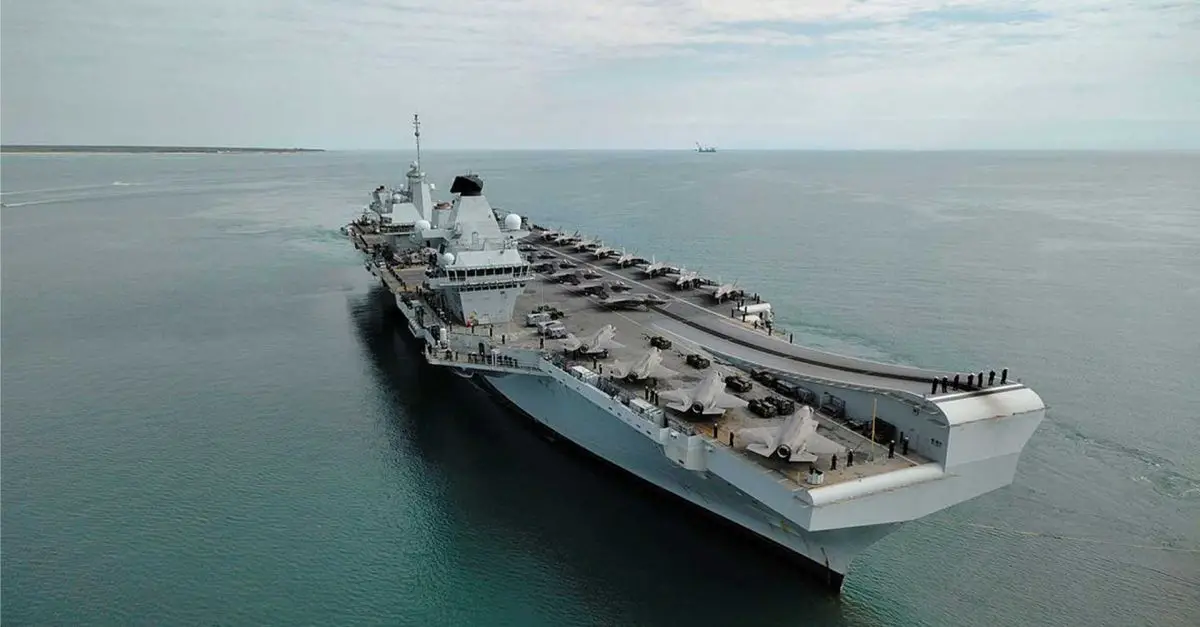
British Royal Navy aircraft carrier and fleet flagship, Queen Elizabeth-class aircraft carrier HMS Prince of Wales, visits Darwin in Australia’s Northern Territory in her latest stop of the UK Carrier Strike Group’s deployment to the Indo-Pacific. (Picture source: UK MoD)
Exercise Talisman Sabre 2025 brings together 19 participating nations and over 30,000 personnel, including ships and aircraft conducting integrated operations across multiple domains in Australia and Papua New Guinea. As the eleventh and largest iteration of the biennial exercise, this edition focuses on advanced multi-domain warfighting, interoperability, and joint force projection. The presence of the British Royal Navy HMS Prince of Wales aircraft carrier underlines the UK’s strategic ambition to reinforce ties with Indo-Pacific allies, enhance defense diplomacy, and uphold the rules-based international system through a robust military footprint in the region.
The deployment of a full UK Carrier Strike Group to the Indo-Pacific represents a major evolution in British naval strategy, placing a high-end, expeditionary maritime force at the heart of regional security efforts. For the Royal Navy, this deployment is a practical demonstration of its ability to operate globally with carrier-enabled power projection, ensuring a persistent presence in a region marked by increasing geopolitical competition and security challenges. It reinforces London’s commitment to freedom of navigation, open sea lines of communication, and collective deterrence alongside allies such as the United States, Japan, and Australia.
For Australia, the visit of British Royal Navy HMS Prince of Wales aircraft carrier and the participation of UKCSG (UK Carrier Strike Group) in Talisman Sabre significantly strengthen the country’s strategic partnerships and reinforce its defense posture in the Indo-Pacific. With the Royal Australian Navy investing in its own fleet modernization, including future nuclear-powered submarines and advanced surface combatants, joint operations with allies like the UK offer critical opportunities for operational integration, capability development, and shared deterrence. The exercise serves as a key platform for Canberra to project stability, protect national interests, and contribute to a balanced regional power structure.
This first operational presence of a British aircraft carrier in the Indo-Pacific in over two decades marks a significant chapter in UK-Australia defense cooperation. As Operation Highmast progresses, the integration of British sea power into regional coalitions sends a clear signal of allied unity and long-term engagement in maintaining peace and stability in the Indo-Pacific region.
The significance of this deployment is further amplified by the strategic messaging surrounding Exercise Talisman Sabre, which aims to ensure allied forces can operate jointly across air, land, sea, space, and cyber domains in contested environments. HMS Prince of Wales, supported by destroyers, frigates, submarines, and auxiliary ships, brings a fully capable carrier strike group into a region where maritime tensions, particularly in the South China Sea and Taiwan Strait, remain high on the strategic agenda. This visible presence supports regional deterrence objectives and underlines the UK’s readiness to respond rapidly to crises alongside its allies.
Moreover, the visit provides an opportunity to promote British defense industry and innovation. Onboard engagements and joint demonstrations with Australian officials and regional partners serve to showcase British maritime technology, operational doctrine, and integrated platforms such as the F-35B Lightning II and next-generation radar and communications systems. The deployment also fosters long-term industrial collaboration, as the UK and Australia deepen cooperation under existing agreements, including the AUKUS trilateral partnership.
This visit is part of Operation Highmast, the British Royal Navy’s premier global deployment for 2025. Spanning eight months, Operation Highmast includes engagements with over a dozen partner nations and entails a complex journey from Europe to the western Pacific via the Mediterranean and Middle East. The mission is a strategic display of British commitment to both Mediterranean and Indo-Pacific security frameworks, aiming to bolster international cooperation and project UK defense capabilities on a global scale. In total, the UKCSG deployment comprises 4,500 British military personnel, including 2,500 Royal Navy sailors and Royal Marines, 900 British Army troops, and 600 Royal Air Force members.
With the British Royal Navy's HMS Prince of Wales aircraft carrier now actively operating in the Indo-Pacific, this high-profile deployment reflects a broader shift in the UK's defense posture toward persistent global engagement and multilateral force readiness. It reinforces the message that the Royal Navy is not only capable of operating at distance but is fully integrated into the strategic framework of its Indo-Pacific allies.