






Breaking News





DSEI 2025: Type 26 frigate Advances Undersea Warfare Capacity in High North.
At DSEI 2025, the British Type 26 frigate was highlighted on the BAE Systems stand, where a detailed model was presented to visitors. The event was opened by an inaugural address from Lord Coaker at the Excel Exhibition Centre in London on 9 September 2025, who underlined the importance of this international showcase and referred to Norway’s decision to acquire at least five units of this vessel. This order, announced a few days before the opening of the exhibition, reflects the growing role of the programme in naval cooperation among allies.
Follow Army Recognition on Google News at this link
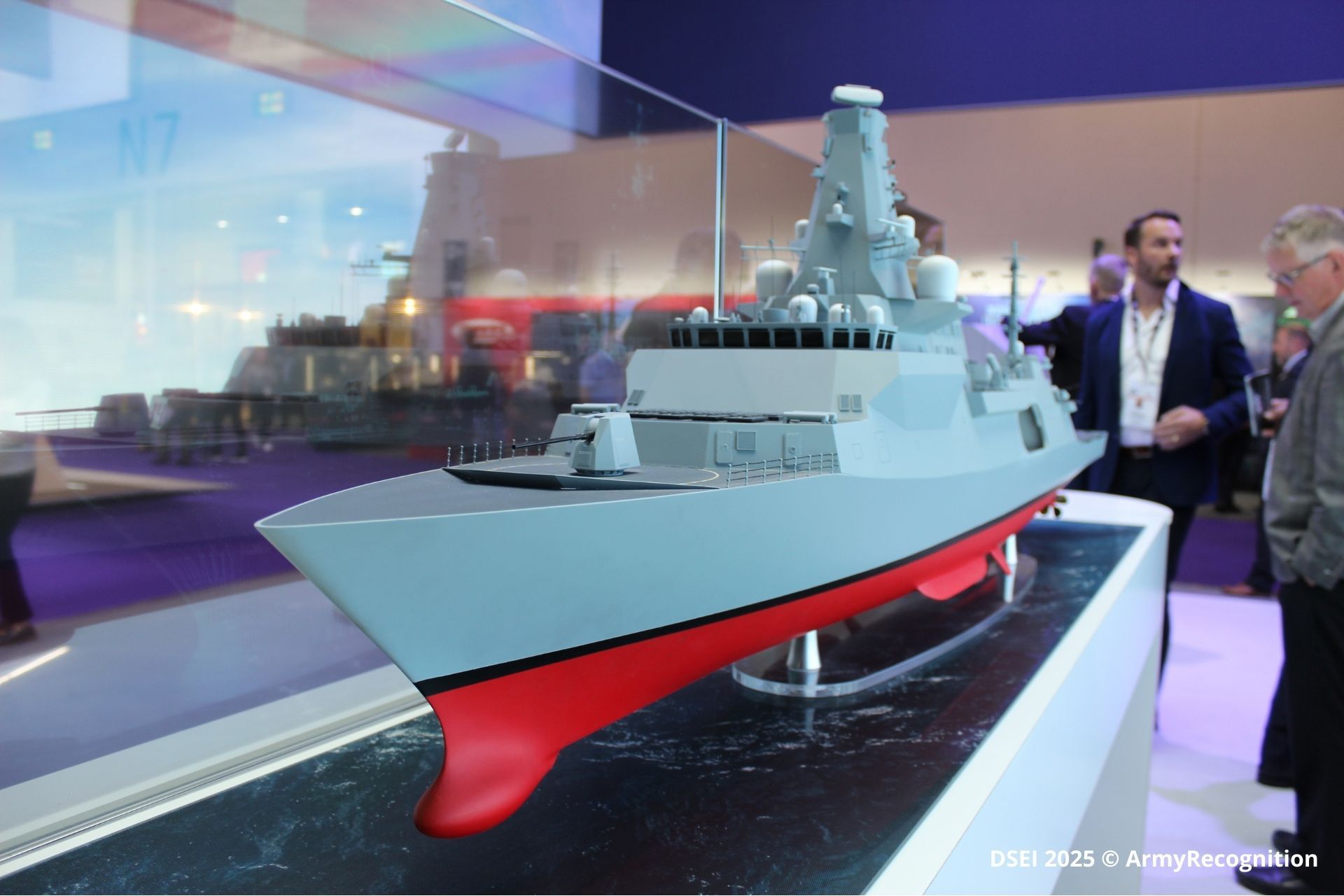
The Type 26 Frigate showcases by BAE Systems at DSEI 2025 (Picture source: Army Recognition)
The Type 26 frigate, also designated as the Global Combat Ship, was developed for the Royal Navy to progressively replace the Type 23 class. It is designed with a primary focus on anti-submarine warfare, featuring a hull optimized to reduce acoustic signatures and a quiet hybrid diesel-electric propulsion system to improve submarine detection. The vessel has a displacement of about 6,900 tonnes, a length of 149 meters, and an endurance exceeding 7,000 nautical miles, enabling it to conduct long-duration missions in the North Atlantic or other distant theatres.
Its combat system is built around BAE Systems’ CMS-1, capable of managing a wide range of threats. The standard armament includes a 127 mm gun, Sea Ceptor surface-to-air missiles housed in vertical launch systems, and the option to integrate anti-ship or land-attack missiles according to user requirements. The frigate can also embark a Merlin or Wildcat helicopter for anti-submarine warfare, enhancing its ability to operate jointly with other platforms.
Space on board allows for the embarkation of additional modules, including aerial or naval drones, as well as a flexible hangar for two medium helicopters. Emphasis on modularity is combined with improved accommodation, designed to maintain crew readiness during extended deployments.
The frigate is equipped with advanced sensors, including a medium-frequency hull-mounted sonar and provision for the integration of a Type 2087 towed array sonar, considered one of the most effective systems for submarine detection. The inclusion of next-generation multifunction radars also provides enhanced surveillance and air defense capability.
Norway’s decision to join the programme reflects a strategic requirement, as anti-submarine warfare in the North Atlantic and the Arctic has become a priority in response to increasing submarine activity in the region. With this choice, Oslo is gradually replacing its Fridtjof Nansen-class frigates and acquiring a vessel specifically designed for this role.
Alongside the Royal Navy, Canada, and Australia, Norway now contributes to a programme that will total more than thirty units. This interoperability among allies is expressed through shared training, common spare parts, and harmonized operational standards. It also increases the attractiveness of the Type 26 to other navies seeking a platform specialized in anti-submarine warfare but also adaptable to a range of missions in a complex strategic environment.
BAE Systems thereby maintains its position as a major naval shipbuilder, with a programme now adopted by four allied countries. The wider deployment of the frigate highlights the importance attached to detection and anti-submarine warfare capabilities, which remain a central issue in contemporary maritime security.