







Breaking News




Defense Alert: US Navy Warships Near Venezuela Triggered a Showdown with Fighter Jets in Caribbean.
The ESA’s Sentinel-2 captured the US Navy Iwo Jima amphibious group transiting the Caribbean Sea after exercises south of Puerto Rico, as reported on X by @SADefensa. The formation continued its course south, about 340 miles off the coast of Venezuela. Satellite images taken on September 3, 2025, confirmed the presence of the Iwo Jima Amphibious Ready Group (ARG) in the central Caribbean Sea. The group, centered on the USS Iwo Jima (LHD 7), included two San Antonio-class amphibious transport docks (LPD) as well as an Arleigh Burke-class guided-missile destroyer.
Follow Army Recognition on Google News at this link
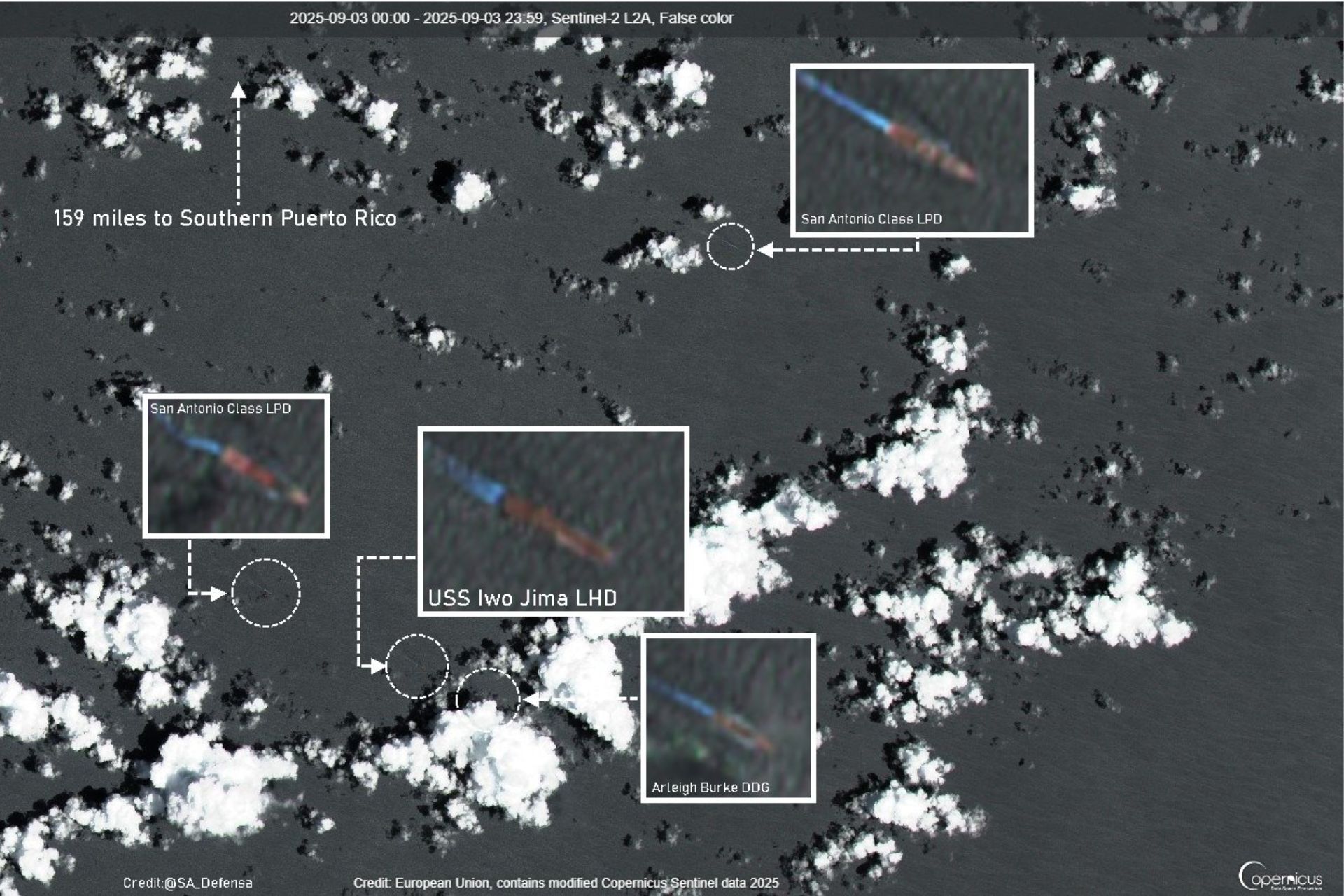
The USS Iwo Jima amphibious group with escort ships was detected in the Caribbean Sea about 550 km off the Venezuelan coast, according to ESA Sentinel-2 satellite imagery. (Picture source: X channel @SADefensa)
The US amphibious force had recently maneuvered south of Puerto Rico before descending into the Caribbean basin, now positioned about 550 kilometers off the Venezuelan coast. The USS Iwo Jima, a Wasp-class ship, is designed to deploy Marine Expeditionary Units, MV-22 Osprey aircraft, helicopters, and landing craft. The San Antonio-class LPDs add capacity for transporting troops, vehicles, and equipment. The Arleigh Burke-class destroyer provides multi-mission coverage, including air defense, anti-submarine warfare, and precision strike.
Beyond this core formation, the United States has deployed a larger force package in the region. Several other Arleigh Burke-class destroyers are present, including the USS Jason Dunham (DDG 109), the USS Gravely (DDG 107), and the USS Sampson (DDG 102). The Freedom-class littoral combat ship USS Minneapolis-Saint Paul (LCS 21) has also been detected, while the nuclear-powered attack submarine USS Newport News (SSN 750) operates in the area, though its precise location remains undisclosed. The maritime deployment is supported by extensive aerial and logistical assets. P-8A Poseidon patrol aircraft conduct wide-area surveillance, C-17 Globemaster III aircraft provide heavy transport, and MV-22 Osprey tiltrotors are deployed from Puerto Rico for rapid mobility. In total, more than 4,000 Marines and sailors are engaged in this operation, combining amphibious projection, maritime security, and counter-narcotics missions.
This naval presence comes amid a rapid escalation between Washington and Caracas. On September 4, 2025, two Venezuelan F-16 fighters conducted a harassment flight over the American destroyer USS Jason Dunham, also operating in the southern Caribbean. The Pentagon described the action as “highly provocative,” stating it was intended to interfere with counter-narcotics and counter-terrorism operations. The US ship did not respond militarily, but the Department of Defense warned that the “cartel running Venezuela” was strongly advised not to interfere further with American missions in the region.
The aerial incident occurred only two days after a US strike destroyed a vessel suspected of carrying narcotics and linked to the Tren de Aragua criminal group. President Donald Trump announced that 11 individuals were killed during this operation conducted in “international waters.” Secretary of State Marco Rubio justified the action by stressing the need to physically dismantle trafficking networks, stating that “only their elimination” could serve as a deterrent. Caracas denounced the strike as aggression and an illegal use of force.
In response, President Nicolás Maduro announced the mobilization of troops and popular militias, calling on citizens to join the Bolivarian Militia. In a press conference held in Caracas on September 1, he denounced what he called a destabilization attempt and declared that Venezuela would never be “enslaved” by the United States. The Venezuelan government accuses Washington of preparing regime change under the cover of counter-narcotics operations, while the United States maintains a $50 million bounty on Maduro for drug trafficking.
Tensions have reached a concerning level. According to experts, a direct invasion of Venezuela remains unlikely, due to international legal constraints and the absence of a congressional declaration of war. However, the combination of naval deployments, lethal strikes, and aerial confrontations increases the risk of uncontrolled escalation. As summarized by a former US diplomat quoted by the New York Times, the use of military force against traffickers labeled as terrorists is comparable to “using a blowtorch to cook an egg.”
For Washington, these operations send a clear message: the United States is prepared to employ military power to disrupt trafficking networks and increase pressure on the Venezuelan government. For Caracas, they represent an existential threat and a direct violation of sovereignty. Between American force projection and Venezuelan nationalist rhetoric, the Caribbean has once again become a major point of friction where every naval or aerial maneuver is interpreted as a political signal.
The satellite confirmation of the USS Iwo Jima amphibious group and the incident involving Venezuelan F-16s reflect a dynamic of provocation and counter-provocation. The coming weeks will show whether this confrontation remains limited to demonstrations of force or develops into open conflict, in a region now concentrating some of the most volatile security tensions in the Western Hemisphere.