






Breaking News






China's New Fujian aircraft carrier begins first live-force training with strike group.
China’s newly commissioned aircraft carrier Fujian has completed its first “maritime live force training” at sea with an escorting carrier strike group in the South China Sea, according to Chinese state media. The drills, which featured J-35 stealth fighters and KJ-600 early warning aircraft, come as tensions with Japan rise over possible Japanese involvement in a Taiwan crisis, and signal Beijing’s intent to field a fully operational blue-water carrier force.
Barely days after its November 5 commissioning ceremony in Sanya, Hainan, China’s new aircraft carrier Fujian has already wrapped up its first at-sea “maritime live force training” campaign with its carrier strike group, Chinese state broadcaster CCTV reported. The mission, described as part of the navy’s annual training plan, included multiple catapult launches and arrested landings by carrier aircraft and was framed by the People’s Liberation Army Navy as a test of combat readiness and an affirmation of China’s ability to defend its maritime sovereignty and development interests. The timing, coming as Japanese Prime Minister Sanae Takaichi faces domestic and regional scrutiny over comments about Japan’s potential role in a Taiwan contingency, turns what might have been a technical workup into a visible political signal across the Indo-Pacific.
Follow Army Recognition on Google News at this link
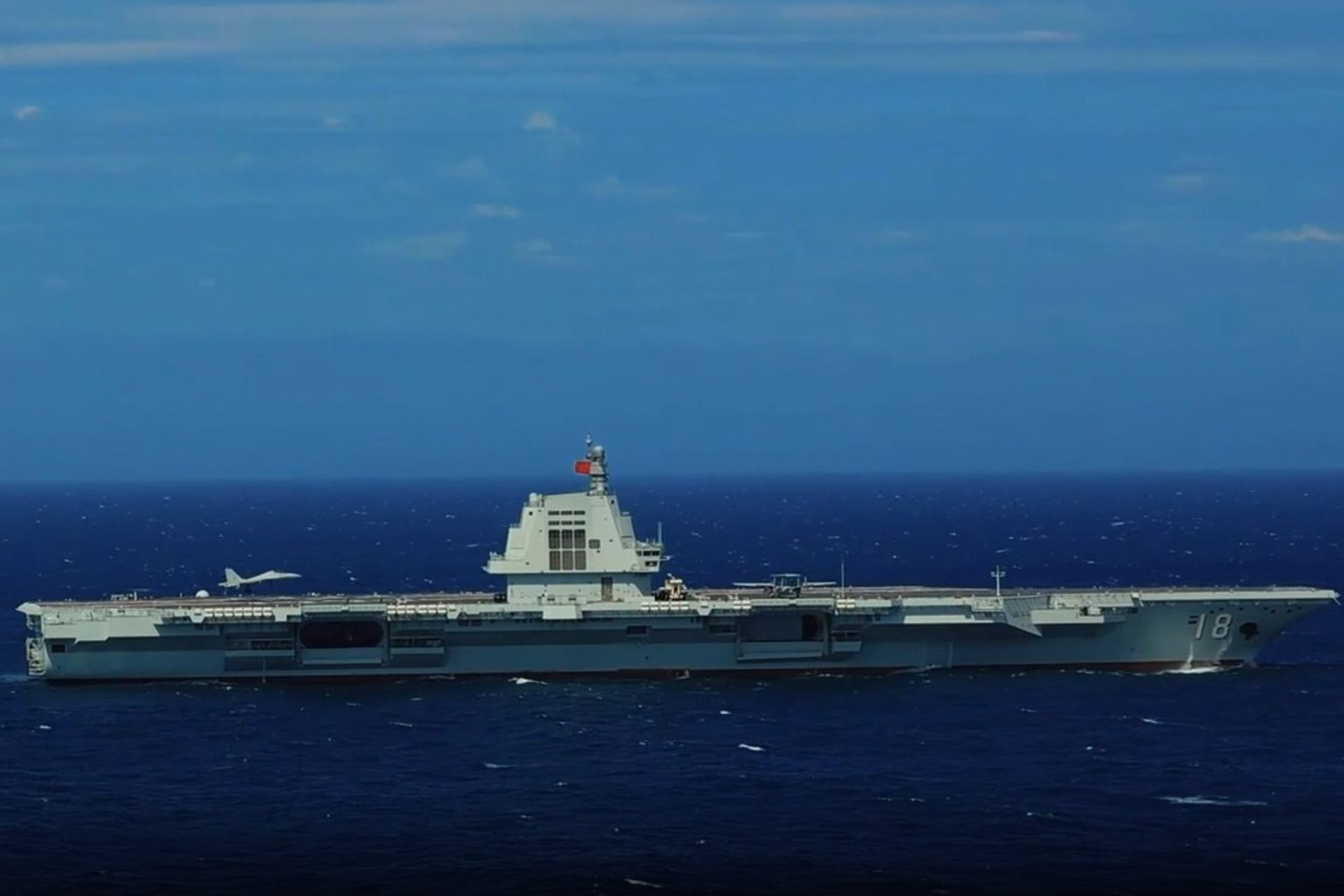
Footage released by Chinese television shows a range of naval aircraft, including the stealth fighter J-35, the multirole fighter J-15T adapted for catapult launches, the electronic warfare variant J-15DT, and the KJ-600 airborne early warning and control aircraft. (Picture source: CCTV)
As China’s third aircraft carrier and the first domestically designed for CATOBAR operations, Fujian has an estimated displacement of between 80,000 and 85,000 tonnes and a length of around 316 meters, with a flat deck equipped with three electromagnetic catapults and an indigenous arresting gear system. This Electromagnetic Aircraft Launch System (EMALS) allows takeoffs with more fuel and weapons than from the ski jumps on Liaoning and Shandong, which expands the combat radius and mission profiles of embarked aircraft. Open source estimates suggest it can carry 48 to 60 fixed-wing aircraft and around a dozen helicopters, for a total of 60 to 75 airborne assets. Even if these figures remain to be confirmed due to the lack of detailed official data, they already mark a change of scale compared with the early years of Chinese carrier aviation.
The air component is at the core of this first campaign. Footage released by Chinese television shows a range of naval aircraft, including the stealth fighter J-35, the multirole fighter J-15T adapted for catapult launches, the electronic warfare variant J-15DT, and the KJ-600 airborne early warning and control aircraft. The J-35, a twin-engine fifth-generation fighter, combines an internal bay for long-range air-to-air missiles and precision guided munitions with an active electronically scanned array radar and electro optical sensors, enabling both air superiority and deep strike missions with a reduced signature. The KJ-600, a turboprop platform inspired by Western airborne early warning and control (AEW&C) concepts, provides extended radar coverage in support of the group’s Recognized Maritime Picture (RMP) and Common Operational Picture (COP), adding the ability to detect aircraft, missiles, and surface vessels at long range.
Fujian’s escort confirms the ambition to field a complete carrier strike group. The exercises described by CCTV include formation manoeuvres, coordinated search and rescue drills, and ship aircraft activities with the Type 055 guided missile destroyer Yan’an and the Type 054A frigate Tongliao. The destroyer provides area air and missile defence through its active array radars and vertical launch systems, while the frigate reinforces anti-submarine warfare and close protection. Together, they create a multilayered defensive bubble around the carrier and allow the Navy to test information flows, emissions control (EMCON), and the coherence of the fleet’s RMP/COP in an increasingly dense operational environment.
China’s naval shipbuilding dynamic gives this programme particular weight. In the space of about fifteen years, Beijing has moved from a first second-hand carrier, Liaoning, to a third domestically designed ship integrating EMALS, while launching at a high tempo Type 055 destroyers, frigates, amphibious ships, and replenishment vessels. The United States retains a clear lead in the number of aircraft carriers, operational experience, and a global network of bases and partners, but Chinese production and the density of the construction programme are gradually narrowing the gap. In the near term, the simultaneous presence of several Chinese carrier strike groups in the South China Sea and beyond the first island chain will become a structuring factor for American and allied planning, without removing the still superior advantages of US carrier aviation.
This buildup should not, however, lead to an overestimation of capabilities that remain little tested. The new Chinese aircraft carriers have never seen combat, and the only available references are exercises, even if they are increasingly realistic. The first deployments of Liaoning and Shandong revealed limitations in sortie generation, coordination, and technical reliability that Beijing appears to be addressing with more mature designs and better-trained crews. Fujian represents a clear improvement over these first platforms, but the real robustness of its weapon systems, maintenance, logistics, and operational doctrine can only be fully assessed in a contested environment, against an adversary able to disrupt data links, the Recognized Maritime Picture, and the replenishment chain.
Fujian is intended to generate continuous sortie cycles at a greater range. The electromagnetic catapults enable full load launches, which increase the combat radius of J-35 patrols and extend the duration of air cover missions over the Taiwan Strait, the South China Sea, or approaches to Japan. With a fixed-wing AEW&C aircraft such as the KJ-600 on station, the group can detect patrol aircraft, bombers carrying anti-ship missiles, and opposing surface vessels earlier, while managing the emissions regime and data flows within the RMP/COP more precisely. For operations forward of China’s coasts, this combination deepens air defence, improves the anti ship targeting chain, and increases the overall resilience of the group against submarine threats.
At the geopolitical level, Fujian crystallises a dual evolution. On one hand, China still trails the United States in the number of carriers, combat experience, and network of partners, which leaves Washington with a comfortable margin of superiority in the short term. On the other hand, the speed of naval production, the concentration of assets in Sanya, and the multiplication of train-as-you-fight style exercises mean that, in the medium term, Chinese carrier strike groups will become permanent players in the power competition in the Indo-Pacific. For allied navies and European defence industrial actors, the challenge is to integrate into their planning a Chinese carrier aviation that is still in a learning phase but now able to project a credible threat well beyond nearby seas.