






Breaking News






FLASH INFO: China’s newest aircraft carrier Fujian tested near Taiwan amid rising tensions.
China’s third aircraft carrier, Fujian, crossed the Taiwan Strait on September 12, 2025, according to Reuters. The People’s Liberation Army Navy described the passage as part of scheduled sea trials and technical testing. While Beijing downplayed the move, the symbolism of a carrier built with electromagnetic catapults transiting one of the world’s most sensitive waterways was not lost on regional observers. Taiwan’s defense ministry confirmed it tracked the vessel’s movement, while Japan’s defense establishment noted the presence of two Chinese missile destroyers accompanying the carrier. For a ship that has not yet been officially commissioned, the transit demonstrated both intent and capability at a time of rising maritime tension in the Western Pacific and Southeast Asia.
Follow Army Recognition on Google News at this link
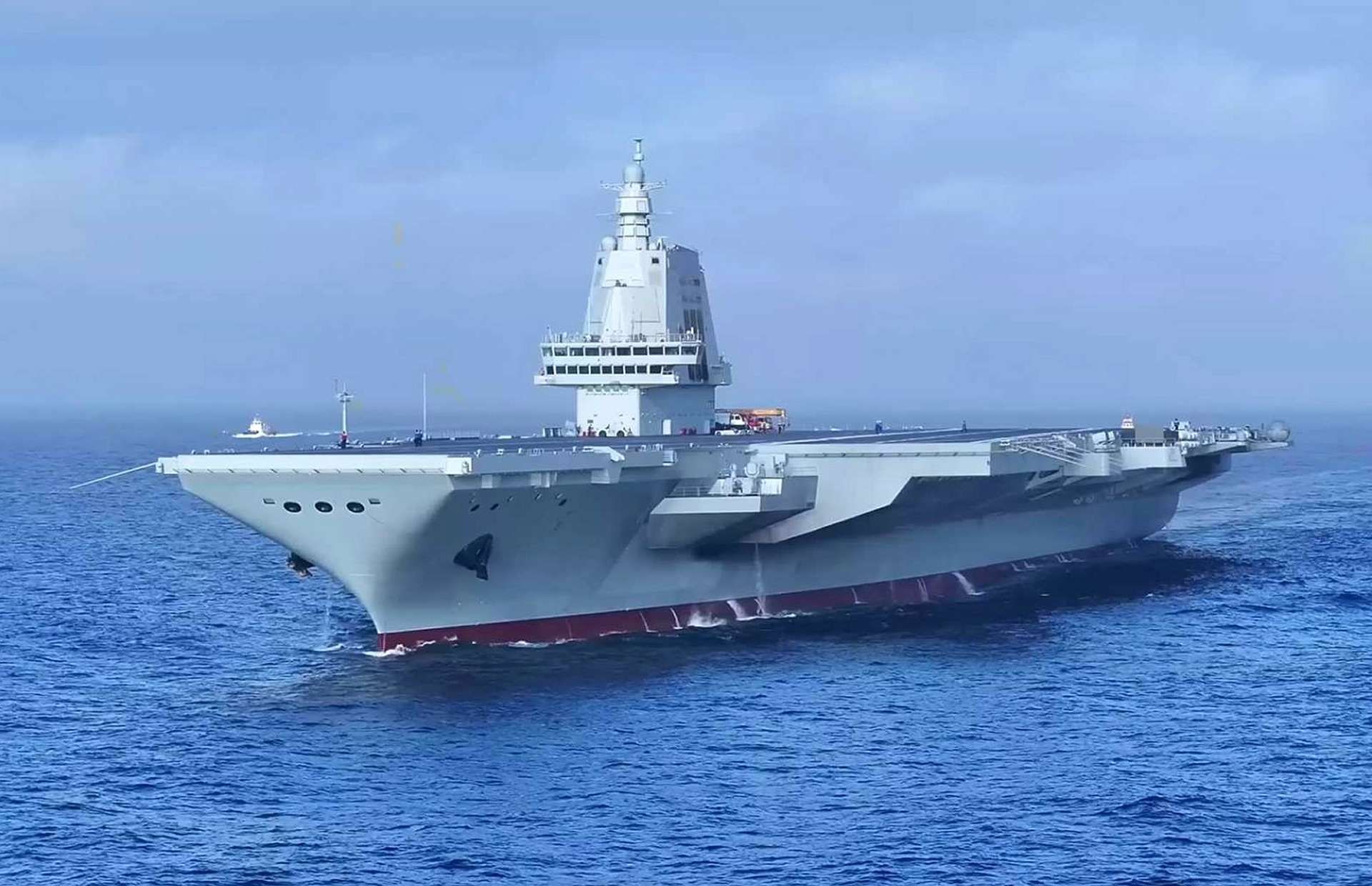
China’s Fujian aircraft carrier, equipped with electromagnetic catapults and designed to launch heavier fighters and early warning aircraft, expands the PLAN’s ability to project sustained air and sea power across regional waters (Picture source: People's Liberation Army Navy).
The Fujian aircraft carrier represents a major step in Chinese naval development. At around 316 meters in length and displacing an estimated 80,000 to 85,000 tons at full load, it is the largest warship ever built by China and the first constructed entirely with domestic technology. Unlike Liaoning and Shandong, which rely on ski-jump ramps to launch fighters, Fujian uses electromagnetic aircraft launch systems. The flat flight deck incorporates three catapult lanes, advanced arresting gear, and two large deck-edge elevators capable of moving heavy twin-engine jets between hangar and deck. The island superstructure is slimmer and carries updated active electronically scanned array radars, designed for better air traffic control and long-range detection. Visible defensive systems include HQ-10 short-range surface-to-air missiles and H/PJ-11 30 mm close-in weapon systems, mirroring the armament seen on China’s latest destroyers. The overall configuration signals a ship designed not for experimentation but for sustained, high-intensity flight operations.
Initial deployments are expected to include upgraded J-15T fighters adapted for catapult launches, alongside the carrier-capable stealth fighter J-35 that has been in testing for several years. Just as significant is the likely inclusion of the KJ-600 fixed-wing airborne early warning aircraft. Launching such platforms from catapults provides a far greater radar horizon than helicopters, improving situational awareness and enabling better coordination of long-range missile strikes. Additional roles could be filled by catapult-capable trainer or tanker variants, extending combat air patrols and strike packages deeper into contested areas. This mix transforms the Fujian from a symbolic demonstration platform into a true combat carrier, one able to generate and sustain sorties over extended periods.
The operational test runs illustrate how Beijing is preparing for full carrier group deployments. Passing through the Taiwan Strait is both a trial of seamanship and a deliberate show of presence. The Japanese defense ministry’s reporting of two destroyers escorting Fujian points to the PLAN practicing standard strike group formations. In time, such groups would likely include Type 055 air-defense destroyers, anti-submarine frigates, and replenishment oilers, providing the layered defenses and logistical endurance needed for long missions. With fixed-wing AEW aircraft orbiting above, a Fujian-led group could establish a moving defensive and offensive bubble stretching several hundred kilometers, protected by integrated missile systems and supported by fighter patrols. For Taiwan’s military planners, this capability complicates already difficult calculations about air defense, naval interdiction, and the timing of mobilization in a crisis.
The tactical value of catapults lies in sortie generation. Unlike ski-jump carriers, CATOBAR operations allow for simultaneous launch and recovery cycles, reducing downtime and increasing the number of aircraft airborne at any given time. Faster turnaround means more fighters aloft, more tankers available to extend range, and longer on-station persistence for early warning aircraft. In essence, Fujian’s design allows the PLAN to approach the operational model long mastered by the U.S. Navy, even if China remains years away from matching American proficiency. The challenge now is training deck crews to manage these demanding cycles, particularly in poor weather or under simulated combat conditions, where small mistakes have outsized consequences.
The Fujian’s transit underscores a new phase in China’s naval modernization. Beijing has steadily increased pressure on Taiwan with air and naval sorties across the median line, joint exercises simulating blockades, and constant drone flights around the island. The carrier’s presence in the strait, just days after a joint U.S.–UK transit that China condemned, adds to this layered pattern of signaling. For Washington and its allies, the development sharpens debates about force posture and deterrence. The U.S. and Japan have been strengthening anti-ship capabilities around Okinawa and the Ryukyus, including the deployment of mobile missile batteries such as the Typhon system. Southeast Asian states like Vietnam and the Philippines, locked in their own disputes with Beijing in the South China Sea, see in Fujian a symbol of long-term Chinese blue-water ambitions that will directly shape regional maritime balances.
The introduction of a third carrier also allows China to maintain a rotational cycle familiar to major navies: one ship deployed, one in training, and one in refit. If Fujian commissions on the anticipated timeline, the PLAN will have the capacity to sustain a carrier presence in multiple theaters, from the East China Sea to the Indian Ocean. This will not only extend Chinese influence but also complicate allied naval planning, forcing adjustments in logistics, surveillance, and missile deployment strategies. Taiwan, situated at the center of this evolving maritime geometry, faces the most direct implications. A catapult carrier with a full air wing represents not just a symbolic threat but a potential shift in Beijing’s invasion calculus, enhancing its ability to project airpower over the strait and to sustain operations in contested environments.
Fujian’s first transit of the Taiwan Strait was more than a technical exercise. It was a demonstration of progress, of intent, and of China’s ambition to redefine its role as a carrier power. The ship still has many trials ahead, and its crews must learn the demanding art of carrier aviation. Yet the message to the region is clear: China’s naval modernization is moving steadily toward parity in capability with established carrier navies, and each sea trial brings that reality closer. For regional governments and defense planners, the Fujian is no longer just a ship on the horizon. It is a factor in today’s calculations, with implications that will only deepen once the carrier enters full operational service.