






Breaking News






China Deploys Submarine to Russia for the First Time During Joint Naval Drills in the Sea of Japan.
Since August 1, 2025, the port of Vladivostok, a longstanding bastion of Russia’s Pacific Fleet, has been hosting a Chinese naval group participating in the Joint Sea 2025 exercise, scheduled to run through August 5, according to the Russian news agency TASS. The arrival of a Chinese Navy Kilo-class attack submarine, accompanied by the Shaoxing and Urumqi Type 052D-class guided-missile destroyers, a Type 903A supply ship, and a submarine rescue vessel, marks a new stage in naval coordination between Beijing and Moscow. This deployment marks the first time a Chinese submarine has docked in Russia as part of a joint exercise, taking place amid ongoing tensions in the Asia-Pacific region.
Follow Army Recognition on Google News at this link
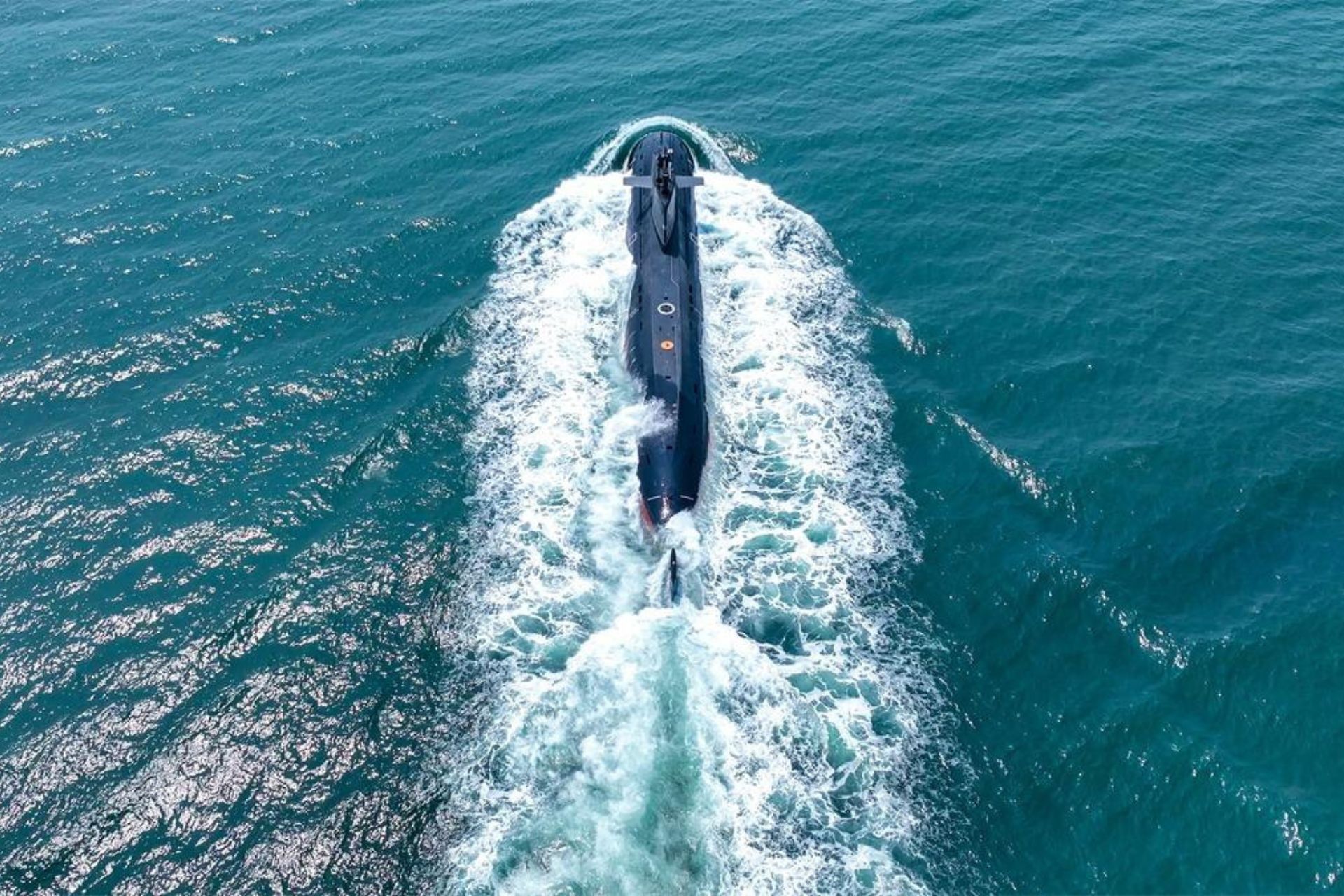
The Chinese naval group deployed to Vladivostok includes units from both the Northern and Eastern Theater Fleets of the People’s Liberation Army Navy (PLAN), suggesting a possible intention to expand operational exposure across different regional commands (Picture source: Chinese MoD)
Although relatively dated, the Kilo-class submarine plays both a symbolic and operational role. Originally acquired from Russia in the 1990s, the submarine was likely chosen to avoid exposing the more sensitive acoustic signatures of the newer Yuan-class (Type 039A) submarines to foreign surveillance systems, particularly during transit through the Sea of Japan. The Kilo features a hydrodynamic teardrop-shaped hull, an air regeneration system enabling submerged endurance of nearly two weeks, and an isolated propulsion system designed to reduce vibration-induced noise. While cutting-edge at the time of its introduction, it is now considered less competitive compared to newer Japanese and South Korean submarines equipped with lithium-ion battery technology.
The Chinese naval group deployed to Vladivostok includes units from both the Northern and Eastern Theater Fleets of the People’s Liberation Army Navy (PLAN), suggesting a possible intention to expand operational exposure across different regional commands. On the Russian side, the naval contingent is led by a Soviet-era Udaloy-class destroyer. This composition illustrates a contrast between the naval development trajectories of the two countries: China has commissioned more than two dozen Type 052D destroyers since 2014, while Russia has not laid down a new destroyer since the dissolution of the Soviet Union.
The Type 052D currently constitutes the backbone of the Chinese surface fleet. Each ship is equipped with 88 vertical launch system (VLS) cells capable of deploying a range of missiles, including HHQ-9 and HHQ-10 surface-to-air missiles, YJ-18 cruise missiles, and reportedly the YJ-21 hypersonic missile, considered among the most advanced in its class.
The exercise also includes naval aircraft and features a variety of training scenarios such as air defense, anti-submarine warfare, search and rescue operations, and live-fire drills. These activities aim to enhance interoperability between the two navies in a maritime zone of enduring strategic importance for Russia.
The Chinese Ministry of Defense has stated that Joint Sea 2025 is part of the annual cooperation plan between the two armed forces and is not directed at any third party. However, the exercise coincides with Resolute Force Pacific 2025, a large-scale operation led by the U.S. Air Force from July 10 to August 8, involving over 400 aircraft and 12,000 personnel from the United States, Japan, Australia, and other allied nations. This overlap contributes to growing perceptions of a confrontation between strategic blocs within the Indo-Pacific.
Beijing regularly criticizes what it describes as American military demonstrations aimed at deterrence, while portraying its cooperation with Russia as routine and balanced. In 2024, this dynamic was illustrated through several joint operations, including naval drills in the Baltic Sea, a Sino-Russian bomber patrol off the coast of Alaska, and a deployment of Chinese forces to Belarus near NATO’s eastern border.
Since 2021, China and Russia have also conducted regular joint naval patrols in the Pacific, often aligned with Joint Sea exercises. Separately, Northern Cooperation drills were initiated by the PLA’s Northern Theater Command in 2023 to maintain operational tempo when Joint Sea was not held. This evolving exercise framework underscores the growing maritime dimension of the bilateral partnership.
The current drill takes place in the waters off Vladivostok, a city founded in 1860 and long the operational heart of the Russian Pacific Fleet. Although the main naval base was relocated to Fokino following the 2012 APEC summit, Vladivostok remains a central logistical and symbolic node in Russia’s Far Eastern military posture.
With this eleventh iteration of Joint Sea, Beijing and Moscow continue to structure their naval cooperation around increasingly integrated scenarios, against a backdrop of technological competition, evolving doctrines, and deepening strategic divides in the Indo-Pacific.