







Breaking News




Canada’s final Arctic patrol ship HMCS Robert Hampton Gray to begin final sea trials before commissioning.
On July 22, 2025, Irving Shipbuilding announced that the sixth and final Arctic and Offshore Patrol Ship (AOPS) built for the Royal Canadian Navy, HMCS Robert Hampton Gray (AOPV 435), will begin builder’s sea trials before the end of August 2025. The ship was launched on 9 December 2024, over two months ahead of schedule, at Halifax Shipyard, where it had been transferred onto a submersible barge on 6 December and then floated in Bedford Basin.
Follow Army Recognition on Google News at this link
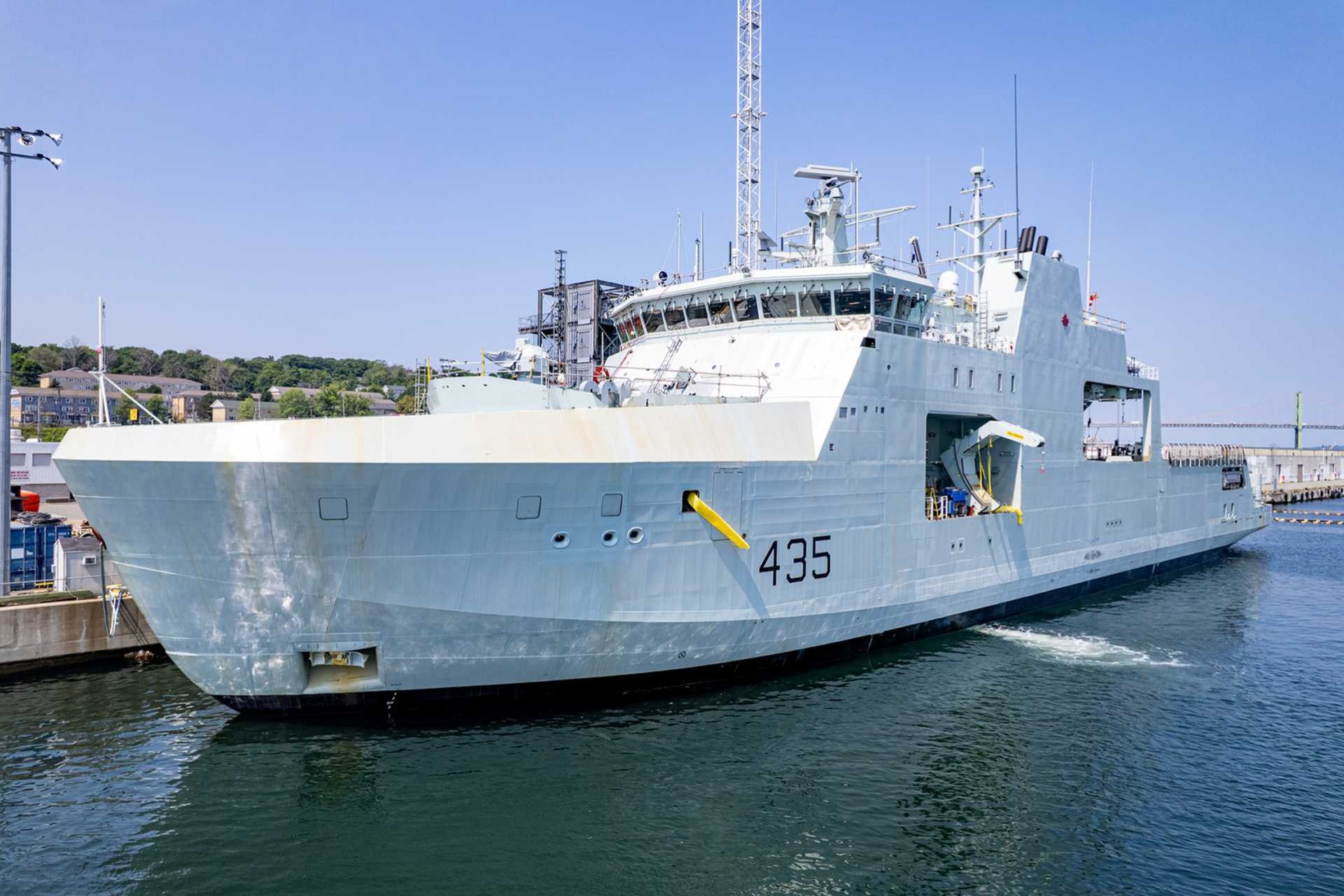
The Harry DeWolf-class is based on the Norwegian Coast Guard’s NoCGV Svalbard and was initially proposed in 2007 under Prime Minister Stephen Harper’s plan to assert Arctic sovereignty. (Picture source: Irving Shipbuilding)
The official naming and delivery are expected to occur shortly after the completion of these sea trials. The vessel, which is the final naval variant of the Harry DeWolf-class, is the first AOPS completed under Canada’s National Shipbuilding Strategy (NSS). The AOPS procurement forms part of the NSS’s combat package managed by Irving Shipbuilding, which also includes two modified variants for the Canadian Coast Guard and 15 future River-class destroyers for the Royal Canadian Navy.
The option to construct this sixth unit was exercised in November 2018. HMCS Robert Hampton Gray was named after Lieutenant Robert Hampton Gray, a naval pilot in the Royal Canadian Naval Volunteer Reserve who served in the Royal Navy’s Fleet Air Arm during the Second World War. On 9 August 1945, Gray led an air attack against Japanese naval vessels in Onagawa Bay, during which he sank the Etorofu-class escort ship HIJMS Amakusa before crashing into the sea. His Victoria Cross, awarded posthumously, was the last such award to a Canadian in that conflict. Gray was previously awarded the Distinguished Service Cross for earlier actions in Japan. The ship’s construction began with the first steel cut in August 2022, the keel was laid on 21 August 2023, and the hull was launched into the water on 9 December 2024. HMCS Robert Hampton Gray is affiliated with the Inuvialuit region, as part of the Royal Canadian Navy’s decision to link each AOPS with one of the six Inuit regions in Northern Canada.
HMCS Robert Hampton Gray is 103.6 meters long, has a beam of 19 meters, a draught of 5.7 meters, and displaces 6,615 tonnes. It is ice-strengthened to Polar Class 5, with a bow region reinforced to Polar Class 4 standards. Its propulsion is diesel-electric, consisting of four MAN 6L32/44CR medium-speed diesel generators producing 3.6 megawatts each, powering two 4.5 megawatt propulsion motors driving twin shafts. It also has a bow thruster for maneuverability. The ship’s maximum speed is 17 knots in open water and 3 knots in first-year ice of up to 1 meter thickness. It has an endurance of 6,800 nautical miles at 14 knots. It carries two 8.5-meter multi-role rescue boats and one 12-meter landing craft. The vessel includes a vehicle bay capable of transporting pickup trucks, ATVs, and snowmobiles, and a 20-tonne crane to support self-loading operations. Accommodation is available for 65 crew, with capacity for up to 87 persons.
The armament includes a single BAE Systems Mk 38 Mod 3A 25 mm chain gun and two M2 Browning machine guns. The ship has a hangar and flight deck suitable for aircraft such as the Sikorsky CH-148 Cyclone, the Bell CH-146 Griffon, and the CU-176 Gargoyle UAV. Sensors and systems on board include the Terma SCANTER 6002 surveillance radar, Kelvin Hughes SharpEye X and S-band radars, OSI Maritime Systems’ integrated bridge and navigation system, BlueNaute inertial navigation, Link 16 SATCOM, and multichannel VHF/HF radios. Combat management is based on Lockheed Martin Canada’s CMS 330. The ship is equipped with a SAGEM damage and machinery control system. OSI has provided all six integrated bridge and navigation systems across the AOPS fleet, while BAE Systems was selected in 2015 to supply all Mk 38 weapons. These systems are intended for Arctic operations and are capable of being adapted to tropical environments.
The Harry DeWolf-class was derived from the Norwegian Coast Guard vessel NoCGV Svalbard and initially announced in July 2007 as part of a government plan to acquire six to eight Polar Class 5 Arctic patrol ships. In 2010, the Arctic Offshore Patrol Ship (AOPS) program was merged with other procurement efforts under the National Shipbuilding Procurement Strategy (renamed National Shipbuilding Strategy), which awarded Irving Shipbuilding the combat package in October 2011. The NSS now includes a third shipyard, Davie, incorporated officially in April 2023 to support icebreaker construction. The NSS originally envisioned 21 combat ships and about 30 non-combat vessels, with rising costs later increasing the budget for AOPS from $3.5 billion to $4.98 billion for the six naval variants and from $1.5 billion to $2.1 billion for the two Coast Guard units. Construction on the first AOPS began in 2015, and since then all six ships have been launched and five are in active service. The first Coast Guard variant was laid down on 31 July 2024.
The class was criticized for limited armament and relatively low speed, especially when compared to similar-sized foreign vessels like Russia’s Project 23550 patrol ships equipped with Kalibr missiles. Some also questioned the cost of design, comparing it to the Norwegian Svalbard OPV, which was built for under $100 million. In contrast, the Canadian design phase alone reached $288 million. Alternative proposals included acquiring separate fleets of icebreakers and offshore patrol vessels. Despite this, the ships have performed regular missions since commissioning. William Hall and Frédérick Rolette were delivered in 2023 and 2024, respectively, and HMCS Max Bernays and Margaret Brooke conducted long-range deployments in 2024. In December 2022, it was discovered that early ships in the class had potable water systems contaminated by high-lead-content fittings, which required subsequent inspection and rectification. In 2024, a Canadian defence policy report proposed installing ocean surveillance sensors aboard AOPS units.
The Arctic and Offshore Patrol Ship (AOPS) fleet represents the largest class of warships constructed in Canada in over half a century, with each ship in the class built using three megablocks, bow, center, and aft, which are themselves composed of a total of 62 blocks. Assembly and outfitting take place at Irving’s Halifax Shipyard. The shipyard began construction of the River-class destroyer production test module in June 2024 and is expected to begin full-rate production in April 2025. The Coast Guard’s Donjek Glacier and Sermilik Glacier are under construction and are based on the AOPS hull, but feature modifications such as a different bridge layout, new accommodations under Transport Canada standards, and areas adapted for non-military systems. Although the structural differences are limited, the budget for these two units was increased by $600 million between 2022 and early 2024. The NSS, now exceeding $100 billion in overall scope, includes over 50 ships across its combat, non-combat, and small-vessel programs. AOPS are the largest warships purpose-built for Canada in over 50 years, following the retirement of the Protecteur-class replenishment oilers.
HMCS Robert Hampton Gray will join a class that includes HMCS Harry DeWolf (Qikiqtani), Margaret Brooke (Nunatsiavut), Max Bernays (Kitikmeot), William Hall (Kivalliq), and Frédérick Rolette (Nunavik), each named after Canadian naval figures. HMCS Robert Hampton Gray commemorates a Canadian naval aviator who also has a memorial erected in Onagawa Bay, Japan, the only such monument dedicated to a foreign servicemember on Japanese soil. His aircraft, a Vought F4U Corsair, was lost during the attack that earned him the Victoria Cross. Gray had previously flown in Africa and Norway, taking part in Operation Goodwood against the German battleship Tirpitz and was twice Mentioned in Dispatches. The ship’s naming aligns with a Royal Canadian Navy initiative to honor Canadian naval heroes for the first time in ship-class naming. With HMCS Robert Hampton Gray’s sea trials set to begin, and its delivery scheduled for August 2025, the Harry DeWolf-class naval procurement will be formally concluded, while work continues on the next stage of the NSS shipbuilding plan.