






Breaking News






British Navy aims to be Europe’s first to field an armed shipborne UAV with Peregrine Drone.
On July 18, 2025, during the Royal International Air Tattoo, Thales UK confirmed that it is working on developing an armed version of the Peregrine aerial drone, currently operated by the Royal Navy. The announcement was made by Matt Moore, a Thales UK executive, and reported by FlightGlobal on July 19. The project aims to transform the Peregrine, which is currently limited to surveillance and reconnaissance missions, into an offensive platform by integrating the Lightweight Multi-role Missile (LMM) Martlet.
Follow Army Recognition on Google News at this link
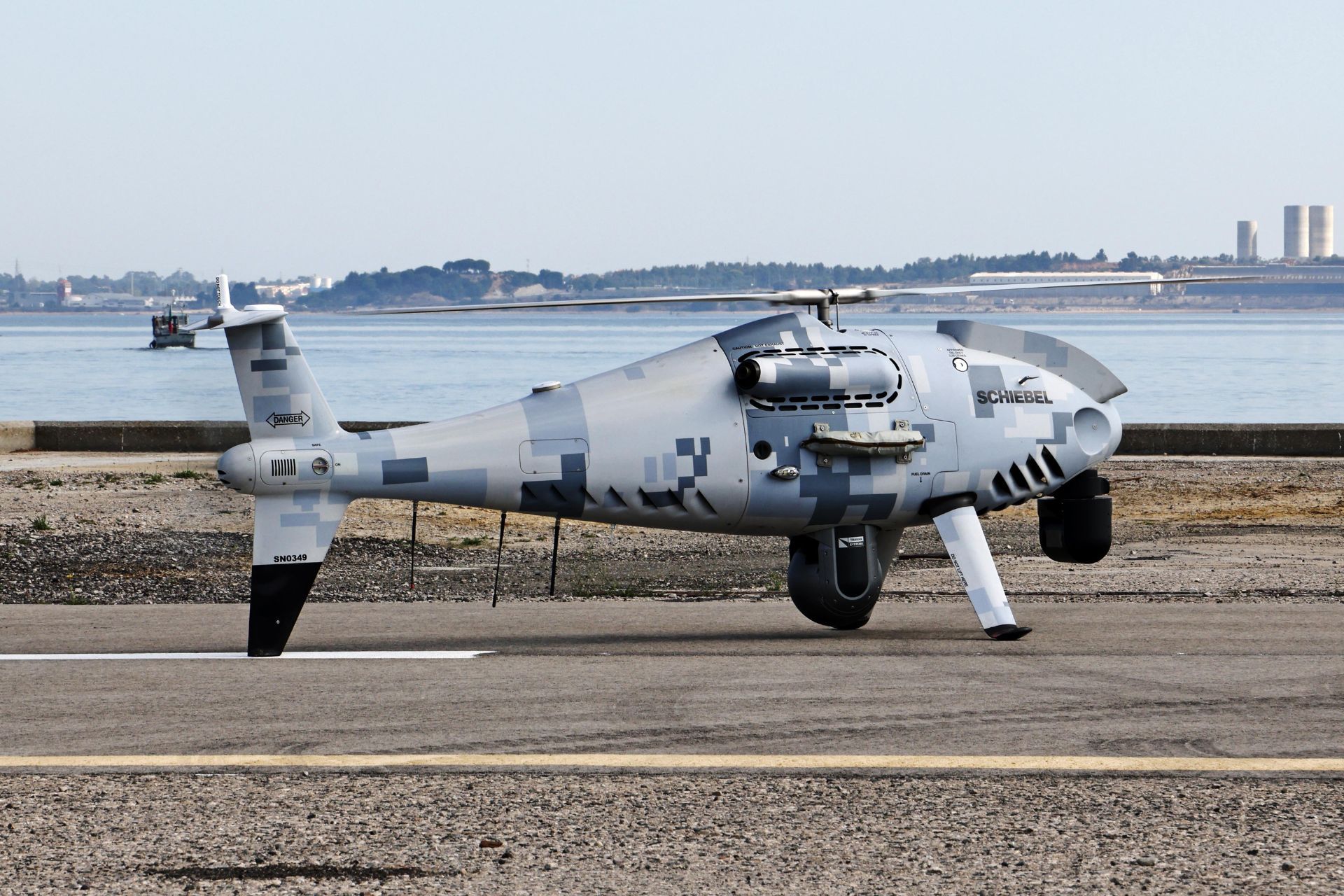
Thales UK and Schiebel are also planning to expand Peregrine's operational roles to anti-submarine warfare by using it to relay signals from deployed sonobuoys (Picture source: UK MoD)
This 13 kg laser-guided missile carries a 3 kg explosive charge and can engage targets up to 8 kilometers away. According to Thales, the drone will be able to carry two Martlet missiles, with live-fire trials scheduled for 2026. This development would mark a significant capability upgrade for the Royal Navy, positioning it as one of the first European navies to equip its ships with an armed drone.
The Peregrine is already a central asset in the Royal Navy’s operational setup. Developed by Schiebel from the well-known Camcopter S-100, this vertical take-off and landing (VTOL) drone is designed for demanding maritime environments. It has an endurance of over six hours, extendable to ten hours with an additional fuel tank, and can operate up to 200 kilometers from its host ship via multiple data link options, including satellite communication. Its modular architecture allows it to carry a wide range of sensors, notably Thales UK’s I-Master radar, capable of generating high-resolution images through Synthetic Aperture Radar (SAR) mode and detecting moving maritime targets via the Maritime Moving Target Indication (MMTI) mode. The drone is also equipped with electro-optical and infrared cameras, LiDAR sensors, and various maritime and terrestrial detection systems, making it a versatile intelligence, surveillance, and reconnaissance (ISR) platform.
Arming the Peregrine with the Martlet missile would significantly change its operational profile. The Martlet, also referred to as the Lightweight Multi-role Missile, is designed to neutralize fast and agile threats such as speedboats and small craft, which increasingly challenge naval security in littoral or asymmetric environments. Thales is also considering enabling the drone’s control directly from the AW159 Wildcat helicopter using the Scorpion helmet-mounted sight, which would enhance coordination between manned and unmanned assets. This feature would provide crews with a real-time strike capability without relying solely on shipborne control systems.
Beyond light attack missions, Thales UK and Schiebel are planning to expand the Peregrine's operational roles to anti-submarine warfare by using it to relay signals from deployed sonobuoys, a task traditionally carried out by specialized helicopters. Additionally, trials are being considered for mine warfare, where the integration of LiDAR sensors could enable precise detection and mapping of underwater threats even in low visibility conditions. These initiatives are part of the UK’s Peregrine program, which has reached a key milestone with the successful completion of factory acceptance tests, as recently confirmed by Thales UK and Schiebel. This technical validation ensures full compatibility of the drone with the combat management systems aboard Royal Navy frigates and enhances interoperability with existing naval assets.
While France has opted for a more cautious approach by developing the unarmed VSR-700 drone under its SDAM program, the United Kingdom is pursuing a clear ambition to make the Peregrine not only a high-performance sensor platform but also a strike-capable system. If the Martlet missile tests prove successful, the Royal Navy could become the first European naval force to deploy a shipborne drone capable of both intelligence gathering and engagement, marking a shift in naval drone doctrine and shaping the future of maritime operations.