






Breaking News






Austal USA launches first Landing Craft Utility LCU 1710 ship for U.S. Navy to boost deployment power.
According to information published by Austal USA on August 29, 2025, the company launched its first U.S. Navy Landing Craft Utility (LCU) vessel, designated LCU 1710, at its ship manufacturing facility in Mobile, Alabama, on August 22. The vessel is the lead unit of a new generation of U.S. Navy LCUs being built under a contract awarded in September 2023. The initial award provided $91.5 million for the construction of three LCU-1700-class ships, with options for nine additional craft, potentially bringing the program’s total value to nearly $380 million. In August 2024, the U.S. Navy exercised an option for two more vessels, raising the confirmed number under construction to five, while Austal USA currently has three in active production.
Follow Army Recognition on Google News at this link
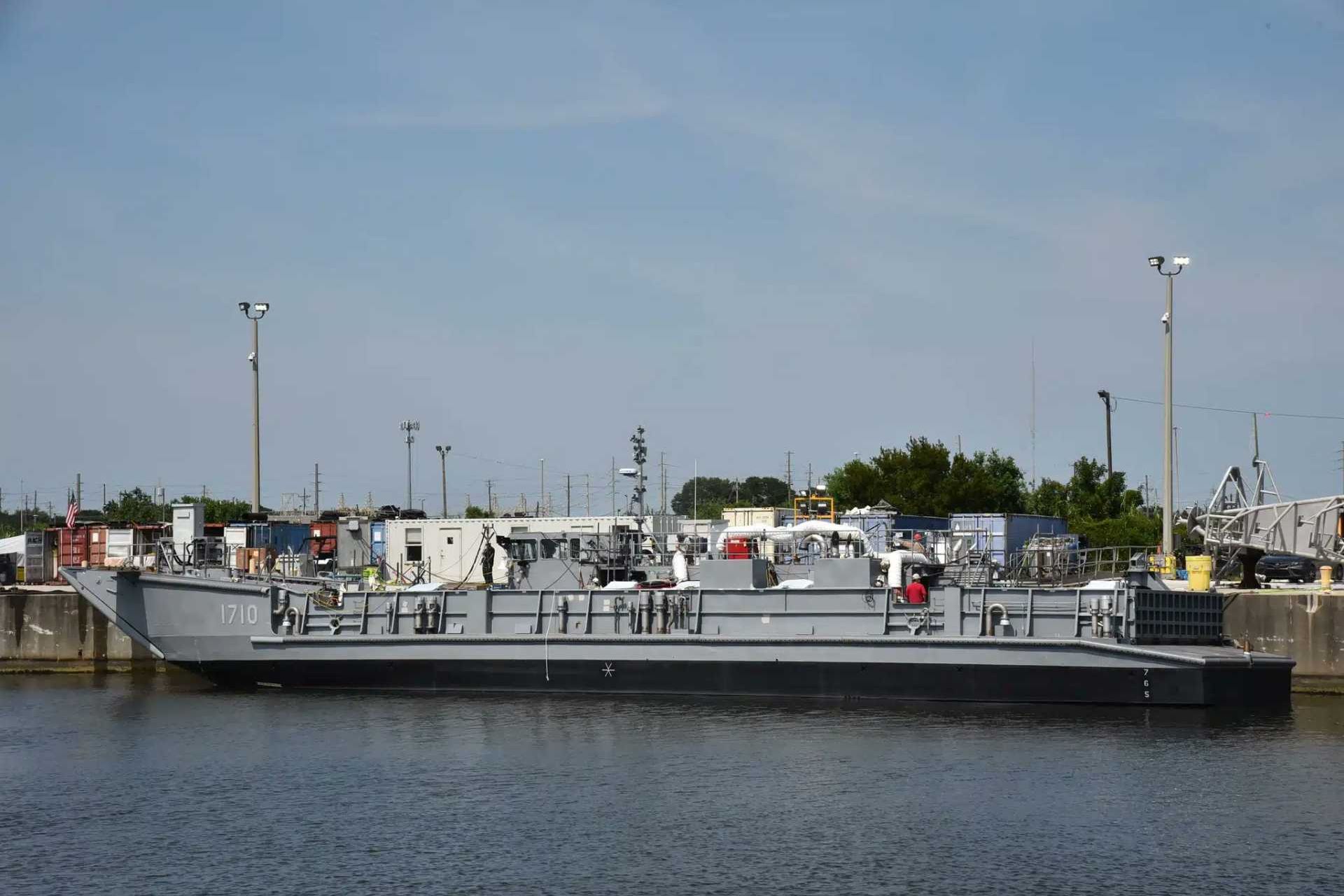
The U.S. Navy’s Landing Craft Utility (LCU) is a heavy-lift connector designed to transport tanks, vehicles, troops, and supplies directly from amphibious ships to shore. With a payload of up to 170 tons, roll-on/roll-off ramps, and long-range endurance, LCUs provide critical sea-to-shore mobility for both combat and humanitarian missions. (Picture source: Austal USA)
The LCU-1700 program is designed to replace the U.S. Navy’s aging LCU-1650 fleet, which has been in service for decades and is reaching the limits of operational relevance. The modernized design offers a 139-foot steel hull, a 31-foot beam, and displacement of approximately 428 long tons. It features roll-on/roll-off bow and stern ramps, enabling efficient embarkation and disembarkation of vehicles and supplies. Importantly, multiple LCUs can be linked together to form an improvised causeway, a feature that dramatically improves the speed and efficiency of offload operations in contested or austere environments.
LCU 1710 can transport up to 170 short tons, equivalent to the payload of several U.S. Air Force C-17 Globemaster III sorties. This heavy-lift capacity enables the transport of two M1A1 Abrams tanks, 350 combat troops, or an equivalent logistics package. With a maximum speed of 11 knots and a range of 1,200 nautical miles at cruising speed, the vessel provides the endurance required for long-range littoral missions. By delivering this level of capacity directly from the sea base to shore, the LCU enhances the U.S. Navy and U.S. Marine Corps’ ability to conduct amphibious assaults, sustain expeditionary advanced base operations (EABO), and provide humanitarian assistance in regions without functioning ports.
Austal USA President Michelle Kruger highlighted the significance of this milestone, noting that the successful launch reflects both the hard work of the shipbuilding team and the company’s expanding role in strengthening the U.S. maritime industrial base. She emphasized that each step in the LCU program consolidates Austal’s transition from aluminum ship construction to advanced steel production, placing the company in a position to handle simultaneous programs of national importance. Alongside the LCUs, Austal USA is also producing three U.S. Navy Navajo-class Towing, Salvage and Rescue ships (T-ATS) and two U.S. Coast Guard Heritage-class Offshore Patrol Cutters (OPC).
The construction of LCU 1710 began with a keel-laying ceremony in June 2024, following the start of fabrication earlier that year. With the first vessel now in the water, Austal is on track to deliver the three baseline LCUs (1710–1712) by July 2026. Deliveries of additional units under contract options are projected to continue through 2027 and possibly extend to 2029 if the U.S. Navy chooses to exercise the full procurement of 12 craft. Initial Operational Capability (IOC) for the class could be declared as early as late 2025 or early 2026, following acceptance trials, crew training, and integration into the amphibious fleet.
Strategically, the LCU 1700 plays a vital role in the U.S. Navy’s shift toward distributed maritime operations and expeditionary warfare concepts. In the Indo-Pacific theater, where adversaries may target ports with long-range precision strikes and deny access to fixed infrastructure, LCUs provide a reliable and flexible logistics solution. Their ability to operate directly from amphibious ships to unimproved shorelines ensures that U.S. Marine Corps units can maneuver, resupply, and establish forward operating bases even in highly contested environments. This capability strengthens the resilience of U.S. naval expeditionary forces and enhances deterrence across key maritime regions.
The LCU program also demonstrates the U.S. Navy’s effort to build resilience into its industrial base by engaging multiple shipbuilders. Austal USA was tasked with supplementing Swiftships, the original designer and builder of the LCU 1700, after delays and challenges in early production. The U.S. Navy ultimately envisions acquiring up to 30 vessels in this class, with Austal’s growing role ensuring the fleet’s renewal proceeds on schedule.
Beyond combat operations, the dual-use potential of the LCU adds significant value. These craft can deliver large volumes of supplies, vehicles, and personnel directly to disaster-stricken coastal areas, making them indispensable during humanitarian assistance and disaster relief missions. In this role, they provide the U.S. Navy with the flexibility to project both combat power and humanitarian aid worldwide, reinforcing American influence and partnerships.
The launch of LCU 1710 is therefore not only a shipbuilding milestone but also a marker of evolving U.S. amphibious doctrine. It represents a convergence of industrial resilience, strategic necessity, and operational flexibility. With production underway and delivery schedules advancing, the program will directly shape the U.S. Navy and U.S. Marine Corps’ ability to maneuver, resupply, and project power in an era of renewed great power competition.