







Breaking News




Expodefensa 2025: MKE’s PIRANA Unmanned Strike Vessel Redefines Naval Options for Latin America.
Türkiye’s defense group MKE unveiled a mock‑up of its Pirana kamikaze unmanned surface vehicle at Expodefensa 2025 in Bogotá, its first major showcase in Latin America. The display underscores how affordable naval drones could expand regional sea‑denial options amid tight budgets and growing interest in unmanned systems.
During Expodefensa 2025, Türkiye’s state-owned Mechanical and Chemical Industry Inc. (MKE) presented a scaled mock-up of its PIRANA kamikaze unmanned surface vehicle (USV), bringing the concept of low-cost naval strike drones to the heart of Latin America’s main defense and security exhibition in Bogotá. In a region where navies must protect vast coastlines with constrained budgets, the appearance of a combat-proven maritime drone attracted particular attention, as reported by our editorial team on site in Bogotá and by MKE. This demonstration highlights how unmanned maritime systems are moving from niche technology to practical tools for coastal states facing complex security challenges, from conventional threats at sea to organized crime and critical infrastructure protection.
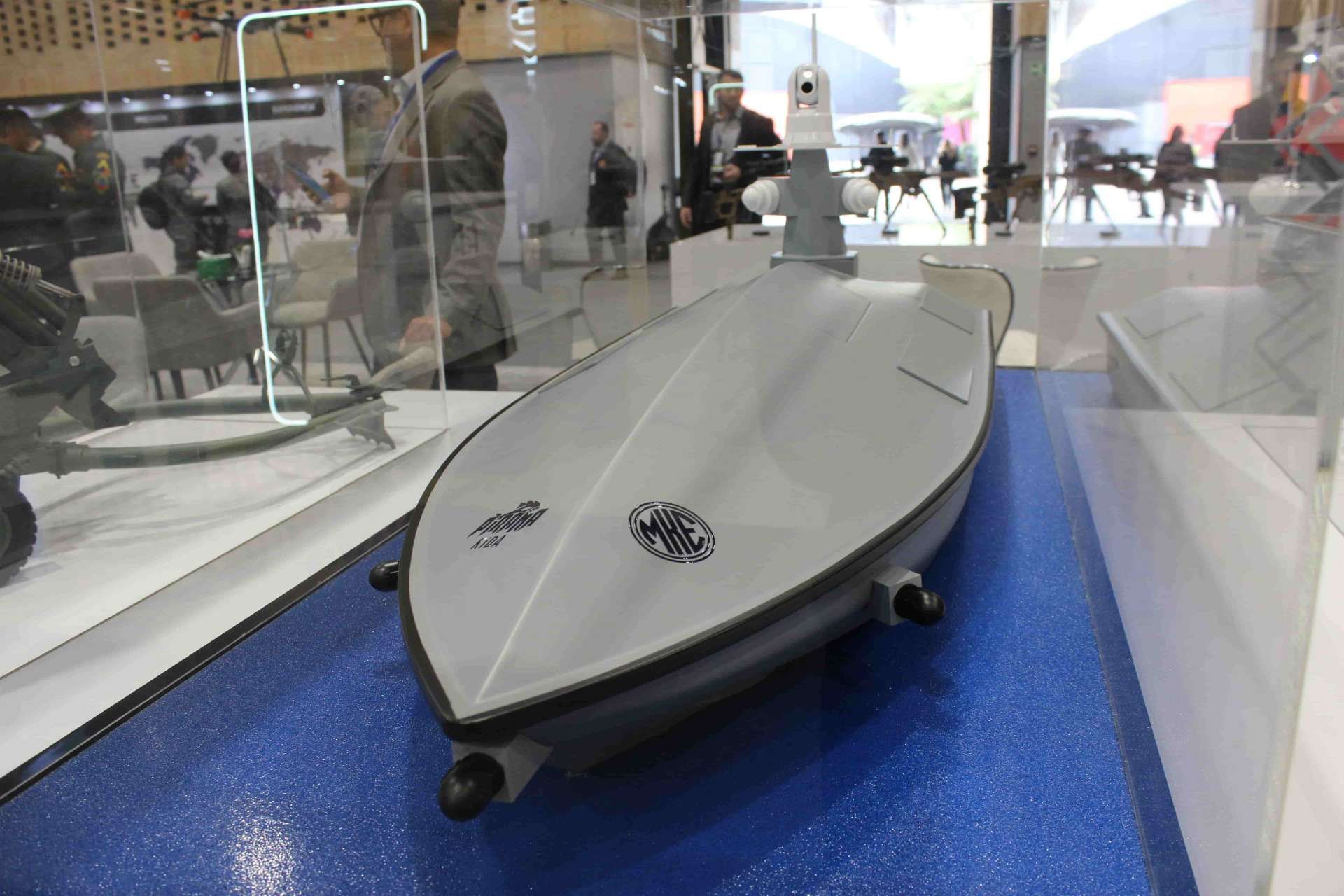
The appearance of MKE’s PIRANA at Expodefensa 2025 illustrates how unmanned surface strike systems are becoming a realistic option for Latin American defense planning (Picture Source: Army Recognition Group)
Developed initially for the Turkish Navy, PIRANA is a compact, high-speed surface drone designed to act as a one-way strike platform against naval and port targets. Built around a water-jet propulsion diesel engine, the operational system is reported to exceed 50 knots and to have a range of more than 200 nautical miles, giving it the ability to approach targets rapidly from stand-off distances. Its hull, made from composite materials with a reduced radar signature, is optimized for stealthy approaches in coastal and port environments. Equipped with GNSS navigation hardened against jamming, an onboard mission computer and electro-optical sensors, PIRANA can be controlled remotely or execute pre-planned routes with a high degree of autonomy, including final attack runs in kamikaze mode where the platform itself becomes the weapon.
The core impact of the system is its warhead, which integrates a high-explosive charge with a pre-penetrator to deliver an overall payload of about 65 kg. This payload is intended to damage or disable surface combatants, support vessels, or critical infrastructure such as piers and fuel depots. MKE notes that sea trials and live-impact tests on small targets have already been completed, underscoring that PIRANA is more than a concept and represents a ready-to-field capability. At Expodefensa, even a reduced-scale mock-up conveyed the same message: the technology on display is an operational system that can be tailored to regional needs rather than a distant research project.
For Latin American navies and maritime security forces, systems like PIRANA align closely with current strategic priorities. Many countries in the region must defend long coastlines, island chains and river estuaries while simultaneously combating illegal fishing, narcotrafficking, piracy and the risk of sabotage against ports, offshore platforms and subsea infrastructure. A relatively inexpensive, expendable USV able to operate in sea state 4, approach at high speed and deliver a concentrated explosive effect offers an additional layer of deterrence and point defense for harbors, naval bases and critical oil and gas facilities. Deployed singly or in coordinated groups, such drones can complicate the planning of any hostile surface action, forcing an adversary to disperse its defenses and invest in counter-USV measures that are often far more costly than the drones themselves.
Beyond the direct military effect, PIRANA’s presence in Bogotá points to potential industrial and technological cooperation between Türkiye and Latin American partners. Expodefensa positions itself as a platform for co-development and local integration of systems that match regional needs, and MKE already has experience in exporting production lines and defense technologies to foreign partners. For Latin American shipyards and defense companies, unmanned surface vehicles offer an accessible entry point into advanced naval capabilities: hulls can be adapted or built locally, integration with national command-and-control networks can be carried out by domestic firms, and specific mission payloads, from surveillance packages to different warhead options, can be tailored to local doctrine. Such cooperation would support regional ambitions for greater strategic autonomy while opening new markets for Turkish know-how in warheads, fuzes and naval drone architecture.
PIRANA’s showing in Bogotá signals the dawn of a broader, cross‑regional collaboration between Türkiye and Latin American partners. Expodefensa is positioned as a platform for co-development and local integration of systems that align with regional needs, and MKE already has experience exporting production lines and defense technologies to foreign partners. For Latin American shipyards and defense companies, unmanned surface vehicles offer an accessible pathway into advanced naval capabilities: hulls can be adapted or built locally, integration with national command-and-control networks can be handled by domestic firms, and mission payloads, from surveillance packages to various warhead options, can be customized to local doctrine. Such cooperation would support regional objectives for greater strategic autonomy while expanding markets for Turkish capabilities in warheads, fuzes, and naval drone architecture.
The appearance of MKE’s PIRANA at Expodefensa 2025 illustrates how unmanned surface strike systems are becoming a realistic option for Latin American defense planning, not just for major powers. By combining relatively low acquisition and operating costs with significant potential impact against naval and port targets, this class of USV offers regional governments an additional tool to protect maritime approaches, deter hostile actions and secure critical economic infrastructure. If translated into concrete partnerships, technology transfer and local integration programs, PIRANA and similar systems could help Latin American industry move from being a customer of unmanned naval technologies to becoming an active contributor, shaping how this new domain of naval warfare evolves in the Americas.
Written by Teoman S. Nicanci – Defense Analyst, Army Recognition Group
Teoman S. Nicanci holds degrees in Political Science, Comparative and International Politics, and International Relations and Diplomacy from leading Belgian universities, with research focused on Russian strategic behavior, defense technology, and modern warfare. He is a defense analyst at Army Recognition, specializing in the global defense industry, military armament, and emerging defense technologies.