







Breaking News




Expodefensa 2025: How Argentina’s SADEM spots and stops hostile drones on the cheap.
Argentine technology firm INVAP is showcasing its SADEM counter drone system at Expodefensa 2025 in Bogotá, presenting a modular suite that detects, classifies, and neutralizes small unmanned aircraft using passive and active sensors. The system highlights how Latin American industry is entering the fast-growing counter-UAS market, with direct implications for base security, critical infrastructure protection, and coalition operations that include U.S. and partner forces.
Argentine company INVAP is using this year’s Latin American defense and security showcase to push its SADEM counter-drone solution into the international spotlight, framing it as a full-spectrum answer to the growing threat from small commercial and improvised unmanned aircraft. Built around real-time analysis of radiofrequency emissions, jamming, and optional radar and electro-optical sensors, the system is designed to detect hostile drones before takeoff, track them in flight, and disrupt their links or navigation signals around military bases, borders, and critical infrastructure sites.
Follow Army Recognition on Google News at this link
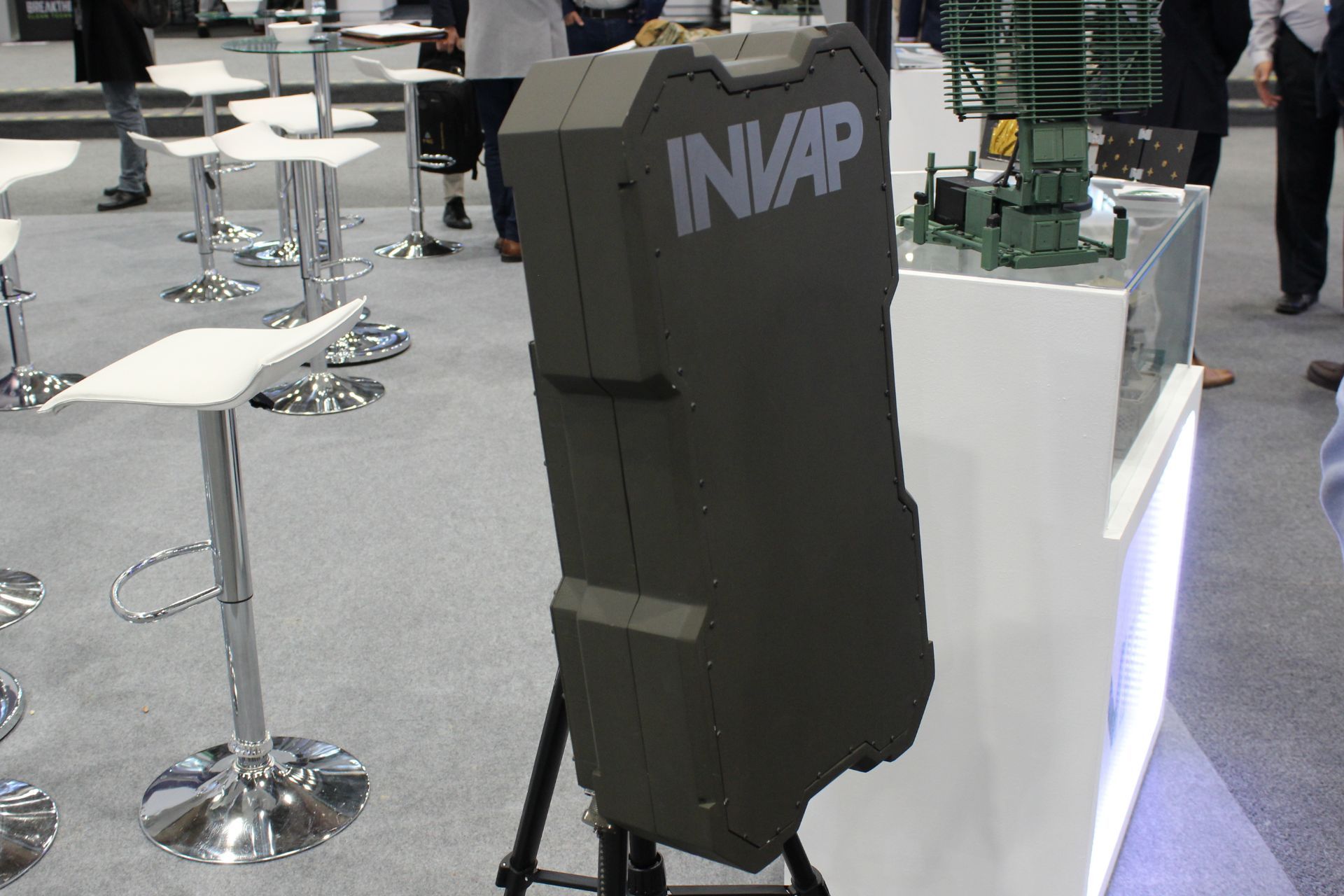
Argentina’s INVAP presents its SADEM counter-drone system at Expodefensa 2025, highlighting Latin America’s push into advanced UAS detection and neutralization. (Picture source: ArmyRecognition)
The rapid development of small drones creates a constant challenge for military authorities. Their ease of manufacture, low acquisition cost, simple operation, and ability to evade traditional detection make them a tool of interest for both state and non-state actors. Civilian models available on the commercial market, as well as those circulating in poorly regulated markets, show how easily these platforms can be adapted for observation, attack, or saturation missions in an asymmetric context. The ability to quickly distinguish an ordinary drone from a hostile platform, therefore, becomes an operational requirement, and SADEM fits into this logic by providing tools capable of identifying radio emissions even before a drone takes off. This early detection makes it possible to alert a defense structure a short time before a potential action, which improves the responsiveness of units responsible for site protection.
The coverage provided by SADEM adapts to requirements through a modular architecture. The detection range depends on the chosen configuration and can exceed the distance between the operator and the drone, although terrain and aircraft characteristics influence the actual range. The system can be deployed on varied terrain, whether in urban areas, mountainous sectors, or wide open spaces. Its architecture allows rapid installation for missions that require high mobility or, on the contrary, integration into a fixed network responsible for monitoring sensitive sites. Tactical, mobile, or fixed options provide continuous protection for military bases, borders, or high-visibility events.
The different SADEM configurations rely on a common technological core that includes real-time signal analysis, advanced processing algorithms, correlative interferometry, and artificial intelligence. The higher-end versions integrate gallium nitride transmitters, InGaP or GaAs receivers, and a complete software suite that ensures continuous monitoring, recording, and operation of the system. Depending on the version, the system can use omnidirectional or directional antennas, jamming capabilities of varying scope, and interference power ranging from 5 to 450 watts, depending on the bands used.
The most advanced versions include electro-optical and infrared sensors that provide complementary visual identification. In the configuration equipped with an X-band radar, SADEM is able to detect and classify drones that emit no radio signal. The cameras provide long-range observation with a visible range of up to 8 km for drones and 12 km for a human target of NATO type, while thermal detection can extend to 26 km for a drone and 38 km for a person. These sensors are linked to fast pan-tilt heads, automatic tracking, and recognition functions supported by artificial intelligence. The system operates in manual or automatic mode, responds in less than five seconds, and can be used locally or remotely within a secure network.
The jamming capabilities cover bands used by commercial drones, such as the 2.4 GHz and 5.8 GHz frequencies, as well as GNSS navigation signals, including GPS, Galileo, BeiDou, and GLONASS. GNSS spoofing options are also available, along with white and black list functions to manage authorized or prohibited frequencies selectively. The integrated database can be updated by the user to follow the evolution of models circulating on the market.
INVAP positions itself as a high-technology company developing custom projects for national and international customers. The growing use of counter-drone systems and the increasing number of scenarios in which these tools are required show how this category of equipment is spreading. The presentation of the SADEM system at Expodefensa 2025 illustrates this trend and indicates that detection and neutralization solutions continue to gain ground, driven by the need to protect critical infrastructure in a context where threats from light drones keep diversifying.