







Breaking News




Expodefensa 2025: Chinese Unmanned Marine Survey Craft Debuts in Latin American Coastal Security Sector.
China Xinxing introduced a compact Marine Survey Unmanned Surface Vessel at Expodefensa 2025 in Bogotá, positioning it for coastal security and reconnaissance missions. The system reflects growing regional interest in unmanned patrol options as Latin American governments tackle trafficking, illegal fishing and port security gaps.
During Expodefensa 2025 in Bogotá, China Xinxing Import and Export Co., Ltd. is presenting a compact Marine Survey Unmanned Surface Vessel (USV) designed for coastal surveillance and security patrol missions. In a regional context marked by rising concerns over maritime trafficking, illegal fishing and port protection, the appearance of this Chinese system underlines how unmanned platforms are becoming a central tool for day-to-day maritime security. The USV is pitched as an autonomous or remotely operated craft able to work without any crew on board, reducing risk for personnel and operating costs for navies and security agencies. Its configuration is intended to combine hydrographic survey tasks with reconnaissance and intelligence collection, making it relevant for both civilian and defense customers across Latin America.
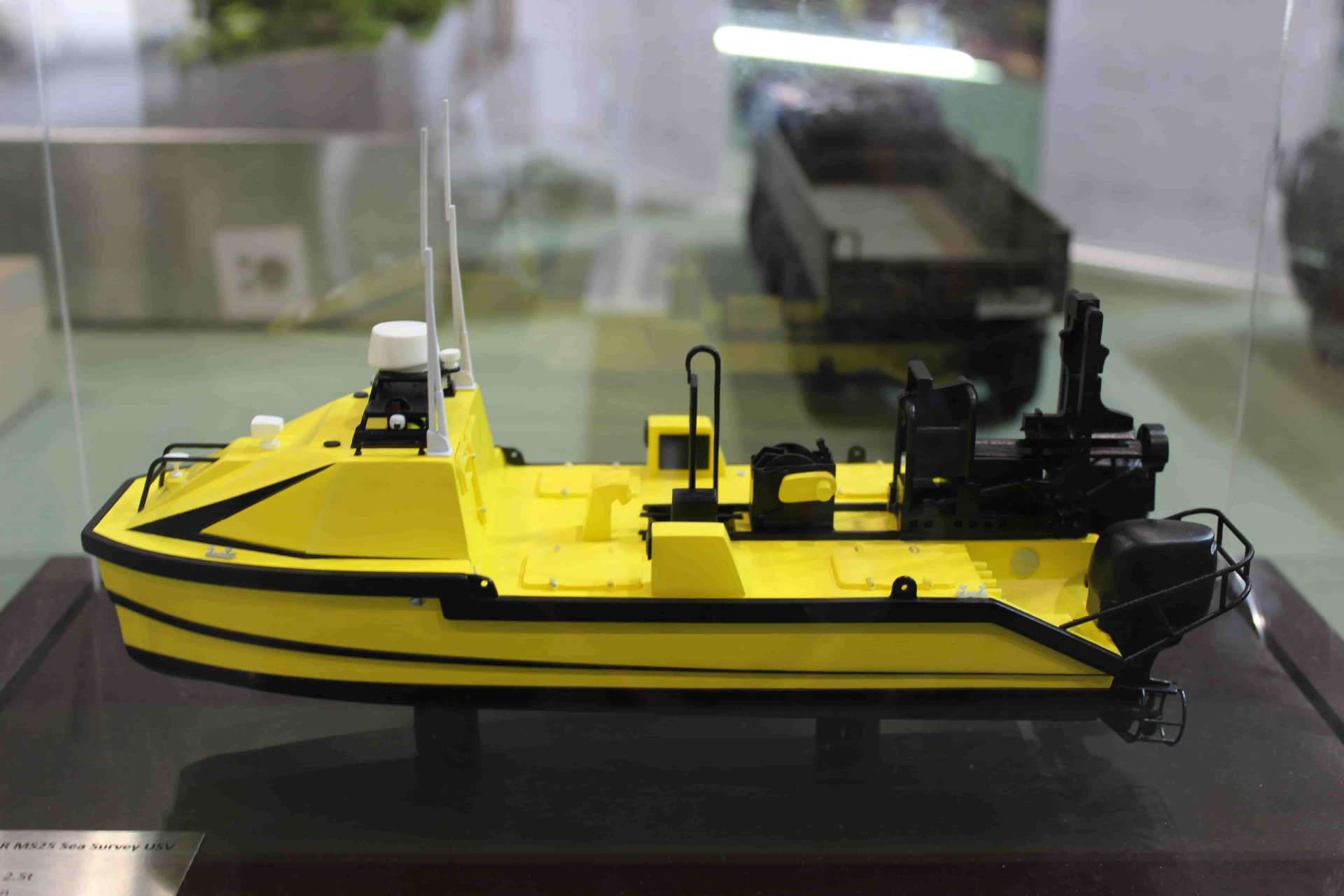
China introduced a compact Marine Survey USV at Expodefensa 2025 in Bogotá, presenting it as a low-risk, low-cost unmanned option for coastal surveillance, hydrographic mapping and day-to-day low-risk maritime security across Latin America (Picture Source: Army Recognition Group)
According to the manufacturer’s data sheet displayed on the stand and titled “Marine Survey USV”, the platform is described as an unmanned surface vessel that is “autonomous or remotely operated surface craft that operate without a crew on board” and whose role is to perform “reconnaissance, surveillance, and intelligence missions.” The craft measures 7.5 metres in length, 2.8 metres in width and 3 metres in height, with a displacement of 2.4 tons. Its maximum speed is given as 10 knots, while the recommended survey speed lies between 4 and 5 knots, reflecting a design optimised for persistent, fuel-efficient patrol or mapping profiles rather than high-speed interception. With an operational envelope up to sea state III, a draught of 0.4 metres and a payload capacity of 200 kilograms, the vessel is dimensioned for operations close to shore, in river mouths, estuaries and harbour approaches where shallow waters and confined spaces limit the use of larger crewed platforms.
Within this envelope, the Chinese Marine Survey USV can host a range of mission packages tailored to maritime security. The 200-kilogram payload allowance is sufficient for a modular suite of electro-optical sensors, small navigation radar, communications relay equipment, loudspeakers for hailing and warning, or hydrographic and environmental sensors for survey work. In a security-patrol configuration, the craft can be tasked to follow pre-programmed routes along port perimeters or critical infrastructure, transmitting live imagery and positional data back to a shore control station. Operating at 4–5 knots for extended periods, such a vessel can maintain an almost continuous presence in areas where crewed patrol boats would quickly accumulate fatigue and fuel costs, while its small draught allows it to manoeuvre in shallow or restricted waters that may be inaccessible to larger hulls.
For armed forces and security agencies in Latin America, the appearance of this Chinese USV at Expodefensa 2025 carries several strategic implications. First, it confirms that unmanned surface platforms are no longer restricted to major navies but are increasingly available as catalogue products in the export market, including for countries seeking relatively affordable tools for coastal monitoring and port protection. The ability to conduct reconnaissance, surveillance and basic intelligence collection without embarking personnel offers an attractive option for missions in high-risk areas, such as zones affected by trafficking or illegal mining along river systems. Second, the combination of survey and security roles makes the vessel relevant for dual-use programmes where ministries of defence, interior and environment may share procurement and operating costs while benefiting from the same platform.
At a broader geopolitical level, China’s decision to showcase this Marine Survey USV in Bogotá underscores its intent to position itself as a supplier of unmanned maritime solutions in a region traditionally influenced by European and North American defence industries. By offering a relatively simple, shallow-draft platform optimised for coastal and riverine environments, Chinese industry is aligning its products with the operational reality of many Latin American states, where long coastlines and complex river networks demand persistent, low-profile surveillance rather than high-end combat capabilities. If adopted, such systems could gradually weave Chinese technologies into local command-and-control networks and maritime domain awareness architectures, creating long-term dependencies in training, maintenance and software upgrades. This dynamic is likely to be watched closely by other global actors, for whom unmanned platforms have become both a capability and an instrument of influence.
The Marine Survey USV from China Xinxing Import and Export Co., Ltd., as displayed at Expodefensa 2025, illustrates how compact unmanned surface craft are becoming integral to maritime security concepts in regions such as Latin America. With its 7.5-metre hull, 2.4-ton displacement, 10-knot top speed and capacity to carry 200 kilograms of modular payload in sea state III, the vessel offers a practical tool for states seeking to strengthen surveillance of their ports, coasts and inland waterways while limiting risk to personnel. Beyond its technical characteristics, the presence of this Chinese USV in Bogotá signals a wider movement: unmanned maritime technologies are shaping new patterns of cooperation and competition, and the choices made today by regional actors will influence both their security posture and their industrial partnerships for years to come.