







Breaking News




UAE Deploys Upgraded Shield AI V-BAT Drone for Maritime Surveillance and Strike Missions.
Shield AI used DIMDEX 2026 in Doha to unveil the latest block upgrade of its combat-proven V-BAT unmanned aircraft, emphasizing heavy-fuel propulsion, SATCOM connectivity, and autonomous operations in denied environments.
Shield AI attended DIMDEX 2026 in Doha to showcase the latest block upgrade of its combat-proven V-BAT unmanned aircraft, highlighting a configuration centered on heavier-fuel propulsion, SATCOM connectivity, and Hivemind autonomy for operations in GPS- and communications-denied environments. On the exhibition floor, Army Recognition observed the system presented as a compact, ship-friendly ISR and targeting asset aimed squarely at Gulf operators seeking persistence without the burden of runways or fixed launch infrastructure. The messaging was direct and operationally focused: V-BAT is positioned as a deploy-anywhere platform able to launch from confined spaces and continue operating when the electromagnetic environment becomes contested.
Follow Army Recognition on Google News at this link
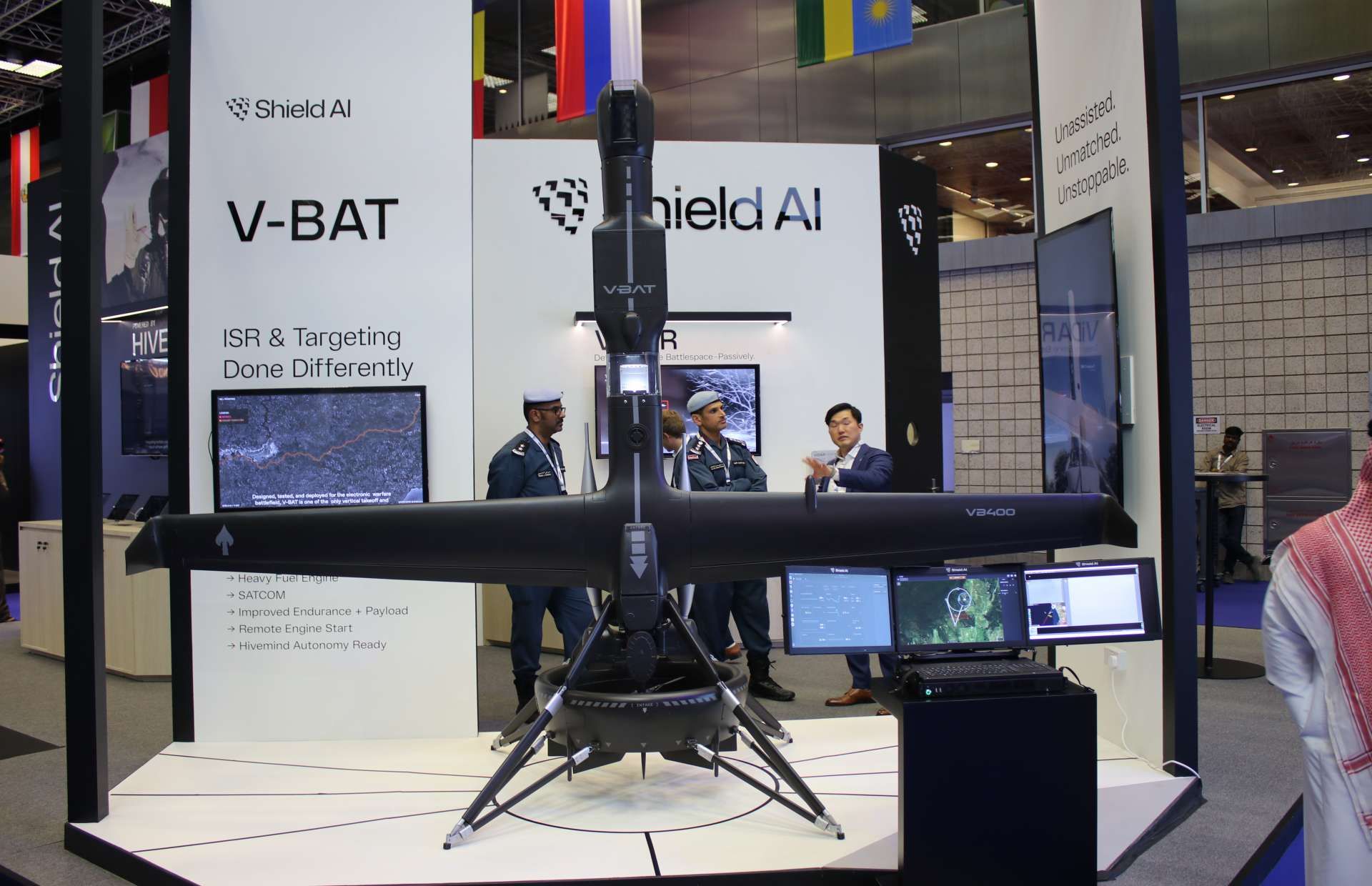
Shield AI V-BAT on display at DIMDEX 2026 showcases a VTOL unmanned aircraft optimized for shipboard operations, combining long-endurance heavy-fuel propulsion, SATCOM, autonomous launch and recovery, and modular ISR-targeting payloads, with the option to integrate lightweight precision munitions for rapid maritime and coastal strike missions (Picture source: Army Recognition Group).
The exhibit focuses on the aircraft’s logistics and autonomy leap rather than a clean-sheet redesign. The block upgrade introduces a heavy-fuel engine optimized for JP-5, a practical detail for navies and coast guards that already stock a single aviation fuel across fleets and expeditionary sites, and Shield AI states endurance extends beyond 13 hours. The updated configuration is also promoted as fully unassisted vertical launch and recovery, reducing the manpower and training burden that often becomes the hidden cost of small UAS detachments. Performance and handling claims align with published specifications that put maximum takeoff weight around 73 kg and payload capacity up to 18.1 kg, with recovery possible in a roughly 15 ft by 15 ft zone, a key enabler for confined-deck maritime operations and dispersed land basing.
V-BAT’s architecture is built around modular payload integration and, critically, it is tied to the U.S. DoD modular payload ecosystem, which simplifies adding third-party sensors and, potentially, light strike stores without a bespoke integration program each time. Defense reporting notes the system features three open payload slots and cites testing that included the Northrop Grumman Hatchet miniature precision strike munition as one of the integrated payloads. Hatchet is a six-pound class weapon intended for unmanned platforms, with Northrop Grumman describing it as GPS-guided; the company's datasheet lists a 6.38 lb total weight and a 3.12 lb warhead, packaged in a compact body with folding wings to minimize carriage penalties. In practical terms, this kind of micro-munition gives a Group 3 aircraft a credible “find-fix-finish” option against point targets where collateral limits matter, while keeping the drone’s signature and operating footprint closer to an ISR asset than a conventional strike UAV.
V-BAT’s armament relevance is not only about what it can drop, but how it compresses the kill chain for everyone else. The platform’s sensor mix commonly includes EO/IR turrets and can be configured for synthetic aperture radar and other mission payloads, with reporting pointing to compatibility with packages from suppliers such as Trillium and IMSAR. The UAS is also marketed for contested navigation and control through Hivemind autonomy, and Shield AI explicitly frames it as a tool for finding and targeting threats in GPS- and communications-denied environments. That matters tactically because the aircraft can be used as an airborne spotter that survives closer to the threat than manned ISR, then hands off target-quality tracks to stand-off fires, a concept defense reporting has described in the context of V-BAT teaming with long-range strikes. Add SATCOM for beyond-line-of-sight control, and you get a small detachment capable of persistent maritime overwatch that does not have to hug the coastline or a fixed ground relay chain.
DIMDEX is a maritime show by design, and Doha’s security problem set is maritime first: port approaches, offshore energy infrastructure, shipping lanes, and the gray-zone friction that comes with a region where drones, electronic warfare, and fast-moving surface threats have all become normal rather than exceptional. A V-BAT detachment operating from a small naval vessel, a coastal site, or an improvised landing zone can give Qatar persistent ISR over critical sea lines and fixed infrastructure while also offering a limited precision-strike option through lightweight munitions like Hatchet, potentially allowing commanders to act quickly against time-sensitive threats without escalating to manned sorties. The heavy-fuel detail is not glamorous, but for a fleet operator, it is the difference between a capability that gets used daily and one that becomes a niche demo asset.
The regional audience at DIMDEX should also be reading between the lines. Gulf and wider Middle East buyers are watching Ukraine and the Red Sea playbook: persistent sensors, fast targeting cycles, and an acceptance that autonomy must keep working when the spectrum is contested. Shield AI’s V-BAT pitch fits that trend, and the armament discussion is a signal that “ISR” is no longer enough; militaries want ISR that can either cue strikes instantly or deliver a low-collateral effect on its own. In Doha, Shield AI is effectively arguing that a small VTOL air vehicle, properly networked and optionally armed, can punch above its weight not by carrying big weapons, but by making every other weapon in the force more informed, faster, and harder to disrupt.
Written by Evan Lerouvillois, Defense Analyst.
Evan studied International Relations, and quickly specialized in defense and security. He is particularly interested in the influence of the defense sector on global geopolitics, and analyzes how technological innovations in defense, arms export contracts, and military strategies influence the international geopolitical scene.