







Breaking News




Qatar Deploys Skynex 35mm Air Defense at DIMDEX 2026 to Counter Growing Drone Threats.
Qatar highlighted Rheinmetall’s Skynex short-range air defense system at DIMDEX 2026 in Doha, emphasizing point defense against drones, rockets, and cruise missiles. The display reflects a broader regional shift toward cost-effective, layered defenses designed to counter saturation attacks on critical infrastructure.
The ninth edition of DIMDEX opened on January 19, 2026, at Doha’s Qatar National Convention Centre, placing air and missile defense firmly at the center of this year’s security dialogue as regional threats continue to evolve. At the Qatar Emiri Air Defence Forces booth, Army Recognition’s team documented the presentation of a Rheinmetall Oerlikon Skynex configuration centered on the 35 mm gun effector, underscoring how point-defense has become as strategically relevant to Gulf states as major surface combatants. Displayed as a ready-to-field capability, the system highlights Qatar’s focus on protecting airbases, ports, and high-value national infrastructure across a compact yet operationally dense national territory.
Follow Army Recognition on Google News at this link
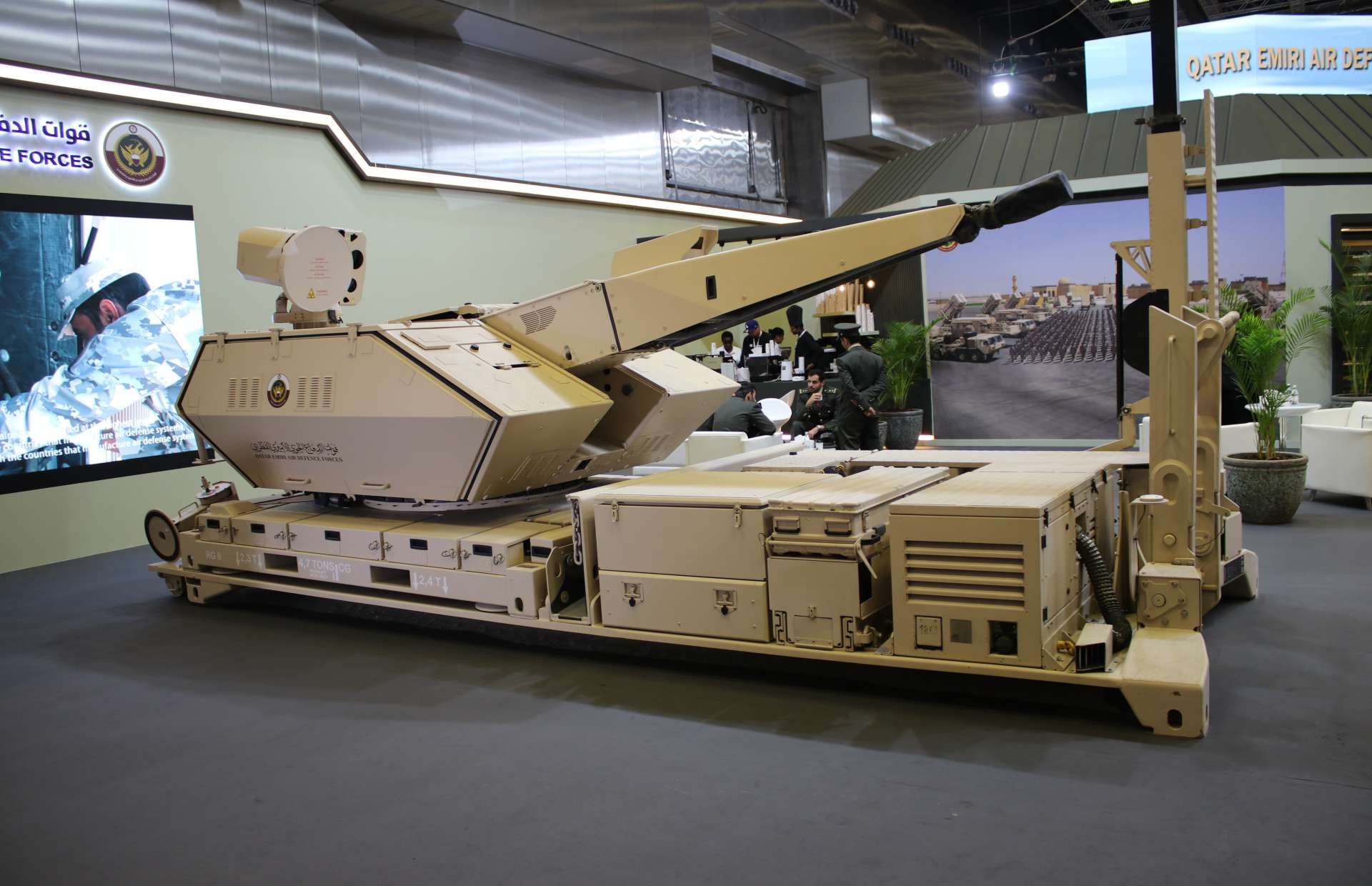
Rheinmetall Oerlikon Skynex air-defense system combining networked sensors, Skymaster C2, and a 35 mm gun with AHEAD ammunition to counter drones, missiles, and rockets at close range (Picture source: Army Recognition Group).
In October 2022, Qatari authorities revealed the system in the context of a dedicated air-defense exercise, signaling that Doha had moved beyond evaluation and into operationalization of the architecture. What has evolved since then is the urgency: the regional playbook has shifted toward mixed salvos of low-cost one-way attack drones, cruise missiles, and rockets designed to saturate expensive interceptors and exploit gaps close to the defended asset.
Skynex is best understood as a networked short-range air-defense toolbox built around the Oerlikon Skymaster battle management system. Skymaster acts as the control node, fusing sensor inputs into a coherent air picture, running automated threat evaluation, and pushing weapon assignment and coordinated fire control to distributed effectors. The standard Control Node 1 is packaged in a 20-foot container with its own power, cooling, protection, and communications fit, typically operated by four personnel consisting of an operations officer, two target operators, and a technical operator, with capacity to add consoles when the engagement load increases.
On the sensor side, the architecture scales from a single site radar to a layered, emissions-managed posture. Rheinmetall’s X-TAR3D tactical acquisition radar provides a three-dimensional local air picture out to an instrumented 50 km, with operating modes optimized for combat revisit rates, surveillance, and sense-and-warn. It is engineered for low-altitude performance, includes electronic counter-countermeasures features such as track-on-jammer, and supports modern IFF integration, including modes S and 5, to reduce fratricide risk in cluttered airspace. For sites that prioritize rapid deployment and dense small-target work, the Multi Sensor Unit combines a non-rotating 3D AESA multi-mission radar with electro-optical tracking and automated classification aided by artificial intelligence, and it is designed to cue both guns and, in expanded configurations, short-range air-defense missiles. Skynex can also add a passive early-warning suite based on communications electronic support measures to improve survivability under electronic warfare pressure, extending awareness while keeping radars silent.
The booth’s visual centerpiece, however, was the effector that makes Skynex tactically distinctive in today’s counter-UAS fight: the unmanned Oerlikon Revolver Gun Mk3. It fires 35×228 mm ammunition at a nominal rate of 1,000 rounds per minute, with a rapid single-shot mode around 200 rounds per minute, and an effective combat range reaching up to 4,000 meters. The gun carries 252 ready-to-fire rounds and integrates its own tracking suite, combining an X-band or Ku-band radar with an instrumented range of roughly 30 km and high update rates, plus electro-optical sensors for visual identification and a laser rangefinder. This configuration allows autonomous tracking and engagement once a target is handed over by Skymaster.
The decisive enabler is AHEAD programmable air-burst ammunition. Rather than relying on proximity fuzing luck against small, agile targets, Skynex programs each round to release a forward-directed cloud of tungsten sub-projectiles at a precisely calculated point in space. These spin-stabilized sub-projectiles are designed to deliver kinetic mission kills and include a self-destruct function to limit collateral risk. Against quadcopters, loitering munitions, and low-flying cruise missiles inside the last few kilometers, this gun-based approach offers a favorable cost-exchange ratio compared to expending missiles, and it remains resilient against saturation due to magazine depth and sustained firing cadence.
Operationally for Qatar, Skynex fits as the close-in layer beneath longer-range systems already tied into the country’s integrated air and missile defense architecture. Doha has invested heavily in layered defenses, but high-end interceptors are not optimized for routine engagement of small drones probing defended perimeters. Skynex fills this gap as the hard end of the counter-UAS stack, able to provide continuous protection of fixed sites, sustain repeated engagements, and in counter-rocket, artillery, and mortar scenarios, contribute to rapid warning and trajectory-based consequence management around defended assets.
The timing of Skynex visibility at DIMDEX is significant. Recent regional events have underscored how airbases, energy-adjacent infrastructure, and command hubs are now viewed as legitimate targets in crisis escalation scenarios. For Qatar, protecting its airbase network, ports, and critical national infrastructure is inseparable from national resilience and deterrence signaling. A gun-based system like Skynex, integrated into a broader sensor and command network, complicates adversary planning by denying easy, low-cost attack options. Rheinmetall’s modular roadmap further strengthens this logic, as Skynex is designed to accept additional effectors, including missile-based solutions, providing Qatar with a scalable upgrade path without reengineering its command backbone.
Written by Evan Lerouvillois, Defense Analyst.
Evan studied International Relations, and quickly specialized in defense and security. He is particularly interested in the influence of the defense sector on global geopolitics, and analyzes how technological innovations in defense, arms export contracts, and military strategies influence the international geopolitical scene.