







Breaking News




Oman Sends Proven High-Speed Naval Support Vessel Al Mubashir to Doha for DIMDEX 2026.
The Royal Navy of Oman’s high-speed support vessel RNOV Al Mubashir has arrived in Doha for the Visiting Warships Display ahead of DIMDEX 2026. The deployment highlights how Gulf navies are prioritizing speed, logistics, and rapid force movement over traditional surface combat power.
Doha, Qatar, 18 January 2026- As preparations intensified ahead of DIMDEX 2026, the Royal Navy of Oman (RNO) High Speed Support Vessel RNOV Al Mubashir (S11) arrived in Doha and took her place in the Visiting Warships Display at Hamad Port. Low in the water and instantly identifiable by her twin-hull catamaran silhouette, Al Mubashir entered the harbor with the restrained confidence of a ship designed for speed, lift, and operational tempo rather than ceremonial presence. For Oman, this port call is more than a routine deployment: it underscores a strategic message that in the Gulf’s constrained maritime environment, logistics, mobility, and rapid reinforcement are decisive enablers of naval power, even for comparatively small fleets.
Follow Army Recognition on Google News at this link
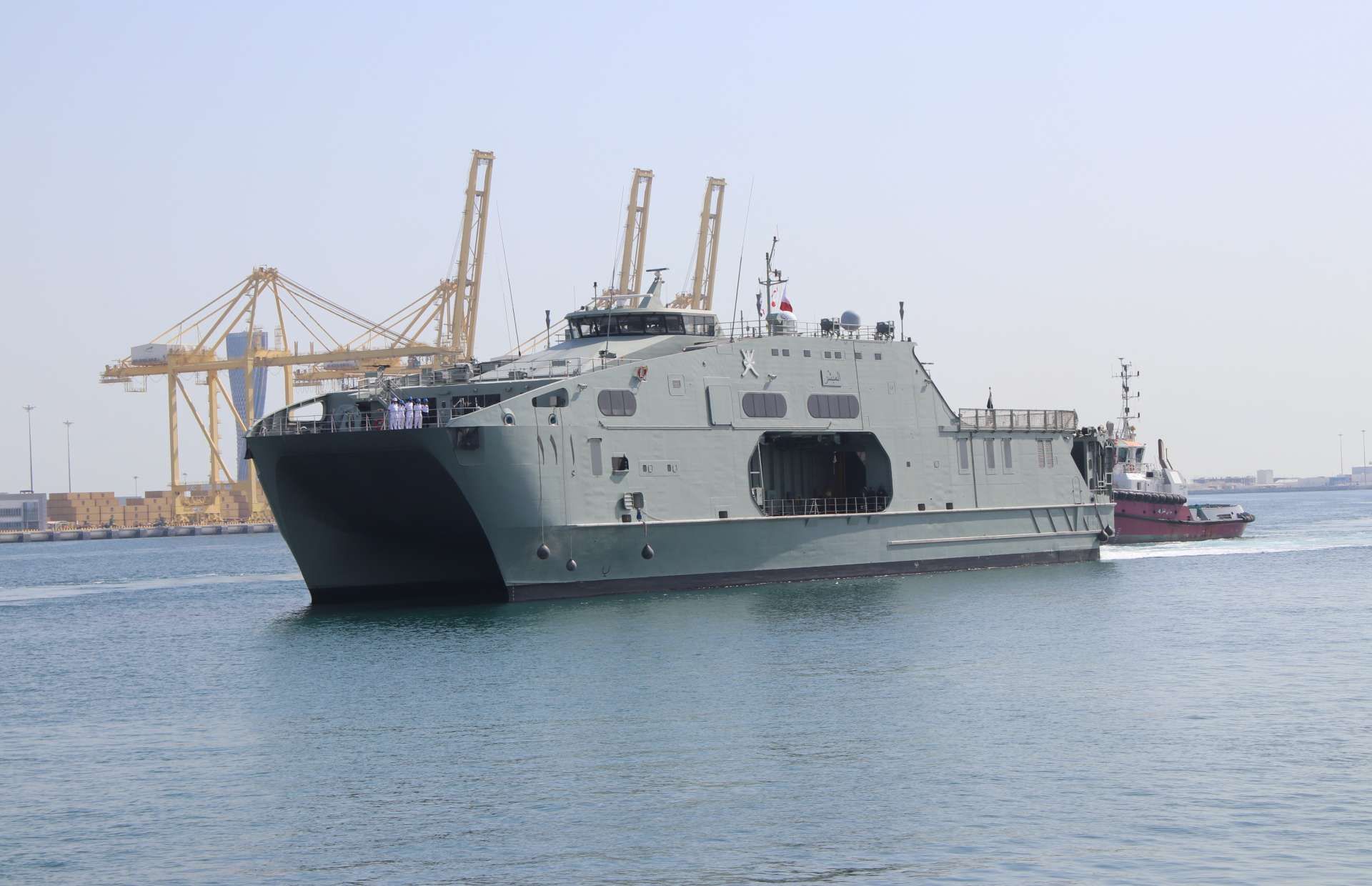
RNOV Al Mubashir (S11) is a 72.5 m high-speed catamaran support ship built to move troops, vehicles, and supplies fast, with a large RO-RO deck, helicopter-capable flight deck, shallow-draft access, and defensive guns for regional security and relief missions (Picture source: Army Recognition Group).
Al Mubashir belongs to a niche category that is increasingly valuable in the Gulf of Oman and Arabian Sea: high-speed intra-theater lift. Built by Austal in Australia and delivered in 2016, she is a 72.5 m all-aluminium catamaran designed around volume and rapid loading rather than missile firepower. Beam is a wide 18.66 m overall, with a shallow approximate draft of 3.0 m that keeps her relevant in coastal approaches, island chains, and ports where larger amphibious ships quickly run out of water. Austal’s own data lists a maximum deadweight of 395 tonnes, paired with a 900 m2 mission and vehicle deck with 4.5 m clear height, which is the real headline: this is a ship built to carry a force package, not just a crew.
The propulsion fit underlines that intent: Al Mubashir runs four MTU 20V 4000 M93L main engines driving four Rolls-Royce 80S3 waterjets, a configuration optimized for acceleration, tight maneuvering, and sustained high speed. Austal cites a maximum speed of 38 knots, with seven days endurance and a range of 2,740 nautical miles at 12.5 knots, giving Oman the ability to reposition troops, vehicles, and mission equipment along its long coastline and out to the approaches of the Strait of Hormuz without waiting on slower sealift. A key enabler for quick turnarounds is the ship’s handling architecture: a 12 m by 4.25 m bi-folding slewing ramp and a beam crane system rated at 12.0 tonnes SWL, which together support rapid roll-on and roll-off, boat handling, and flexible loading in ports that may not offer ideal infrastructure during a crisis.
Aviation and command-and-control are baked in rather than bolted on. The flight deck measures 22.0 m by 12.0 m and is rated for NH-90 class helicopter operations, allowing vertical replenishment, casualty evacuation, and rapid insertion of boarding teams or liaison elements. Internally, Austal lists a crew of 69 with 69 fixed berths, plus seating for 260 embarked personnel, which maps neatly to the kind of company-sized movements Gulf states plan for in reinforcement and coastal defense scenarios. The ship’s organic sensor suite is modest but practical: an Electro Optical Surveillance System (EOSS) and an operations room with eight seated positions. Armament is likewise defensive, consisting of a 20 mm naval gun and four 12.7 mm general purpose machine guns, enough for force protection against small craft threats but not a substitute for escorts in a high-end fight. In analyst terms, Al Mubashir is best understood as a high-speed connector that thrives under an air and surface umbrella provided by corvettes, patrol craft, and shore-based assets.
That connector role is central to Omani maritime strategy because Oman’s geography demands speed. The Musandam Peninsula, separated from the rest of the country by UAE territory, sits on the Strait of Hormuz’s southern edge, while major ports and naval facilities are spread across the Gulf of Oman and down toward the Arabian Sea. In such a setting, the ability to surge troops, vehicles, and disaster relief stores rapidly is not an accessory capability, it is deterrence by responsiveness. When Austal hosted the official naming ceremony, the Commander of the Royal Navy of Oman described the HSSV as a modernization step that would support Oman’s mission to protect its waters and meet joint operational support requirements, including search and rescue and humanitarian and disaster relief. That phrasing is revealing: Oman is investing in ships that can move and sustain forces as readily as they can patrol.
Publicly documented activity around Al Mubashir is consistent with that multi-mission identity. The shipbuilder noted that Al Mubashir was operating successfully in the Gulf of Oman and Arabian Sea soon after delivery, placing her in precisely the maritime space where commercial traffic density, maritime security incidents, and regional signaling intersect. More recently, Al Mubashir’s participation in a search and rescue exercise with the French Navy’s FREMM frigate Languedoc highlighted how Oman uses such platforms to train with advanced partners while sharpening practical skills like at-sea coordination, aviation integration, and recovery procedures. Those are not headline-grabbing missions, but they are the daily mechanics of coalition readiness in a region where hours can matter more than days.
Against that backdrop, Al Mubashir’s appearance at DIMDEX 2026 is strategically coherent. DIMDEX runs from January 19 to 22, and the Visiting Warships Display at Hamad Port is designed to give regional and international delegations direct access to crews and onboard operations. For Oman, sending a high-speed support ship rather than a purely combatant platform is a subtle message to Gulf audiences: the RNO is investing in the connective tissue of maritime power, the lift, sustainment, and rapid reinforcement functions that turn patrol forces into a responsive joint tool. For Qatar and visiting delegations, the ship is also a tangible case study of how a relatively small fleet can buy operational agility through smart platform choices. In a Gulf security environment increasingly shaped by drones, fast attack craft, and the constant pressure of maritime policing, Al Mubashir’s utility is precisely that she makes options available early, before crises harden into campaigns.
Written by Evan Lerouvillois, Defense Analyst.
Evan studied International Relations, and quickly specialized in defense and security. He is particularly interested in the influence of the defense sector on global geopolitics, and analyzes how technological innovations in defense, arms export contracts, and military strategies influence the international geopolitical scene.