







Breaking News




Kuwait Navy Deploys Missile Patrol Craft to Qatar Ahead of DIMDEX 2026.
The Kuwait Navy patrol combatant KNS Al-Garoh entered Doha on Jan. 18, 2026, ahead of the Visiting Warships display at DIMDEX 2026. Its presence highlights how Gulf states are emphasizing in-service, coalition-ready ships as maritime security concerns intensify around energy routes and chokepoints.
Doha, Qatar, 18 January 2026- The Kuwait Navy patrol combatant KNS Al-Garoh (P3725) arrived in Doha to take part in the Visiting Warships display ahead of Dimdex 2026. The ship’s entry into Qatari waters, observed from the harbor approaches as participating naval units converged on Hamad Port, brought a front-line Gulf littoral combatant into an exhibition increasingly shaped by active regional security dynamics. Designated as Kuwait’s representative warship for the ninth edition of Dimdex, Al-Garoh’s presence reflects a deliberate choice by Kuwait to project operational credibility and reinforce naval cooperation within the Gulf maritime security framework.
Follow Army Recognition on Google News at this link
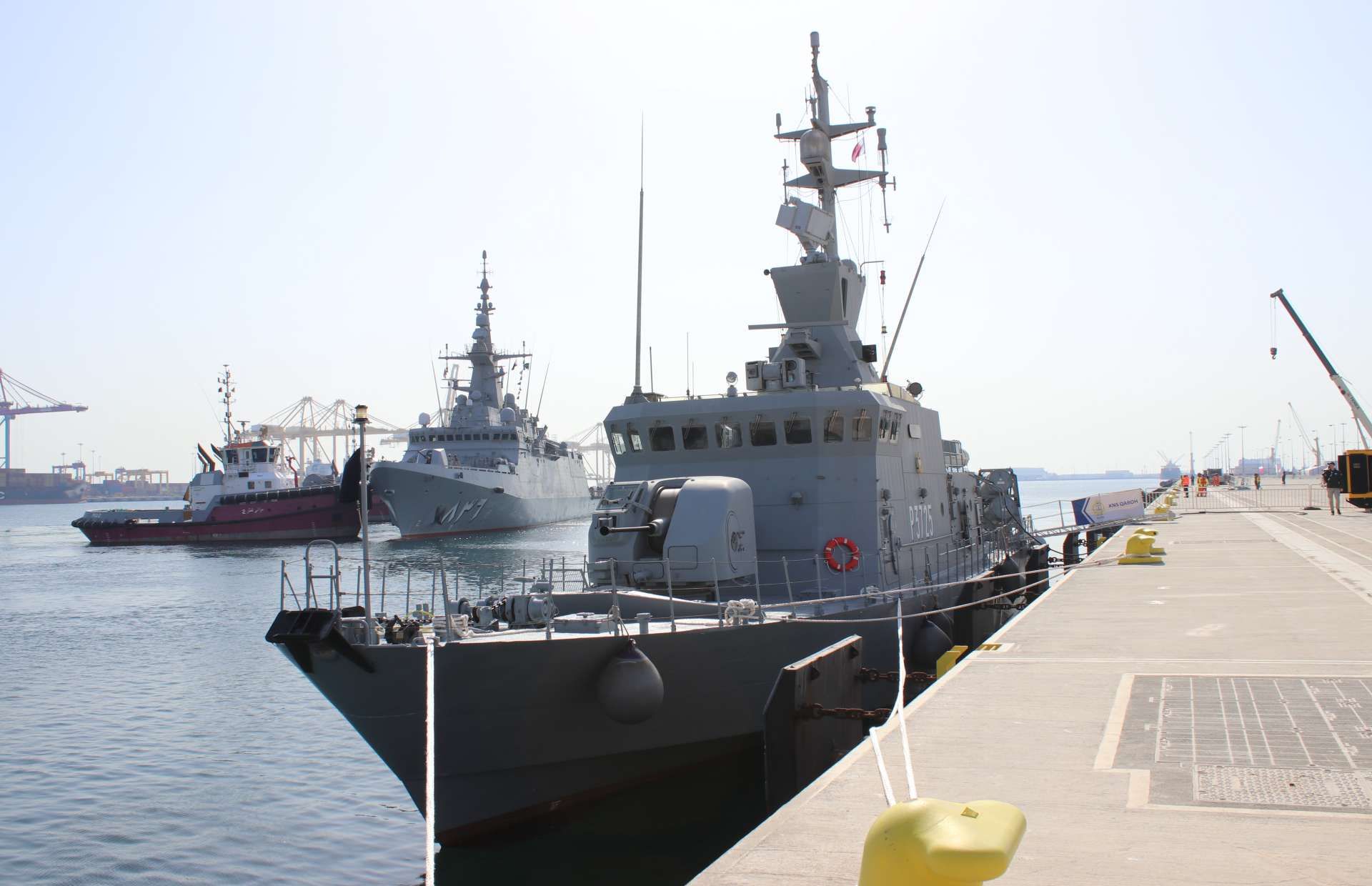
Kuwait Navy missile craft KNS Al-Garoh (P3725) is a high-speed littoral combatant armed with Sea Skua anti-ship missiles and a 40 mm gun, equipped with modern sensors and decoys for maritime security and sea-denial missions (Picture source: Army Recognition Group).
Al-Garoh is part of Kuwait’s Um Al Maradim-class (P37-BRL) fast patrol and missile craft program, a post-1991 rebuilding effort shaped by the harsh lessons of the Gulf War and the vulnerability of small combatants to air attack and saturation threats. In practice, the design reflects a deliberate choice: to keep the ship compact enough to fight inside the northern Gulf’s congested littorals, but to equip it with sensors, electronic support measures, and deception options that enhance survival odds when operating under the umbrella of hostile surveillance. The class was built by CMN in Cherbourg and delivered from the late 1990s into 2000, with later hulls delayed to integrate surface-launched Sea Skua missiles, a detail that underscores how Kuwait prioritized a measured but credible anti-surface punch over the heavier missile-and-gun combinations typical of older fast attack craft.
Al-Garoh sits in the 42 meters class with an 8.5 meters beam and shallow draft around 1.9 to 2 meters, a geometry that fits the Gulf’s constrained operating areas and supports high-speed maneuver close to shipping lanes, approaches, and offshore infrastructure. Open-source ship data places displacement roughly in the 225 tons standard and 245 to 250 tons full load range, with a compact crew in the mid-20s that can expand with additional mission personnel depending on tasking. Propulsion is based on two MTU 16V 538 TB93 diesel engines driving waterjets, a configuration chosen for acceleration, reduced draft limitations, and fast handling in confined waters, with cited top speed around the high-30-knot bracket and endurance on the order of 1,300 nm at economical speed.
Where Al-Garoh becomes more than a fast boat is in its sensor and self-protection fit for its size. The combat system architecture combines surface search and navigation radar with a multi-role radar capability and an electronic support measures suite tied to Kuwait’s long-standing procurement of the DR-3000 family for the P37-BRL craft. In parallel, the ship’s listed fire-control layer includes a Sea Spray Mk3-class radar function and a stabilized electro-optical director family, Najir, with TV and infrared channels plus laser rangefinding, enabling day-night target tracking and gunnery control without relying solely on active emissions. Soft-kill survivability is supported by DAGAIE decoy launchers for chaff and flare, giving the craft at least a basic response set against radar-guided and infrared threats in the cluttered littoral environment.
Armament aligns with the class philosophy of controlled lethality: a single 40 mm gun paired with a 20 mm cannon and heavy machine-gun coverage for close-in defense and warning-fire roles, backed by Sea Skua SL surface-to-surface missiles carried in twin launchers for a four-missile load. Sea Skua’s effective engagement envelope is typically described in the sub-20 km band in public sources, which fits Kuwait’s operational problem set: rapid reaction against small and medium surface contacts, sea-denial strikes inside constrained waters, and precision engagement in scenarios where collateral risk around energy infrastructure must be managed tightly. Tactically, this creates a hit first, relocate fast profile that leverages speed, sensor cueing, and deception rather than armor or area air defense, meaning Al-Garoh is most effective when operating with shore-based surveillance, air cover, or coalition maritime picture sharing.
Al-Garoh has been photographed and documented participating in coalition-oriented maritime security drills that mirror its likely wartime employment. In August 2018, the vessel took part in a trilateral exercise with U.S., Iraqi, and Kuwaiti naval forces focused on maritime security tactics and infrastructure protection, an especially relevant mission set in a region where offshore terminals and narrow sea corridors are strategic chokepoints. In June 2021, Al-Garoh again appeared in formation during Eager Defender 21 alongside U.S. and Kuwaiti units, an exercise series explicitly framed by U.S. Naval Forces Central Command as interoperability training for maritime security operations. Separate reporting on the class indicates it saw early operational tasking in the post-2000 period, intercepting Iraqi fishing vessels, reflecting day-to-day sovereignty enforcement that often sits just below the threshold of open conflict in the northern Gulf.
For Kuwait, the strategic value of Al-Garoh is not that it turns the navy into a blue-water force. It is that it provides a credible, locally optimized combatant for the defense of ports, approaches, and energy lifelines, while giving commanders an agile tool for patrol, escort, interdiction, and rapid concentration of firepower in short-range sea-denial scenarios. This matters even more as Kuwait navigates a modernization transition: recent analysis notes Kuwait’s plan to introduce larger, more capable Falaj 3-class patrol vessels, likely to replace aging Um Al Maradim craft over time, but that transition also raises training and crewing pressures that make today’s smaller combatants operationally indispensable in the near term. Against that backdrop, bringing Al-Garoh to Dimdex 2026 is a pointed choice: it showcases an in-service platform with real coalition drill mileage, supports Gulf maritime diplomacy in Doha, and positions Kuwait to engage industry on sustainment and upgrade pathways while its next-generation fleet is still maturing.
Written by Evan Lerouvillois, Defense Analyst.
Evan studied International Relations, and quickly specialized in defense and security. He is particularly interested in the influence of the defense sector on global geopolitics, and analyzes how technological innovations in defense, arms export contracts, and military strategies influence the international geopolitical scene.