






Breaking News






U.S. Army Deploys Apache Helicopter Drone Wingmen in New Launched Effects Unit.
On January 23, 2026, the U.S. Army activated Foxtrot Troop at Fort Riley to field a new Launched Effects unmanned capability paired with AH-64E Apache helicopters. The move signals a major shift in how the Army's attack aviation plans to fight in heavily defended airspace against peer adversaries.
On January 23, 2026, Soldiers and families gathered at Fort Riley to witness the activation of Foxtrot Troop, 1st Attack Battalion, 1st Combat Aviation Brigade, a newly established Tactical Unmanned Aircraft System – Launched Effects unit designed to expand the reach and survivability of U.S. Army attack aviation. The ceremony marked a structural and doctrinal shift within the 1st Infantry Division as Army aviation adapts to increasingly contested airspace. Speaking to the significance of the moment, Foxtrot Troop commander Capt. Paul Shorkey-Chacon described the activation as a milestone intended to “push the Army forward,” while also acknowledging the legacy inherited from 1-6 Air Cavalry Squadron and its Apache helicopter mission. The transition underscores how the Army is reengineering long-standing attack aviation roles to meet the demands of peer and near-peer conflict.
Follow Army Recognition on Google News at this link
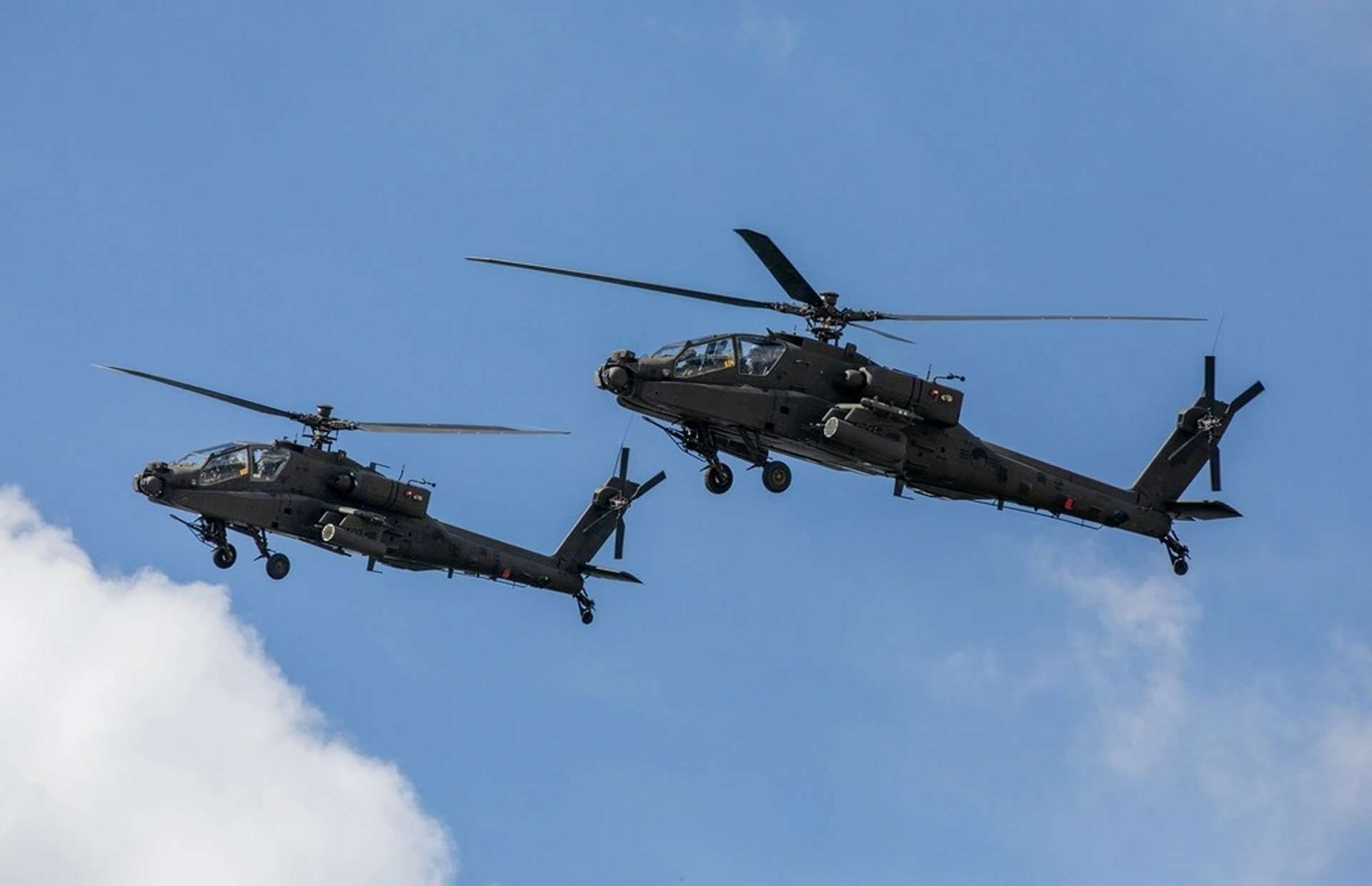
Foxtrot Troop of the 1st attack Battalion, 1st Combat Aviation Brigade, was activated at Fort Riley to field the U.S. Army's new Tactical Unmanned Aircraft System-Launched Effects capability, pairing forward unmanned systems with AH-64E Apache helicopters to extend reconnaissance, targeting, and strike operations beyond enemy air defense range (Picture source: U.S. DoW).
Foxtrot Troop’s core operational purpose is straightforward, even if its toolset is deliberately modular: extend the “eyes and ears” of AH-64 Apache crews through Manned-Unmanned Teaming so that the manned aircraft can detect, identify, and cue engagements before crossing into an enemy weapons engagement zone. The brigade commander, Col. Eric Megerdoomian, linked the activation to a broader modernization push designed to make formations more agile, more lethal and more resilient, language that tracks with the Army’s ongoing shift from permissive counterinsurgency skies toward air defense-saturated battlefields where stand-off, deception, and rapid kill chains matter as much as raw firepower. The public messaging from the Army is telling. Foxtrot Troop will operate systems designed not just for surveillance, but also intended to confuse, disable and destroy adversary defenses either autonomously or under aviation crew control.
What does that mean in technical and tactical terms? The Army has not publicly named the exact air vehicle family or payload mix assigned to Foxtrot Troop, but the service’s own Launched Effects reporting offers a clear picture of the intended effects stack. In recent Army demonstrations, Launched Effects – Short Range systems were described as lightweight autonomous platforms able to deliver lethal precision strikes or non-lethal effects, with payload options spanning intelligence, surveillance, and reconnaissance, electronic warfare, and warhead configurations tailored to mission needs. Those same Army assessments highlighted that Soldiers evaluated multiple industry offerings, underlining that launched effects is a capability family rather than a single drone model. Foxtrot Troop is best understood as the operational bridge that takes that experimentation and welds it into attack battalion tactics, techniques, and procedures, with aircrews or supported commanders selecting the right mix of decoy, sensing, and strike effects for the threat.
The most consequential armament story here is how Foxtrot Troop enables the Apache’s established lethality to be applied earlier and from safer geometry. The AH-64E V6 Apache Guardian, which is increasingly the baseline attack helicopter standard across the force, is equipped with air-to-ground Hellfire missiles that are semi-active laser or radar guided, 2.75-inch Hydra rockets described by the Army as laser guided point detonating, and the M230 30 mm chain gun firing up to 625 rounds per minute with a stated effective range exceeding four kilometers. Those weapons already give an attack company a layered toolkit for armored targets, exposed infantry, fighting positions, and fleeting systems of opportunity, but they are only as effective as the crew’s ability to find, classify, and track targets in time. This is exactly where launched effects become a force multiplier. Forward-deployed sensors and electronic intelligence can shorten the detect-to-decide loop, then hand off coordinates and terminal cues to the aircraft that still delivers the decisive kinetic action.
In practical terms, Foxtrot Troop makes the Apache less dependent on pushing its own airframe forward to see over the next ridgeline or through the next treeline. In a peer fight, that matters because modern integrated air defenses and ubiquitous tactical drones punish predictable flight profiles. A launched effect that can be sent ahead as a reconnaissance scout, a communications relay, or a decoy can expose hostile emitters and air defense behavior without immediately risking the manned aircraft. The Army has already demonstrated the logic of this approach through manned-unmanned teaming events where an AH-64E interoperated with other unmanned aircraft to extend stand-off and enable cooperative engagement, reinforcing the doctrinal point that shared situational awareness can keep crews outside an adversary’s kill zone while still enabling rapid, accurate fires.
The activation at Fort Riley is about institutionalizing a new method of fighting. By putting expendable or recoverable unmanned effects in front of the Apache, the Army expands its sensing horizon and turns the helicopter’s traditional weapons suite into a faster, more survivable system-of-systems. If Shorkey-Chacon’s closing message hinted at the unit’s global employment, from Europe to the Middle East to the Americas, the technical throughline is consistent. Launched effects give the 1st Infantry Division’s aviation brigade a means to probe, deceive, and strike in contested environments while keeping the manned platform’s risk curve lower. That is the operational promise of Foxtrot Troop, and it is why this activation represents a genuine inflection point for U.S. Army attack aviation rather than a ceremonial footnote.